
How To Calculate The Freezing Point Of A Solution

Alright, buckle up buttercups! We're about to dive into the wonderfully weird world of freezing points. And yes, we’re talking about how to figure out exactly when your sugary concoction will turn into a solid block of deliciousness!
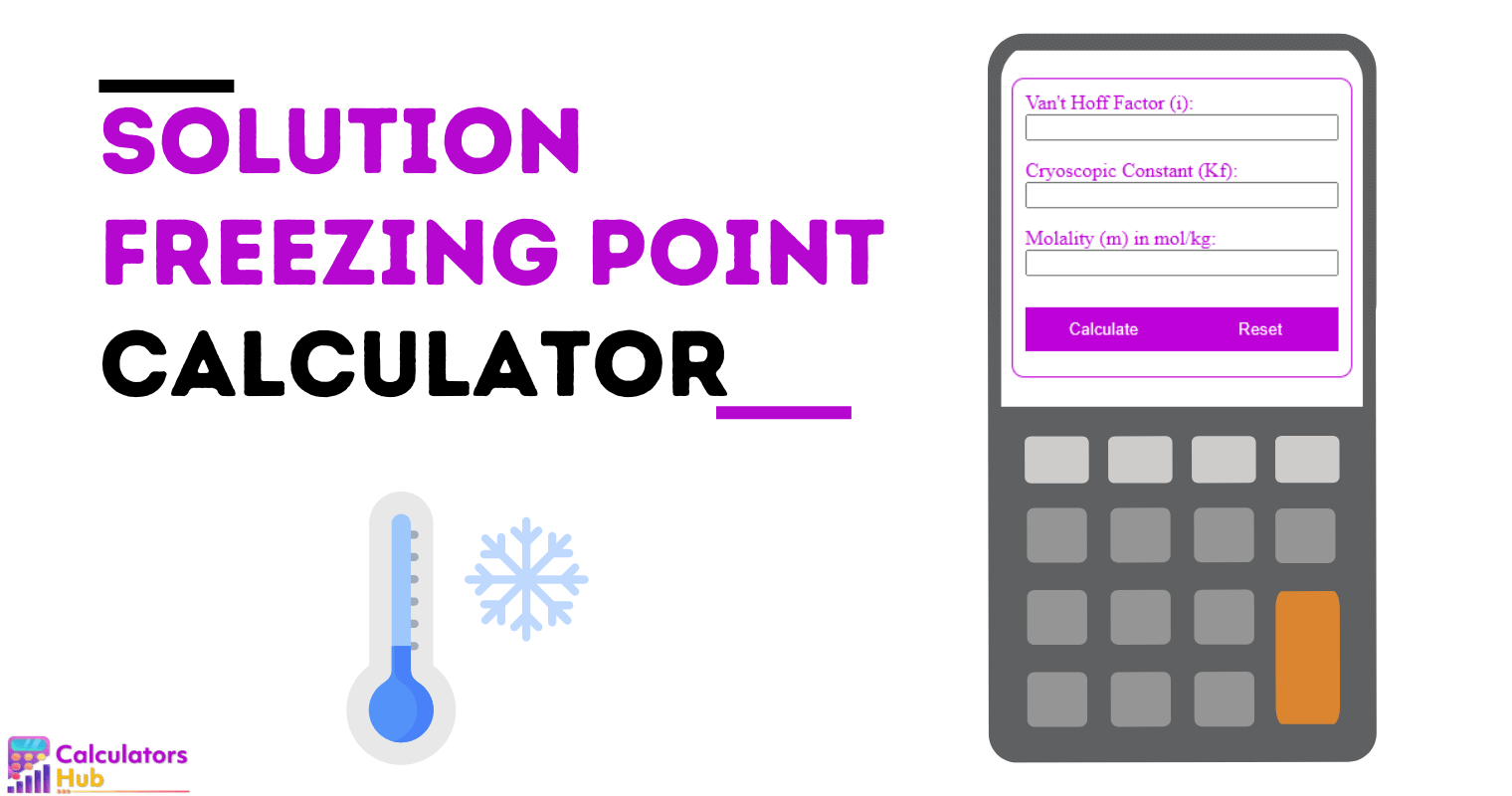
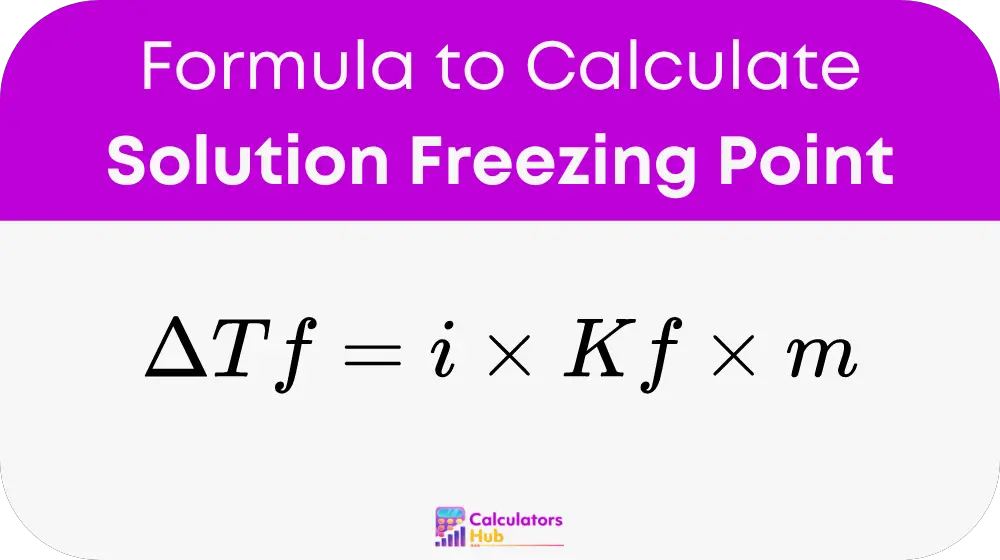
The Magic Formula: ΔTf = Kf * m * i
Don't run away screaming just yet! I promise this isn't as scary as it looks. Think of it as a secret recipe, like your grandma's famous chocolate chip cookies, but for science!
First, let's break down this mystical equation: ΔTf = Kf * m * i. It's the key to unlocking freezing-point-calculating superpowers!
Must Read
Unpacking the Symbols
ΔTf? That's the "change in freezing point." It’s how much lower the freezing point of your solution is compared to pure water.
Think of it this way: pure water freezes at 0°C (32°F). If you add sugar, it might freeze at -2°C (28.4°F). The ΔTf would be 2°C!
Next up, we have Kf, the "freezing point depression constant." Each solvent (like water) has its own unique Kf value.
For water, Kf is usually around 1.86 °C kg/mol. Don't worry about the units too much. Just know that it's a magic number specific to water!
Then comes m, which stands for "molality." Now, this might sound like a villain from a cheesy sci-fi movie, but it's actually pretty simple.
Molality is the number of moles of solute (the stuff you're dissolving, like sugar) divided by the kilograms of solvent (usually water).
Finally, we have i, the "van't Hoff factor." It accounts for how many particles your solute breaks into when dissolved in water.

For example, sugar doesn't break apart, so its van't Hoff factor is 1. But salt (NaCl) breaks into two ions (Na+ and Cl-), so its van't Hoff factor is 2.
Let's Do Some Math (I Swear It's Fun!)
Okay, let's say we want to figure out the freezing point of a saltwater solution. We've got 58.44 grams of salt (NaCl) dissolved in 1 kg of water.
First, we need to calculate the molality (m). The molar mass of NaCl is about 58.44 g/mol. That means we have 1 mole of NaCl.
So, the molality (m) is 1 mole / 1 kg = 1 mol/kg. Easy peasy!
Next, we need the van't Hoff factor (i). Since NaCl breaks into two ions, i = 2.
And we already know that the freezing point depression constant for water (Kf) is 1.86 °C kg/mol.
Now we can plug everything into our formula: ΔTf = Kf * m * i = 1.86 °C kg/mol * 1 mol/kg * 2.
ΔTf = 3.72 °C. This means the freezing point is lowered by 3.72 degrees Celsius.
Since pure water freezes at 0°C, the saltwater solution will freeze at 0°C - 3.72°C = -3.72°C.
Real-World Applications (Beyond Frozen Treats!)
Okay, so calculating freezing points might seem like a purely academic exercise. But it actually has tons of real-world uses!
One big example is using salt to de-ice roads in the winter. The salt lowers the freezing point of the water, preventing ice from forming.
This is why you see those big trucks spreading salt on the roads when it snows. They're not just being nice. They're using science to keep us safe!
Another example is in the food industry. Knowing the freezing point of different solutions is crucial for things like making ice cream and preserving food.
Have you ever wondered why your homemade ice cream sometimes gets icy? It's often because the sugar concentration isn't quite right, affecting the freezing point!
And let's not forget about antifreeze in your car! Antifreeze contains chemicals that lower the freezing point of the coolant, preventing it from freezing in cold weather and cracking your engine block.
Tips and Tricks for Mastering Freezing Point Calculations
Want to become a freezing point calculation pro? Here are a few tips and tricks to keep in mind.
First, always double-check your units! Make sure you're using kilograms for the mass of the solvent and moles for the amount of solute.
Second, pay close attention to the van't Hoff factor. Remember that ionic compounds break apart into multiple ions, while covalent compounds usually don't.
Third, don't be afraid to use a calculator! Freezing point calculations can involve some pretty tedious math, so a calculator can save you a lot of time and effort.
Finally, practice makes perfect! The more you practice calculating freezing points, the easier it will become.
Common Mistakes to Avoid
Even the most seasoned scientists can make mistakes, especially when dealing with complex calculations. Here are a few common freezing-point-calculation blunders to watch out for.
Forgetting the van't Hoff factor is a big one! Always remember to consider how many particles your solute breaks into when dissolved in water.
Using the wrong Kf value is another common mistake. Make sure you're using the freezing point depression constant for the correct solvent (usually water).
Mixing up molality and molarity is also a frequent error. Molality is moles of solute per kilogram of solvent, while molarity is moles of solute per liter of solution. They are not the same!
.PNG)
And finally, don't forget to subtract the ΔTf from the freezing point of the pure solvent to get the freezing point of the solution!
Let's Get Advanced: Non-Ideal Solutions
So far, we've been talking about ideal solutions, which are solutions where the interactions between the solute and solvent molecules are similar to the interactions between the solute molecules themselves and the solvent molecules themselves.
But in reality, many solutions are non-ideal. In non-ideal solutions, the interactions between the solute and solvent molecules are significantly different.
This can cause deviations from the freezing point depression predicted by our simple formula. To account for these deviations, we need to use more advanced thermodynamic models.
These models often involve activity coefficients, which are correction factors that account for the non-ideal behavior of the solution. But that's a topic for another day!
Freezing Point Depression: A Cool Conclusion
So there you have it! You're now armed with the knowledge to calculate the freezing point of a solution like a boss.
Remember the formula: ΔTf = Kf * m * i, and don't forget to double-check your units and watch out for common mistakes.
Now go forth and conquer the frozen frontiers! And maybe make some delicious ice cream along the way. Happy calculating!