How To Calculate The Efficiency Of Solar Cell

Ever wondered how much of the sun's powerful energy your solar panel actually turns into usable electricity? Figuring out the efficiency of a solar cell is like unlocking a secret code, and it's surprisingly fun! Whether you're a curious beginner, a family thinking about going green, or a hobbyist tinkering with solar projects, understanding solar cell efficiency is super useful.
Why bother, you ask? For beginners, it demystifies the whole solar power thing. It moves beyond "sunlight goes in, electricity comes out" to a more nuanced understanding. For families considering solar panels for their homes, knowing efficiency helps you compare different brands and models, ensuring you get the most bang for your buck. And for the hobbyist, calculating efficiency is essential for optimizing homemade solar projects, like powering a garden fountain or a small charging station.
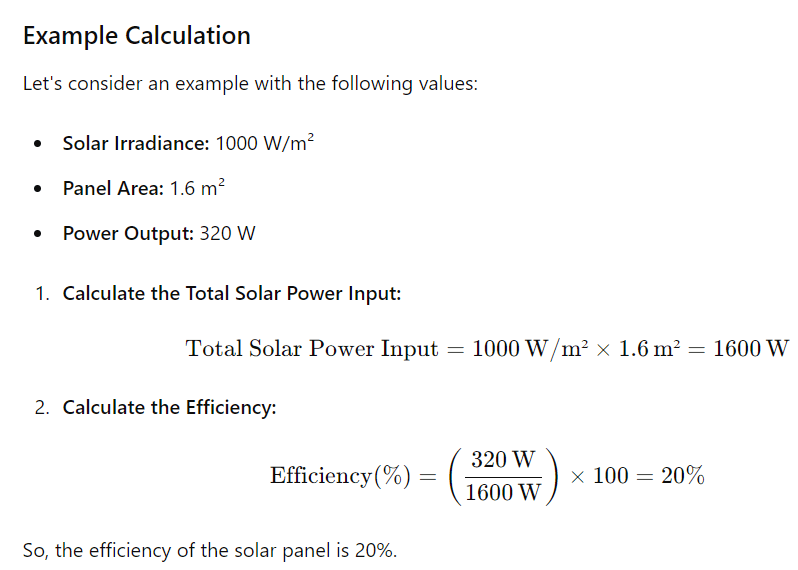
So, how do we crack this efficiency code? The formula is pretty straightforward: Efficiency (%) = (Power Output / Power Input) x 100. Let's break it down:
Must Read
Power Output: This is the amount of electrical power your solar cell produces, measured in watts (W). You'll find this value on the solar cell's datasheet. Imagine it's the amount of light you can get from a torch. Say, for example, our cell can produce 2W.
Power Input: This is the amount of solar power hitting the cell, also measured in watts (W). This depends on the sunlight's intensity and the cell's surface area. The standard measurement is 1000 W/m² (full sunlight). So, if your solar cell's area is 0.01 m² (a square 10cm by 10cm), the power input would be 1000 W/m² x 0.01 m² = 10W. That's the brightest the sun is on our torch.
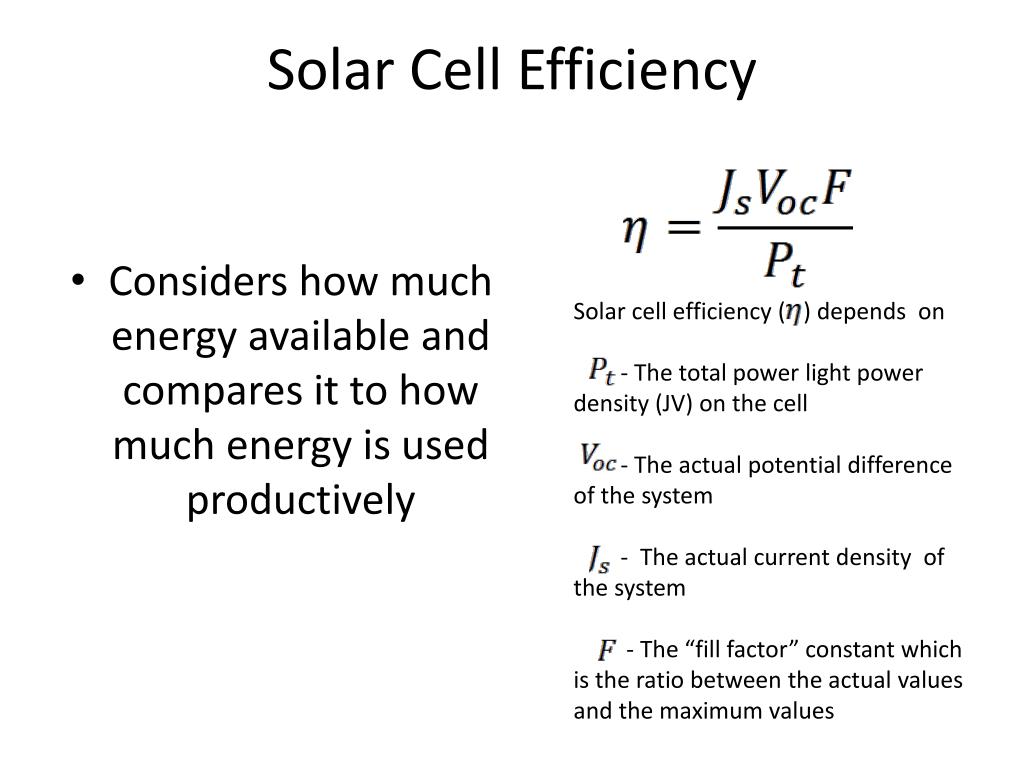
Now, let’s plug those numbers into our formula: Efficiency = (2W / 10W) x 100 = 20%. That means our solar cell converts 20% of the sunlight hitting it into electricity. Not bad!
There are variations in how efficiency is reported. Sometimes, you'll see "cell efficiency" which refers to the efficiency of a single solar cell, like the example above. You might also see "module efficiency," which is the efficiency of an entire solar panel made up of multiple cells. Module efficiency is usually a bit lower because of factors like spacing between cells and frame shading.

Practical Tips for Getting Started:
- Read the Datasheet: Always start with the solar cell's datasheet. It contains crucial information about power output.
- Measure Accurately: Use a ruler or measuring tape to get an accurate measurement of the cell's surface area.
- Consider Lighting: For indoor experiments, use a solar simulator or a bright halogen lamp. A regular lightbulb won’t cut it.
- Use a Multimeter: A multimeter is your best friend for measuring voltage and current, which you need to calculate power output (Power = Voltage x Current).
Calculating solar cell efficiency might seem a bit technical at first, but with a little practice, it becomes second nature. It's a powerful tool for understanding and appreciating the technology behind renewable energy. So, grab a solar cell, a ruler, and a calculator, and start exploring! You might be surprised at how much fun you have unlocking the secrets of the sun.