
How To Calculate Kinetic Coefficient Of Friction
Ever wondered why your car skids on ice, or why it's so much easier to push a shopping cart full of groceries than to drag it across the parking lot? The answer, my friend, lies in the fascinating world of friction, and specifically, the kinetic coefficient of friction.
Think of friction as that clingy friend who just won't let go. It's the force that opposes motion when two surfaces slide against each other. And the kinetic coefficient of friction? That's just a fancy way of quantifying how "clingy" these surfaces are when they're already moving. It's represented by the Greek letter μk (pronounced "mu-kay"), and it's a number that tells us the ratio between the force needed to keep something moving and the normal force (the force pressing the two surfaces together).
Okay, but How Do We Actually Calculate It?
Fear not, math-phobes! It's not as daunting as it sounds. Let's break it down:
Must Read
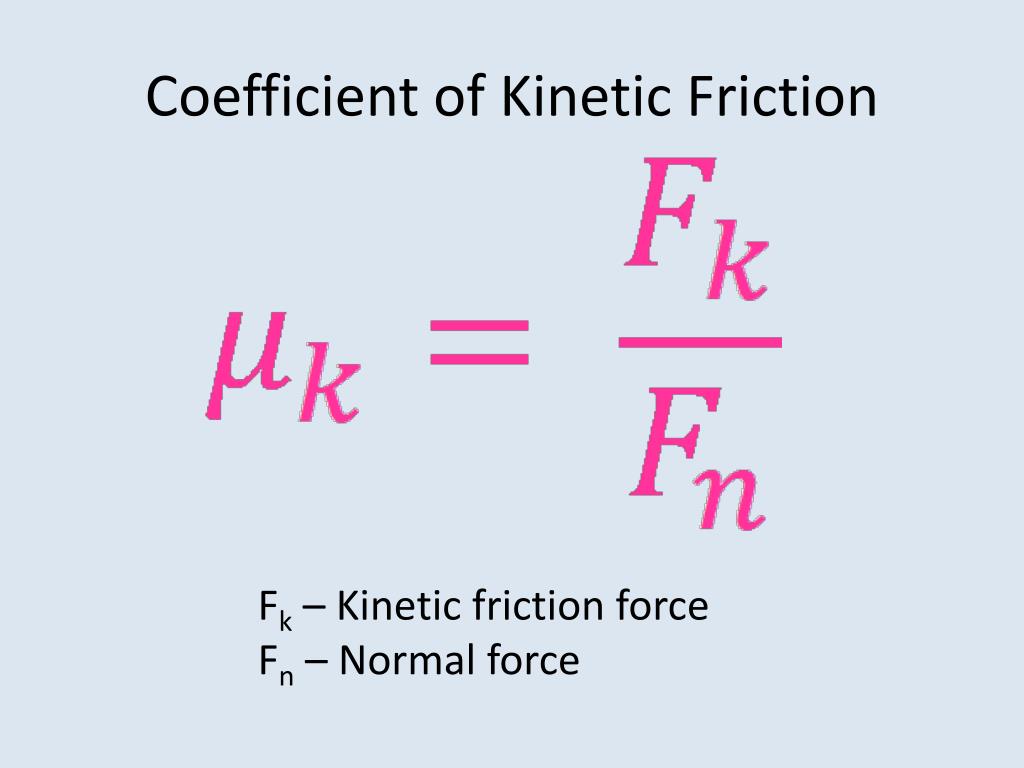
The formula is simple: μk = Fk / N
- μk: The kinetic coefficient of friction – the thing we're trying to find!
- Fk: The kinetic friction force – the force required to keep the object moving at a constant speed. This is measured in Newtons (N).
- N: The normal force – the force pressing the object against the surface. This is also measured in Newtons (N). Typically, on a flat surface, the normal force is equal to the object's weight (mass x gravity).
Imagine pushing a box across your living room floor. You're applying a force (Fk) to keep it moving at a constant speed. Gravity is pulling the box down, and the floor is pushing back up with an equal and opposite force (N), preventing the box from falling through the floor. That's your normal force!

Practical Steps for Finding μk
Ready to get your hands dirty (metaphorically, unless you're literally experimenting on a dusty floor)? Here's how to calculate μk:
- Gather Your Supplies: You'll need the object you want to test, a flat surface, a force gauge (or spring scale), and a way to measure mass (a scale).
- Determine the Normal Force (N): Weigh your object to find its mass. Multiply the mass by the acceleration due to gravity (approximately 9.8 m/s²) to get the weight. On a flat surface, this is your normal force.
- Measure the Kinetic Friction Force (Fk): Attach the force gauge to the object and pull it horizontally across the surface at a constant speed. This is crucial! The reading on the force gauge represents the kinetic friction force. Think of it like Goldilocks – not too fast, not too slow, but just right.
- Calculate μk: Divide the kinetic friction force (Fk) by the normal force (N). Boom! You've got your kinetic coefficient of friction.
Pro-Tip: Do multiple trials and average the results to get a more accurate measurement. Think of it as scientific triangulation – the more data points, the more reliable your result.

Fun Facts and Real-World Applications
Did you know that the kinetic coefficient of friction is usually less than the static coefficient of friction (the force needed to start something moving)? That's why it's harder to get a heavy object moving than it is to keep it moving. It's like getting out of bed on a Monday morning versus cruising through your afternoon Netflix binge.
The value of μk depends on the materials involved. Rubber on dry asphalt has a high coefficient, which is why your car's tires grip the road. Ice on ice has a very low coefficient, hence the slippery slopes and impromptu ice-skating rinks in winter. Engineers use this data all the time when designing everything from brakes to ski equipment.

Consider the sport of curling. The curlers sweep the ice in front of the stone not to melt the ice directly (though a tiny bit of melting does occur), but to reduce the kinetic friction between the stone and the ice. This allows them to control the stone's speed and trajectory with incredible precision. Pretty cool, huh?
So What? Why Should I Care?
Understanding the kinetic coefficient of friction might seem like an abstract concept, but it touches our lives in countless ways. From the shoes we wear to the cars we drive, from the design of our furniture to the physics of our favorite sports, friction plays a crucial role. Being aware of it, even on a basic level, allows you to better understand the world around you. Plus, you can impress your friends at parties with your newfound knowledge of tribology – the science of friction, wear, and lubrication. Just try not to be too clingy with that information!
