
How Much Watt Power Bank Is Allowed In Flight

Hey there, tech-savvy traveler! Ever wondered if you can bring your trusty power bank on your next flight? You’re not alone! Figuring out what's allowed and what's not when it comes to flying with electronics can feel like navigating a jungle. But fear not! This guide will make sure you're powered up and ready to go, all while staying within the rules. Think of it as your cheat sheet to electrifying adventures!
Power Banks and the Wild Blue Yonder
So, the big question: how much power can you actually pack? Well, airlines don't measure power banks in watts (W) directly. Instead, they look at watt-hours (Wh). Confusing, right? Don't worry, it's easier than it sounds!
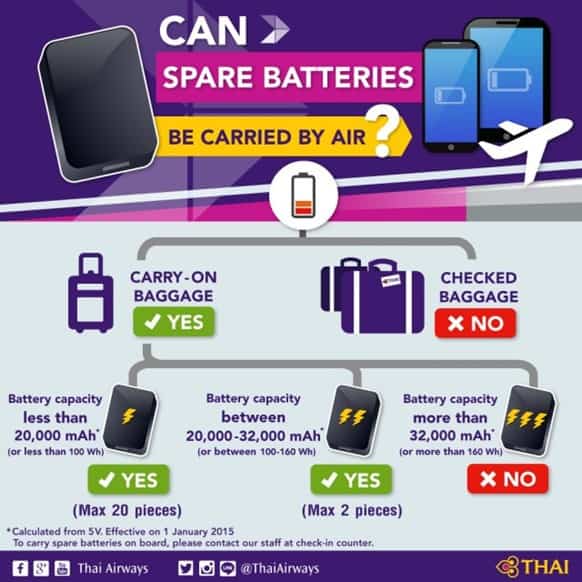
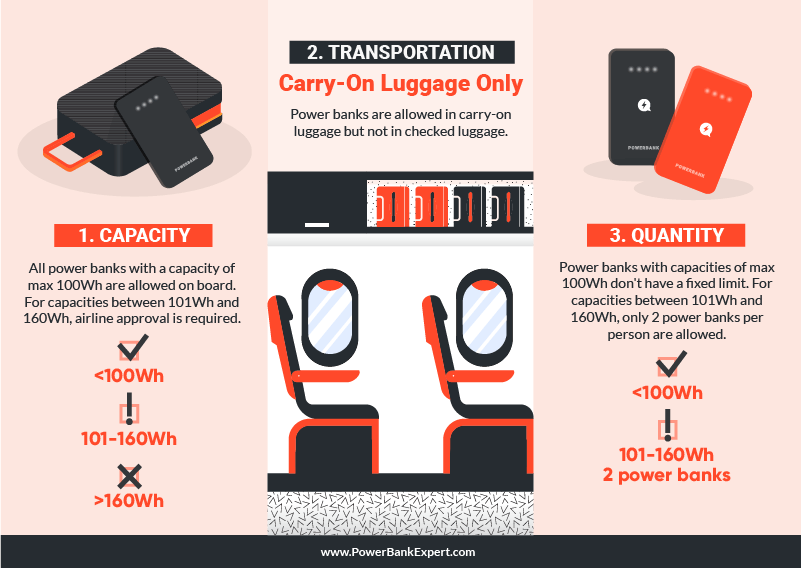
Think of watt-hours as the "fuel tank" of your power bank. The bigger the number, the more juice it holds. Airlines generally allow power banks with a capacity of up to 100 Wh without needing approval. That's usually enough to charge your phone several times, your tablet, and maybe even give your laptop a boost. Pretty sweet, huh?
Must Read
Now, for the bigger beasts! If your power bank is between 100 Wh and 160 Wh, you'll usually need to get prior approval from the airline. It's always best to check with them directly before you fly to avoid any last-minute hiccups at security. Trust me, nobody wants that!
And what about anything over 160 Wh? Sorry, friend! These are generally not allowed in your carry-on or checked baggage. Think of it as a safety measure – these super-powerful batteries have a higher potential risk. Better safe than sorry, right?

Finding the Watt-Hours: It's Easier Than You Think!
Okay, so how do you find the watt-hours on your power bank? Most power banks have this information printed directly on the device. Look for something like "Wh" or "Watt-hours" followed by a number. Sometimes, you might only see the voltage (V) and milliamp-hours (mAh) listed. Don't panic! You can easily calculate the watt-hours using a simple formula:
Wh = (V x mAh) / 1000
For example, if your power bank is 5V and 20,000 mAh, the calculation would be:
Wh = (5 x 20,000) / 1000 = 100 Wh
Ta-da! You're a watt-hour whiz! See? Math isn't so scary after all!

Carry-On Only: A Crucial Rule
Here's a golden rule: power banks (lithium-ion batteries in general) are almost always required to be in your carry-on baggage, not your checked baggage. This is because if a battery malfunctions, it's much safer to have it in the cabin where it can be monitored. Imagine a battery incident happening in the cargo hold – not a pleasant thought, right?
So, pack your power bank in your carry-on, and you'll be good to go!
Extra Tips for Smooth Sailing (or Flying!)
- Check with your airline: Always double-check the specific rules and regulations of the airline you're flying with. Policies can vary slightly, and it's better to be safe than sorry.
- Original packaging or clear labeling: If possible, keep your power bank in its original packaging or ensure it has clear labeling indicating its capacity. This can help speed things up at security.
- Protect those terminals: Consider covering the terminals of your power bank with tape or placing it in a protective pouch to prevent short circuits. A little extra precaution never hurts!
Why All the Fuss? Safety First!
You might be thinking, "Why all these rules? It's just a battery!" Well, lithium-ion batteries, while incredibly useful, can be a fire hazard if they're damaged, short-circuited, or poorly manufactured. The airline regulations are there to minimize the risk and ensure the safety of everyone on board. Think of it as a team effort to keep our skies safe!
Empower Yourself with Knowledge!
So, there you have it! Flying with power banks doesn’t have to be a stressful ordeal. With a little bit of knowledge and preparation, you can keep your devices charged and your adventures powered up. Now you can confidently navigate the airport, knowing you're prepared and in compliance with the regulations. Isn't that a great feeling?
Go forth and explore! The world is waiting, and with your trusty power bank by your side, you'll never have to worry about a dead battery ruining the moment. Don't be afraid to delve deeper into the world of travel electronics and battery regulations. The more you know, the more confident and prepared you'll be, making your travel experiences even more enjoyable. Happy travels!