
How Much Is Kevin Durant Rookie Card Worth

Alright, let's talk rookie cards! Specifically, the Kevin Durant rookie card. Imagine you find a dusty box in your attic – kinda like that old box of cassette tapes your parents swear contains the original mix they made for their first date (spoiler alert: it’s probably just Kenny G). But instead of tapes, it’s cards! And nestled among them is... a Kevin Durant rookie card.
Suddenly, you're wondering: "Hold on a second, is this my golden ticket? Am I about to fund my next vacation to Hawaii with this piece of cardboard?" Well, let's dive into that question. It's not quite as simple as finding buried treasure, but it can definitely be exciting!
The Million-Dollar Question: How Much?
Okay, the burning question: what's a Kevin Durant rookie card worth? The short answer? It depends. It's like asking how much a used car costs. A beat-up Ford Pinto from the 70s isn’t going to fetch the same price as a mint-condition classic Mustang, right?
Must Read
Several factors play a huge role in determining the value of a KD rookie card. Think of them as ingredients in a delicious (and potentially very valuable) card-collecting recipe.
Ingredient #1: The Specific Card
There isn’t just one Kevin Durant rookie card. There are different sets, different variations, and different designs. Some are more common than others. Imagine trying to find a rare, limited-edition comic book versus a mass-produced one. Which do you think will cost more?
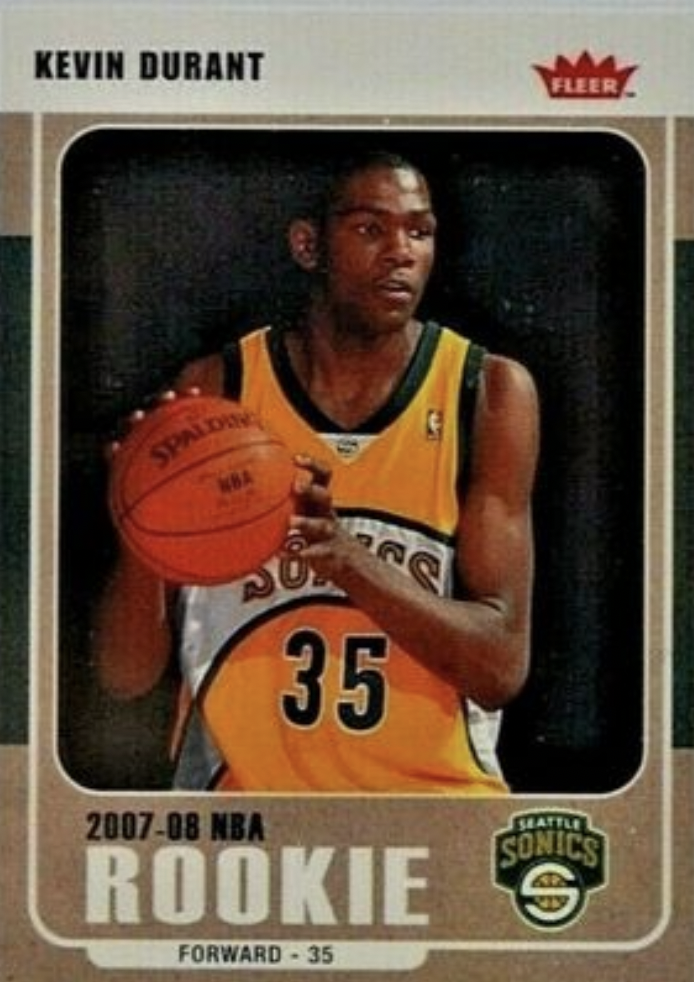
Key brands to look for include Topps, Upper Deck, and SP Authentic. Some of these sets have special autograph versions, which naturally, are highly sought after.
Ingredient #2: Condition, Condition, Condition!
This is a big one. Condition is king! Is the card pristine? Sharp corners? No scratches? Or does it look like your dog used it as a chew toy? A card that’s been through the wringer is going to be worth significantly less than one that looks like it just came off the printing press. Think of it like this: would you rather buy a new phone with all its original packaging or a used one with a cracked screen and missing buttons? Same principle applies.

Professional grading services like PSA (Professional Sports Authenticator) and Beckett (BGS) assess the condition of cards and assign them a grade. A PSA 10 or a BGS 9.5 or higher is the gold standard, indicating a virtually perfect card. These cards command the highest prices.
Ingredient #3: Autograph or No Autograph?
An autograph can drastically increase the value. It’s like adding sprinkles to an already amazing ice cream sundae. That little signature can turn a good card into a great card. But, and this is a big BUT, it needs to be a certified authentic autograph. A signature you think might be his isn't going to cut it. Think of it like claiming your grandma’s mystery meatloaf is Gordon Ramsay-approved. Unless you have proof, no one’s buying it!
Ingredient #4: Serial Numbering and Limited Prints
Some cards are serial numbered, meaning they're printed in limited quantities. For instance, a card might be stamped "1/25," meaning it's the first card printed out of a total of 25. The lower the serial number (e.g., 1/25), the more desirable (and valuable) it tends to be. Scarcity drives demand, just like trying to get concert tickets to the hottest band in the world. The fewer there are, the more people are willing to pay.

So, What are We Talking About, Price-Wise?
Alright, let's put some numbers on the table. A basic Kevin Durant rookie card in decent (but not amazing) condition might fetch anywhere from $50 to $200. A graded, high-condition (PSA 9 or BGS 9) card could easily be worth several hundred to several thousand dollars. And the super rare, autographed, and perfectly graded versions? Those can reach tens of thousands, or even hundreds of thousands, of dollars!
For example, a high-grade (PSA 10) Kevin Durant 2007 Topps Chrome Rookie card could potentially sell for over $100,000.

Why Should You Care?
Maybe you're not a hardcore card collector. That’s totally fine! But understanding the value of these cards is like understanding the stock market, or real estate. It’s about appreciating something that has potential value, and understanding what drives that value.
Plus, it's just plain fun! Imagine the thrill of potentially uncovering a hidden treasure. Even if you don't find a multi-thousand-dollar card, it's still cool to learn about the hobby, and who knows, you might find something valuable!
Ultimately, whether you're a seasoned collector or a curious newcomer, the world of sports card collecting is an exciting one. So, go check that attic! You never know what treasures you might uncover. Happy hunting!