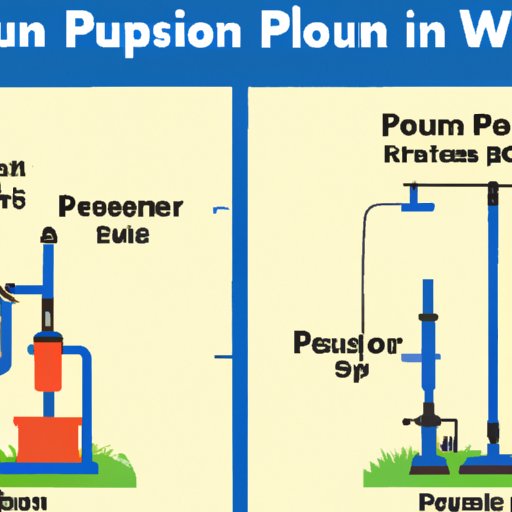
How Much Electricity Does A Well Pump Use Per Month

Ever wonder how you get that refreshing gulp of water straight from the tap? If you're on a well, it's all thanks to a hardworking electric well pump! But that constant, reliable flow begs the question: how much electricity is this thing really using? It's a fascinating question, and honestly, more important than you might think. Let's dive in, shall we?
The Deep Dive: Decoding Well Pump Electricity Use
Okay, first things first. There's no one-size-fits-all answer. It's like asking "How much gas does a car use?" Well, a Mini Cooper is going to be very different from a Hummer, right? Same with well pumps! A few key factors come into play:
- Pump Size (Horsepower): This is the big kahuna. A larger, more powerful pump (measured in horsepower, or HP) will naturally use more electricity. Think of it like this: a tiny fountain pump sipping power is vastly different from a pump drawing water from a deep well.
- Well Depth: The deeper your well, the harder the pump has to work. Imagine trying to suck a milkshake through a really, really long straw! More effort = more juice.
- Water Usage: The more water you use (think showers, laundry, watering the garden), the more your pump has to run. Simple, right?
- Pump Age and Efficiency: Just like anything else, older pumps tend to be less efficient than newer ones. They might be working harder just to achieve the same result. Think of it like an old car – still gets you there, but not as smoothly!
- Your Local Electricity Rate: Of course, the cost of electricity varies depending on where you live. So, the same amount of power consumed will cost different amounts depending on your location.
So, how do we figure out a ballpark estimate? Let's break it down.
Must Read
The Math (Don't Worry, It's Not Scary!)
We need to consider wattage, which is a measure of how much electrical power a device uses. Horsepower (HP) can be converted to watts. A rough estimate is that 1 HP is about 746 watts. However, pumps are not 100% efficient. So, we should consider that 1 HP pump can consume ~1000 watts or 1 kilowatt.
Let's say you have a 1 HP pump that runs for 1 hour each day. That’s 1 kilowatt-hour (kWh) per day (1 kW x 1 hour = 1 kWh). If your electricity costs, say, $0.15 per kWh, that's $0.15 per day. Multiply that by 30 days in a month, and you get $4.50 per month. Not bad, right?

But here's the catch: Most pumps don't run continuously for an hour. They cycle on and off as needed to maintain water pressure. Figuring out the actual run time is key!
Becoming a Water Detective: Finding Your Run Time
Here's where things get a little more investigative. You could try to manually monitor your pump, noting how long it runs each time it kicks on and tallying it up over a week or so. But that sounds… tedious! A better option? A smart energy monitor. These nifty devices can track the electricity usage of specific appliances, giving you a precise picture of your pump's energy consumption. They also show you the voltage and amperage the motor is pulling so you can make sure you don't have a failing motor.

Think of it like getting a fitness tracker for your well pump! You can see how much "energy" it's expending and identify areas where you might be able to improve efficiency. For instance, a leaky toilet or faucet can cause your pump to run more frequently, costing you money.
Why Should You Care? (Besides Saving Money!)
Okay, so saving a few bucks on your electricity bill is a nice perk. But understanding your well pump's energy use is about more than just your wallet. It's about:
- Sustainability: Being mindful of our water and energy consumption is crucial for the environment. Every little bit helps!
- Early Problem Detection: A sudden spike in energy usage could indicate a problem with your pump, like a leak or a failing motor. Catching these issues early can prevent costly repairs down the road.
- Making Informed Decisions: When it's time to replace your pump, knowing your current energy consumption will help you choose a more efficient model.
Ultimately, knowing how much electricity your well pump uses is like understanding the health of your home's circulatory system. It's a vital piece of the puzzle that allows you to be a more informed, responsible, and maybe even a slightly greener homeowner. And who wouldn't want that?
So, grab a smart monitor, become a water detective, and start digging into the fascinating world of well pump electricity usage. You might be surprised by what you discover!