
How Much Electricity Does A 12000 Btu Ac Use
Hey there, friend! Ever found yourself staring at your power bill, a single bead of sweat trickling down your brow, and wondering, "Just how much juice is that glorious, life-saving air conditioner guzzling?" Especially that 12,000 BTU beast you rely on when summer decides to really show off its inferno skills?
Well, pull up a comfy chair, grab another sip of whatever you're drinking (iced coffee, perhaps?), because we're about to demystify that slightly intimidating number. And trust me, it’s not as scary as you might think… sometimes.
First off, What Even IS a 12,000 BTU AC?
Alright, before we get into the nitty-gritty of electricity bills, let's just quickly tackle what "12,000 BTU" means. BTU stands for British Thermal Unit. Fancy, right? Basically, it’s a measurement of heat energy. In AC terms, it tells you how much heat your unit can remove from a room in an hour.
Must Read
A 12,000 BTU AC is a pretty common size. It's usually good for cooling a decent-sized room, like a master bedroom, a larger living room, or even a small open-plan studio. We're talking anywhere from 450 to 550 square feet, give or take. So, it's not a tiny window unit, but it's not trying to cool your entire house like a central air system either. It’s kind of the Goldilocks zone for many folks.
So, How Much Juice Does It Sip? (Spoiler: It's Complicated... But Not That Complicated!)
Okay, the big question! You want a nice, clean number, right? Like, "It uses exactly X watts per hour." Oh, if only it were that simple! Unfortunately, it's not a one-size-fits-all answer, because your AC is a bit like a moody teenager – its energy consumption depends on a bunch of factors.
But fear not! We can get you pretty close to an educated guess.
The Real MVPs of AC Efficiency (and Your Wallet!)
Think of these as the main characters in our little electricity drama:
1. The Mighty SEER Rating
This is perhaps the most important factor. SEER stands for Seasonal Energy Efficiency Ratio. The higher the SEER number, the more efficient your AC is. Imagine a car: a high SEER AC is like a hybrid sipping fuel, while a low SEER one is like a big old gas-guzzling SUV. A 12,000 BTU unit with a SEER of 10 will use significantly more electricity than one with a SEER of 20. Big difference maker! Modern units are generally 13 SEER or higher, thankfully.
2. How Often It's Running (Duh!)
This one's a no-brainer, right? If your AC is running constantly, non-stop, 24/7, because it's hotter than Hades outside and your insulation is non-existent, then yes, it's going to rack up a bill. If it cycles on and off occasionally to maintain a comfortable temperature, your wallet will breathe a sigh of relief.
3. Your Thermostat Setting
Are you trying to turn your living room into an arctic wonderland? Setting it to a frosty 68°F (about 20°C) when it's 95°F (35°C) outside will make your AC work much harder than if you set it to a still-comfortable 75°F (24°C). Every degree makes a difference! Seriously, try bumping it up just a couple of degrees. You might be surprised how quickly you adjust, and your wallet will thank you.
4. Your Home's Insulation (or Lack Thereof)
This is a huge one! If your windows are drafty, your walls are thin, or your doors have big gaps, that lovely cool air is escaping like a naughty toddler from a playpen. And what does your AC do? It works harder to replace it! Seal those leaks, folks! It's like pouring water into a leaky bucket versus a solid one.
5. The Great Outdoors (Temperature, Sunshine, Oh My!)
Obviously, if it's scorching hot and sunny outside, your AC has a tougher job to do than on a milder, overcast day. The sun beaming directly into your windows can also make your unit sweat (figuratively, of course).
Let's Talk Numbers (ish!)
Okay, okay, enough with the disclaimers! Let's get to some rough figures so you have an idea.
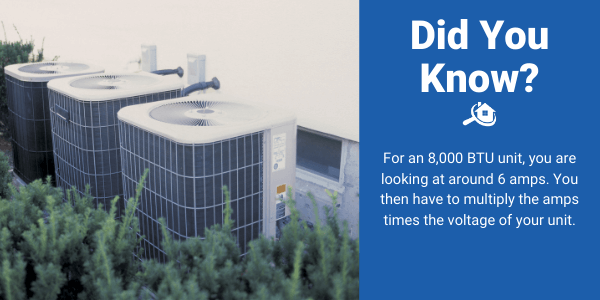
A 12,000 BTU AC unit typically draws between 900 to 1,500 watts of power when it's actively cooling. Let's pick a middle ground for our example, say 1,200 watts (or 1.2 kilowatts, kW).

Here’s how you'd calculate it:
- Watts / 1000 = Kilowatts (kW)
- kW × Hours of Use = Kilowatt-hours (kWh)
- kWh × Your Electricity Rate (per kWh) = Cost!
So, if your 12,000 BTU unit uses 1,200 watts (1.2 kW) and runs for, say, 8 hours a day (a pretty common scenario on a hot day):
1.2 kW × 8 hours = 9.6 kWh per day
Now, let's pretend your electricity rate is $0.15 per kWh (check your bill, it varies widely!).

9.6 kWh × $0.15/kWh = $1.44 per day
Over a 30-day month, that's roughly $43.20. Not too shabby, right? But remember, this is for 8 hours of use in moderate conditions with a mid-range SEER. If it's running 16 hours a day in a poorly insulated space, that daily cost could easily double to nearly $3, making your monthly bill closer to $90 for that single AC unit. See how quickly it adds up?
Wanna Keep Your Wallet Happy? (And Your AC Efficient?)
Alright, so now you know the general drill. But how do you keep that 12,000 BTU unit from turning your bank account into a barren wasteland? A few friendly tips:
- Clean Those Filters! Seriously, this is like giving your AC a clear breathing path. A clogged filter makes it work harder, which means more electricity. Do it monthly!
- Seal It Up: Go on a detective hunt for air leaks around windows and doors. Weatherstripping and caulk are your best friends here.
- Smart Thermostat: Invest in a programmable or smart thermostat. They can learn your habits or let you control things from your phone, so you're not cooling an empty house.
- Use Fans: Ceiling fans or portable fans don't actually cool the air, but they create a wind chill effect that makes you feel cooler. This means you can often set your AC a few degrees higher. Synergy!
- Shade Those Windows: Curtains, blinds, or even strategically planted trees can block out direct sunlight, reducing the heat entering your room.
- Regular Maintenance: Just like your car, your AC benefits from a tune-up now and then.
So there you have it! Your 12,000 BTU AC isn't a power-hungry monster plotting against your finances, but it's also not a completely innocent little lamb. By understanding how it works and what affects its usage, you can be smarter about how you cool your space and keep that electricity bill from giving you a heart attack. Stay cool, my friend!