
How Many Watts To Run A House With Central Air

Okay, picture this: I'm sprawled on the couch, remote in hand, finally ready to binge-watch that show everyone's been talking about. The AC is humming along, a beautiful, cool oasis in the summer heat. Suddenly… darkness. Power outage. My precious, precious AC silenced! It got me thinking – just how much juice does this thing suck up, anyway? Enough to single-handedly crash the grid? Probably not (hopefully not!), but it definitely made me curious about the wattage needed to keep my house, and yours, comfortably cool.
So, let's dive in, shall we? The million-dollar question (or, you know, the several hundred-dollar electricity bill question) is: How many watts does it really take to run a house with central air conditioning?
The Central AC Power Hog: A General Overview
The bad news first: central AC units are among the biggest energy consumers in your home. Think of them as the gluttonous kings and queens of your appliance empire. The good news? Understanding their power needs can help you make smart decisions and potentially save some serious cash. (Who doesn't love saving money? Raise your hand!)
Must Read
Generally speaking, a central AC unit can range from 1,500 watts to a whopping 5,000 watts or even more! Yeah, I know, that's a huge range. So, what affects the specific wattage? Lots of things, actually.
Factors Influencing AC Wattage: Prepare for Science! (Kind Of)
Here’s where things get a little technical, but I promise to keep it simple. Several factors come into play when determining how many watts your AC unit needs.
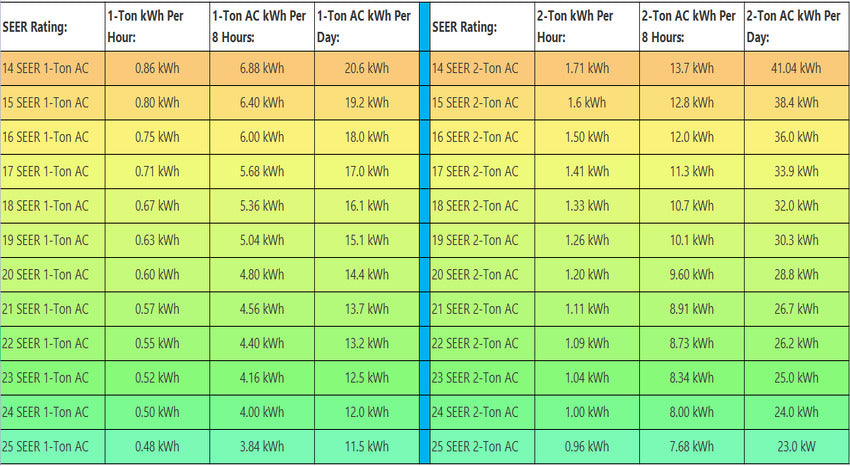
- Size of the Unit (BTUs): Bigger house = bigger unit = more watts. Makes sense, right? AC units are measured in BTUs (British Thermal Units), which indicate their cooling capacity. A larger BTU rating means more cooling power and, consequently, higher wattage. A 1.5-ton unit might use around 1,500 watts, while a 5-ton unit could easily surpass 3,500 watts.
- SEER Rating: This stands for Seasonal Energy Efficiency Ratio. The higher the SEER rating, the more efficient the unit. Basically, it's a measure of how much cooling you get per watt of electricity used. A higher SEER rating usually (but not always) translates to lower wattage consumption. Look for that yellow Energy Guide sticker!
- Age of the Unit: Older units tend to be less efficient. They’ve probably lost some of their mojo over the years. Like us all, right? Newer models often incorporate energy-saving technologies that reduce wattage requirements. If your AC is ancient, consider upgrading! It'll pay for itself in the long run.
- Usage Habits: How often and how long you run your AC obviously impacts energy consumption. Constantly blasting it on full blast? Expect a hefty electricity bill. Setting a reasonable temperature and using a programmable thermostat can make a big difference.
- Insulation and Home Efficiency: A poorly insulated home forces your AC to work harder to maintain a comfortable temperature. Leaky windows and doors? Drafty walls? These all contribute to increased energy consumption. Beef up your insulation – your wallet will thank you!
Beyond the AC: Other Appliances to Consider
Okay, the AC is a major player, but it's not the only thing sucking down watts in your house. Think about it: fridge, lights, TV, computers, maybe an electric stove or oven? They all contribute to your overall energy consumption.
To get a truly accurate picture of how many watts you need to run your entire house, you have to consider everything. A good starting point is to check the wattage ratings on your appliances. They're usually printed on a sticker on the back or bottom.

Estimating Your Total Wattage Needs: A Back-of-the-Envelope Calculation
Want a rough estimate? Here’s a simplified approach.
- Estimate your AC wattage (based on the factors above). Let's say it's 3,000 watts.
- Add up the wattage of your essential appliances: fridge (200 watts), lights (200 watts), TV (100 watts), etc. Let's say that totals 500 watts.
- Consider peak usage: what appliances do you typically run simultaneously? Add their wattages together. Maybe it's the AC, TV, and oven (1,500 watts) at dinner time.
- Add it all up: 3,000 (AC) + 500 (essential) + 1,500 (peak) = 5,000 watts.
Remember, this is just a very rough estimate. Your actual wattage needs may vary. But it's a good starting point for understanding your energy consumption.

Final Thoughts: Be Watt-Wise!
Understanding the wattage requirements of your central AC and other appliances is crucial for managing your energy consumption and saving money. By taking steps to improve your home's energy efficiency, upgrading to newer appliances, and being mindful of your usage habits, you can keep your house cool and comfortable without breaking the bank. Plus, you'll be doing your part for the environment! So, go forth and be watt-wise! You (and your wallet) will be glad you did.
And hey, maybe that power outage was a blessing in disguise. It forced me to think about all this. Now, if you'll excuse me, I have a thermostat to adjust... and a show to get back to!
