
How Many Watts Is In A Kilowatt

Have you ever stopped to think about the invisible force that zips through your walls and powers everything from your tiny phone to your roaring air conditioner? It’s all thanks to electricity, a truly fascinating marvel of our modern world.
But how do we actually measure this incredible power? How do we quantify the "oomph" that makes our gadgets go? That's where our friends, the watt and the kilowatt, come into play.
Let's start with the humble watt. Named after the brilliant Scottish inventor James Watt, a watt is essentially a unit of power. Think of it as a small burst of electrical energy, like a tiny powerhouse working hard.
Must Read
It’s the fundamental measurement of how much energy a device uses at any given moment. A single watt might seem insignificant on its own, but it’s the building block for all electrical activity around us.
Look around you! Your smartphone charger might pull about 5 to 20 watts of power. A bright LED light bulb typically consumes around 6 to 10 watts.
Even your alarm clock, quietly sitting on your nightstand, might be using a watt or two. These little power units are constantly at work, often without us even realizing it.
The Big Secret: Unveiling the Kilowatt Connection
Now, for the exciting part! What happens when these individual watts start to add up? What do we call a much larger collection of this electrical "oomph"?
This is where the magnificent kilowatt makes its grand entrance. It’s a term you’ve probably seen on appliance labels or even your electricity bill, but what does it truly mean?
Get ready for the big reveal, the simple truth that makes understanding your energy world so much easier and more engaging. This isn't just a number; it's a key to unlocking energy insights.
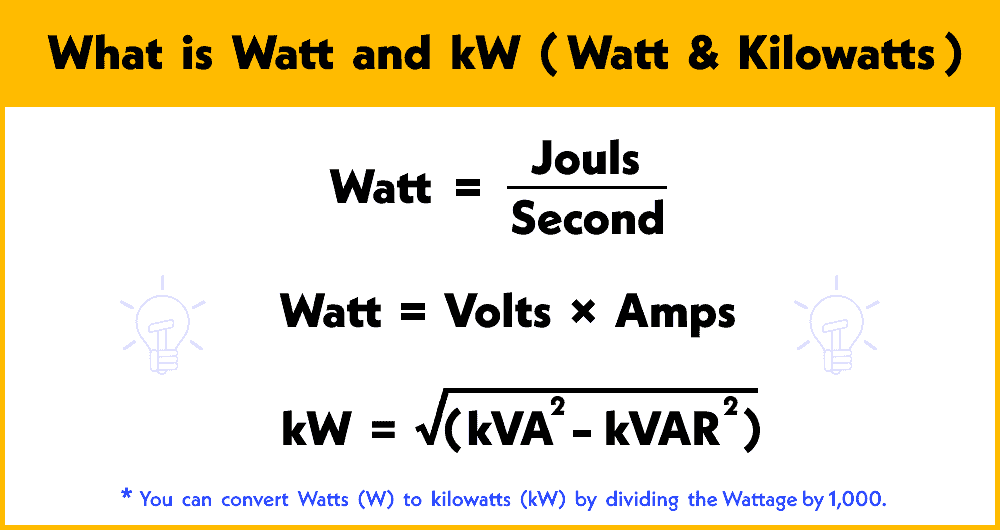
Here it is: There are exactly 1,000 watts in just one kilowatt!
Isn't that wonderfully straightforward? The magic lies in that little prefix, "kilo-". It’s a universally recognized term in the metric system that consistently means a thousand of something.
You've encountered it countless times: a kilogram is 1,000 grams, a kilometer is 1,000 meters. The same elegant simplicity applies to electrical power.
So, a kilowatt is simply a convenient bundle of a thousand individual watts. It’s like grouping a thousand pennies into a single ten-dollar bill – much easier to handle and understand!
Why This Simple Truth Is So Entertaining and Special
"Entertaining and special?" you might ask. "It's just a number conversion!" But trust us, this simple fact opens up a surprisingly fun new way to look at the world around you.
Firstly, it makes big numbers manageable. Imagine talking about a powerful electric car charger delivering 150,000 watts. That sounds like a lot to process, right?
But when you say it’s delivering 150 kilowatts, it instantly sounds clearer, more powerful, and much easier to grasp. It’s a linguistic shortcut that simplifies complexity.

This conversion empowers you to become an instant energy detective in your own home. Pick up almost any electrical appliance, and you'll find its power rating.
Often, it’s listed in watts. Now, with your newfound knowledge, you can instantly convert that number to kilowatts in your head! Try it!
Your vacuum cleaner might be rated at 1,200 watts. Poof! You instantly know that's 1.2 kilowatts. Your coffee maker could be 900 watts, meaning it's 0.9 kilowatts.
There’s a real satisfaction in understanding these numbers. It’s like having a secret decoder ring for all the electrical devices that fill your life.
You begin to see your home not just as rooms and furniture, but as a vibrant ecosystem of power users. Which appliance is the biggest energy enthusiast?
This is where the fun really begins! Your water heater, for instance, might be a real powerhouse, drawing 4,500 watts when it's heating water. That’s a whopping 4.5 kilowatts!
Compare that to your television, which might only use around 100 watts (0.1 kilowatts). Suddenly, you have a scale for understanding energy hungry versus energy efficient.
This isn't just a mental exercise; it directly impacts your wallet. Your electricity provider charges you based on kilowatt-hours.
A kilowatt-hour is simply using 1 kilowatt of power for one entire hour. Knowing this, your electricity bill starts to make a lot more sense.
You can now look at your bill and visualize exactly what those numbers mean in terms of your appliances. It makes energy consumption tangible, not just an abstract charge.
This new understanding can inspire small, yet powerful, changes in your habits. Maybe you’ll unplug devices not in use, or opt for energy-efficient options when buying new electronics.
It’s about gaining a quiet sense of control and awareness over the energy flowing through your home. It’s empowering to know what those numbers truly signify.
The conversation about clean energy and sustainability often revolves around kilowatts and megawatts (a thousand kilowatts!). By understanding this basic conversion, you're joining a larger, important discussion.

You're not just a passive energy consumer; you're an informed participant in the energy landscape. That’s pretty special, isn't it?
Even in the world of renewable energy, from solar panels on roofs to massive wind turbines, power generation is measured in kilowatts. Knowing the connection helps you appreciate the scale of these green technologies.
So, the next time you see "kW" or "W" on an appliance, don't just gloss over it. Pause for a moment and perform that quick, satisfying mental conversion.
You'll feel a tiny spark of understanding, a sense of being "in the know" about the invisible forces that shape our everyday lives. It's a small fact with a surprisingly big impact.
Go ahead, give it a try! You’ll find that understanding how many watts are in a kilowatt is a genuinely illuminating and enjoyable journey into the heart of electrical power.
It's more than just arithmetic; it's a step towards becoming a more mindful and connected inhabitant of our electrically-powered world.
Who knew such a simple conversion could be so utterly captivating? Now you do!