
How Many Watts Is A Light Bulb
Alright, let's talk light bulbs. Remember the good old days? You needed more light, you grabbed a 100-watt bulb. Needed less? A 40-watt. Simple! Life was uncomplicated, and we all knew what a "watt" meant, right?
Or did we?
Fast forward to today, and you're standing in the light bulb aisle, staring at a bewildering array of boxes. You see things like "60-watt equivalent," "800 lumens," "9 watts," and suddenly you feel like you need a Ph.D. in "Bulbology" just to illuminate your living room. It's enough to make you want to just light a candle and call it a day!
Must Read
The Old Friend We Thought We Knew: Watts
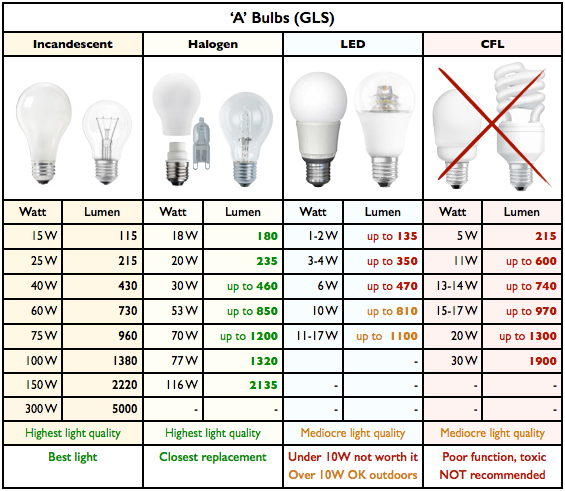
So, what is a watt when it comes to a light bulb? In the glorious era of incandescent bulbs, watts were basically a stand-in for brightness. A 100-watt bulb was brighter than a 60-watt bulb because it used more electricity to generate both light and, let's be honest, a good deal of heat.
Think of it like this: a watt is really about how much power the bulb is consuming. It's like asking how much gas your car burns. More gas generally meant more oomph (and heat) from your old incandescent bulb. But here's the kicker: it was never a direct measure of the light itself, just the energy used.
It's a bit like saying "My car uses a lot of gas, so it must be super fast!" Not necessarily. It might just be a big, thirsty SUV that's not exactly a speed demon. The same goes for old bulbs – a lot of watts meant a lot of energy consumed, much of it wasted as heat, and some of it turning into light.
Enter the New Kid on the Block: Lumens
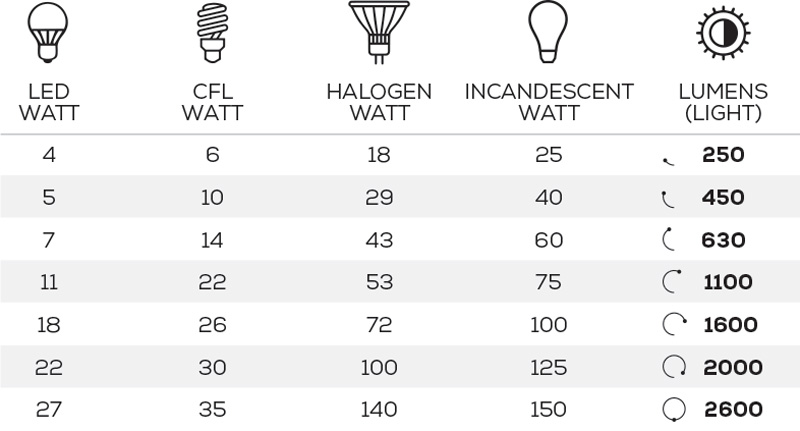
Then, along came the energy-efficient revolution: CFLs, and now, the superstars, LEDs. These new bulbs are incredibly efficient. They use a tiny fraction of the electricity to produce the same amount of light as their old incandescent cousins.

This is where lumens swoop in like a superhero to save the day! Lumens actually tell you how much light you're getting. Period. No guessing, no translating. If you want a brighter room, you look for a higher lumen number. If you want softer mood lighting, you go for fewer lumens.
It's like comparing apples to apples. Or, well, light to light!

The "Equivalent" Confusion (We've All Been There)
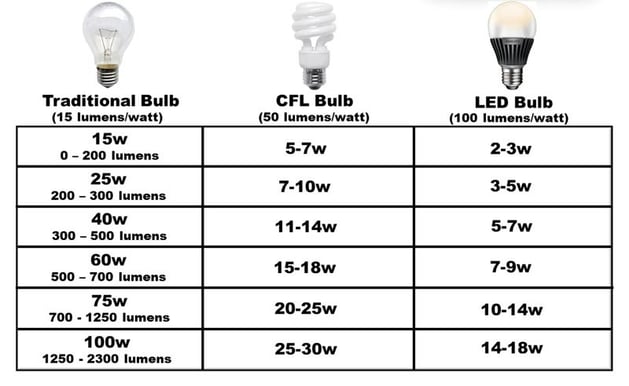
So, when you see a box that says "60-watt equivalent LED" and then proudly displays "9 watts," what's going on?
It means that little LED bulb, chugging along on a mere 9 watts of power (saving you money on your electricity bill, yay!), is giving off roughly the same amount of light as an old 60-watt incandescent bulb (which would have been sucking down 60 watts of power). Pretty neat, right?
I once bought an "equivalent" bulb for my bedside lamp, thinking I was getting something gentle for reading. Screwed it in, flicked the switch, and nearly needed sunglasses. It was like I'd installed a miniature sun in my bedroom! Turns out, my definition of "equivalent" and the bulb's definition of "equivalent brightness to a supernova" were slightly different. Always check the lumens!
Why Does It Matter in Real Life?
Beyond the philosophical musings on what a watt truly represents, understanding this stuff actually saves you headaches (and maybe a few bucks).
- Saving Money: Lower watts (for the same lumens) mean less electricity consumed, which means a happier wallet at the end of the month. Those old incandescent bulbs were basically tiny, inefficient heaters that also made some light.
- Getting the Right Light: No more guessing! Want your kitchen bright enough to perform brain surgery? Look for high lumens. Want a cozy glow for movie night? Go for lower lumens.
- No More Blind Spots: You can actually compare different types of bulbs directly. An 800-lumen LED gives the same light as an 800-lumen CFL, even if their wattages are wildly different.
So, next time you're standing in that bulb aisle, don't sweat the wattage too much (unless you're looking at your electricity bill). Instead, look for your new best friend: lumens for how bright it is, and then glance at the actual watts to see how much energy it's going to use. Your eyes (and your wallet) will thank you!