
How Many Protons Are In Tin

Ever looked at a shiny tin can, or maybe noticed the solder holding together the circuits in your electronics? Tin is one of those humble elements that’s just… everywhere. It’s been helping us out for millennia, from making sturdy bronze tools to keeping our food fresh. But have you ever paused to think about what actually makes tin, well, tin? What's its secret identity, deep down at the atomic level?
It all boils down to something incredibly fundamental, something tiny that gives every element its unique fingerprint: protons. These aren't just any old particles; they're like the element's official ID card. The number of protons an atom has is its superpower, its defining characteristic. Change that number, and you change the entire element!
So, let's get right to it, shall we? For an element as versatile and important as tin, how many of these identity-defining protons are we talking about?
Must Read
The Big Reveal: Tin's Proton Count!
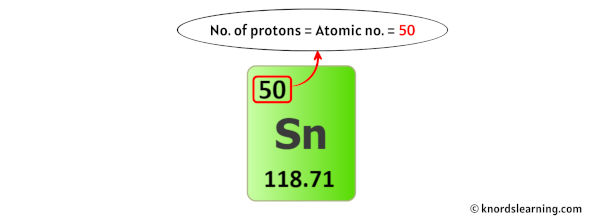
Drumroll, please… Tin has exactly 50 protons!
That's right, fifty. Not 49, not 51. Just a precise, unwavering 50. This number is so crucial that scientists have a special name for it: the atomic number. For tin, its atomic number is 50. This isn't just a random piece of trivia; it’s the very essence of what makes tin, tin.
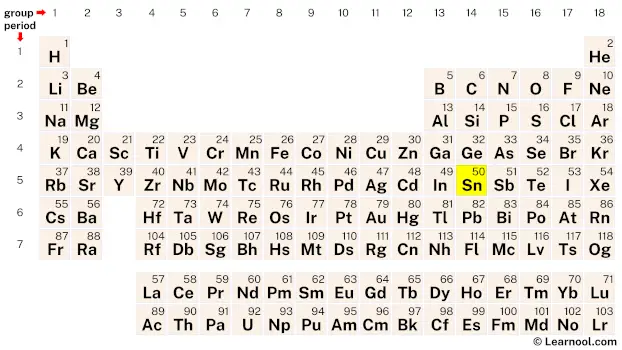
Think of it like this: imagine a grand cosmic club, and each element gets a unique membership number. If your atom has membership number 50, congratulations, you're part of the exclusive "Tin Club"! No other element can claim that specific number. Copper has 29 protons. Gold boasts 79. Lead sits at 82. Each number is unique, like a molecular postcode that tells you exactly where you are in the periodic table.
This steadfast count of 50 protons is what dictates tin's behavior. It shapes how tin atoms interact with other atoms, how they form bonds, and ultimately, what kind of material they create. It’s like the blueprint for all of tin's amazing properties.
Why 50 Protons Are Such a Big Deal
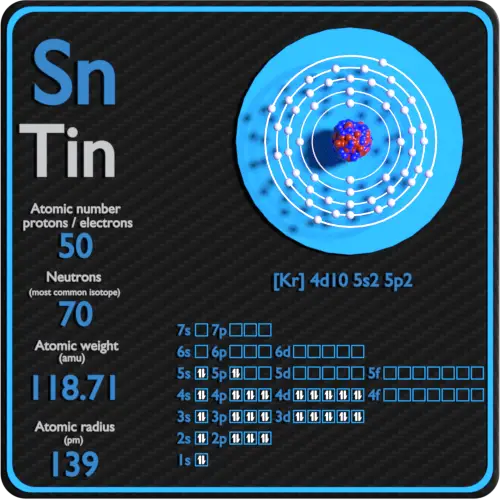
So, why does this specific number matter so much? Because those 50 protons in the nucleus are like the central magnet of the atom, attracting exactly 50 electrons when the atom is neutral. And it's these electrons, whizzing around the nucleus, that are the real social butterflies, deciding how tin will behave chemically.
Those 50 electrons arrange themselves in specific "shells" or "orbitals" around the nucleus. This arrangement is what gives tin its particular metallic luster, its relatively low melting point (making it great for solder!), and its resistance to corrosion (perfect for protecting those food cans!). If tin had 49 protons, it would be Indium, a much softer metal with different uses. If it had 51, it would be Antimony, a brittle metalloid often used in alloys. See? Big difference!
It's truly mind-boggling that such a small, fundamental count can lead to such distinct macroscopic properties that we rely on every single day.
A Quick Detour: The Isotope Story
Now, while the proton count is fixed, atoms can have different numbers of neutrons. You might have heard the term isotopes. These are like siblings – they have the same parents (the same number of protons, so they're the same element), but they might have slightly different "weights" because of varying numbers of neutrons.
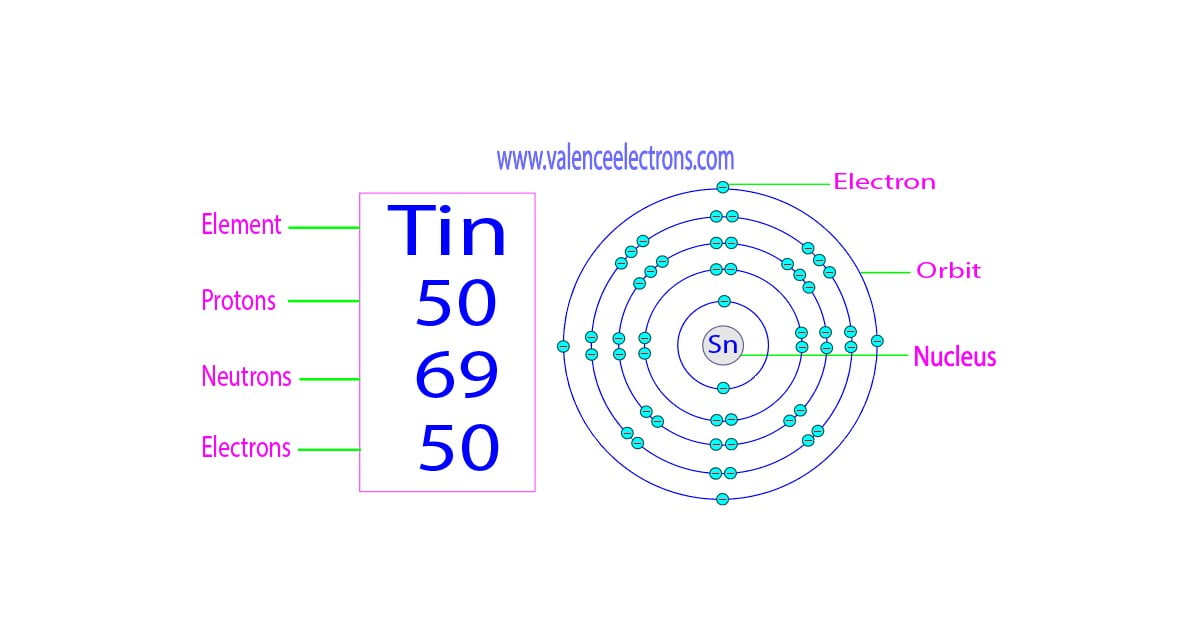
And here’s another cool fact about tin: it has more stable isotopes than almost any other element on the periodic table! We're talking about ten stable isotopes, ranging from tin-112 (50 protons, 62 neutrons) all the way up to tin-124 (50 protons, 74 neutrons). This variety is quite unusual and makes tin even more fascinating to chemists. But no matter how many neutrons it has, if it’s tin, it always has 50 protons. That's the constant!
The Everyday Impact of 50 Protons
So, next time you encounter tin in your daily life—perhaps as the protective layer inside a soup can, the shiny metal in a piece of jewelry, or the crucial component that holds together the electronics in your phone—take a moment to appreciate those 50 protons. They are tirelessly working at the heart of every single tin atom, defining its identity, and giving it all the unique characteristics that make it so useful to us.
It’s a wonderful reminder that the universe operates on incredibly precise, fundamental rules. The simple, unwavering number of protons in an atom is a powerful testament to the elegant order that governs everything around us, from the smallest subatomic particle to the grandest galaxy. Pretty neat, right?