How Many Amps Is 8 Gauge Wire

Alright, let's talk wires! Specifically, let's untangle the mystery of how many amps 8 gauge wire can handle. Now, before your eyes glaze over thinking this is going to be some dry, technical lecture, hit pause! Because understanding this little nugget of electrical wisdom is actually like unlocking a secret superpower for your DIY dreams. Seriously!
Imagine you're finally ready to install that killer car audio system, set up a sweet solar panel array for your RV, or wire up a new circuit for your workshop's power tools. What's the one thing all these awesome projects have in common? Yep, you guessed it: wires. And choosing the right size wire for the job isn't just about safety (though that's super important, we'll get to it!), it's about making sure your stuff works efficiently, reliably, and without any hiccups.
The Big Question: What's an Amp, Anyway?
Let's start with the basics, shall we? When we talk about "amps," we're talking about amperage, which is simply the measure of electrical current flowing through a wire. Think of electricity like water flowing through a hose. The amps are the volume of water. More amps? More water!
Must Read
Now, about that "gauge" thing. Wire gauge refers to the thickness of the wire. And here's the fun, counter-intuitive part: the smaller the gauge number, the thicker the wire! So, 8 gauge wire is thicker than, say, 12 gauge, but thinner than 4 gauge. Got it? Think of it like shotgun shells: a 12 gauge is smaller than a 20 gauge. The same logic applies to wires!
Why does thickness matter? Because a thicker wire is like a wider hose – it can carry more electrical current (more amps!) without getting too hot. If a wire tries to carry too many amps for its size, it heats up, potentially melting insulation, causing shorts, or even fires. Yikes! We definitely don't want that on our awesome projects.
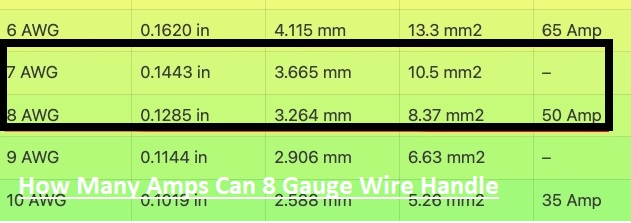
So, How Many Amps Can 8 Gauge Wire Handle?
Alright, drumroll please! For 8 gauge copper wire, you're generally looking at a safe current-carrying capacity (what the pros call ampacity) in the range of 40 to 60 amps.
"Wait," you might say, "that's a range! Why isn't it just one magical number?" Good question, my curious friend! It's because the exact ampacity depends on a few real-world factors that are like spicy secret ingredients in an electrical recipe:
- Insulation Type: Different types of wire insulation (like THHN, NM-B, etc.) are rated to withstand different temperatures. A wire with insulation rated for higher temperatures can safely carry a bit more current.
- Temperature of the Environment: If your wire is running through a scorching hot attic, it's already starting warm, so it can't handle quite as much additional heat from current flow compared to a wire in a cool basement. Makes sense, right?
- Number of Wires in a Conduit: If you bundle a bunch of wires together in a tight space, they can't dissipate heat as easily. This means each wire needs to be derated (carry a little less current) to prevent overheating.
- Length of the Run: While not directly affecting ampacity, longer wire runs can lead to voltage drop. If your voltage drops too much, your devices won't get enough power, which can lead to them drawing more current and generating more heat. Something to keep in mind!
For most common applications like wiring up a sub-panel in your garage, a dedicated circuit for a powerful appliance, or bringing power to your RV, 8 gauge wire is often chosen for circuits protected by 40 or 50 amp breakers. It’s that sweet spot for many medium-to-heavy duty tasks.

Why This Knowledge Makes Life More Fun (and Safer!)
Knowing the ampacity of 8 gauge wire isn't just trivia. It's empowerment!
- DIY Confidence: You can confidently plan your projects, knowing you're choosing the right wire size. No more guessing, no more second-guessing!
- Efficiency: The right wire size ensures your devices get the power they need without unnecessary resistance, meaning they run cooler and last longer.
- Safety First (Always!): This is the big one. Matching your wire gauge to your circuit's amperage rating (and its protective breaker) prevents dangerous overheating and keeps your home, vehicle, or project safe. It’s like wearing a seatbelt – essential for a smooth ride!
- Saving Money: Avoid buying oversized (and more expensive) wire than you need, or undersized wire that you'll have to replace. Do it right the first time!
Picture this: You're showing off your custom-built outdoor kitchen, or your perfectly wired home theater, and someone asks, "How did you manage all that power?" You can casually reply, "Oh, just made sure I used the right 8 gauge wire for those 40-amp circuits." Boom! Instant expert status.

A Friendly Reminder: Consult the Pros (or the Codes!)
While we're having fun exploring wire magic, it's super important to remember that electrical work can be serious business. Always, always, always refer to local electrical codes (like the National Electrical Code - NEC in the US) and consult with a qualified electrician for complex projects. They're the real superheroes who ensure everything is up to snuff! And never forget your circuit breaker – it’s the ultimate guardian, designed to trip and save the day if too much current flows.
Go Forth and Electrify (Safely!)
See? Wires aren't so scary after all, are they? Understanding something as fundamental as "how many amps is 8 gauge wire" doesn't just make you smarter; it makes you more capable, more confident, and ready to tackle those projects you've been dreaming about.
So go on, embrace your inner electrician! Read up, learn more, and feel the incredible satisfaction of bringing your ideas to life, safely and efficiently. The world of electricity is fascinating, powerful, and absolutely within your grasp to understand. Your next amazing project is just waiting for the right wires!