How Fast Does A Windmill Spin
Ever driven past one of those colossal wind turbines, those majestic giants dotting the landscape, and found yourself wondering, "Man, how fast is that thing actually spinning?" It's a fair question! They look so... well, slow, don't they? Like they're taking their sweet time, enjoying the view, perhaps contemplating the meaning of life. You half expect to see a tiny little 'Do Not Disturb' sign hanging from one of the blades.
You might imagine they're zipping around like a fidget spinner on overdrive, a blur of clean energy. But here's the kicker: they're usually spinning at a pace that’s more akin to a leisurely stroll than a 100-meter dash.
The Big Reveal: Not a Speed Demon
So, let's get down to brass tacks. How fast does a typical, modern wind turbine actually spin? The big blades themselves, at the hub, are generally rotating somewhere in the ballpark of 10 to 20 rotations per minute (RPM).
Must Read
Yeah, you read that right. Ten to twenty rotations in an entire minute. To put that in perspective, your washing machine on spin cycle is probably doing a couple thousand RPMs. Even your ceiling fan on its lowest setting is likely faster than a windmill's hub! It’s like watching a really calm, very large pendulum swing.
Hold On, There’s a Twist: The Tip Speed
Now, before you declare windmills the official mascot of sloths, there's a crucial distinction. While the hub might be taking it easy, the tips of those blades are covering a serious amount of ground. Because those blades are so ridiculously long (we're talking wing-span-of-a-jumbo-jet long), even a slow rotation at the hub means the very ends of the blades are moving surprisingly quickly.
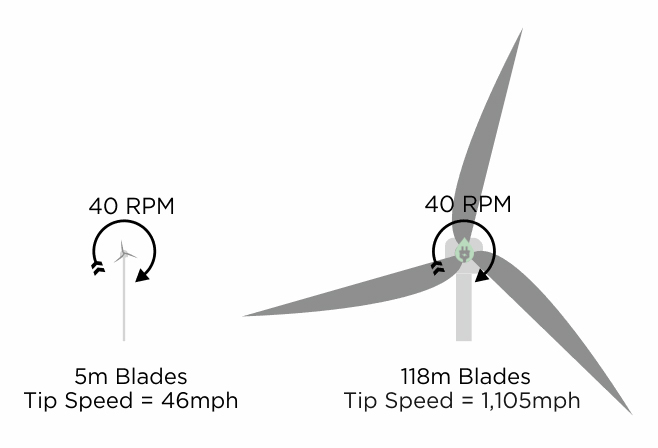
We call this the "tip speed," and it's where the real action happens. These blade tips can reach speeds of anywhere from 100 to 200 miles per hour (around 160-320 km/h)! Yes, you heard that correctly. That’s faster than most cars are allowed to go on the highway, and certainly faster than your average cheetah. It's like the turbine is a giant, graceful athlete, where the body moves slowly, but the outstretched hand delivering the high-five is lightning fast.
Why the Slowness (and the Sneaky Speed)?
Why this seemingly contradictory design? It all comes down to efficiency and safety.
Efficiency First, Always!
Wind turbines aren't trying to win a drag race; they're trying to win the energy-harvesting race. They're designed to capture as much energy from the wind as possible. Spinning too fast would create excessive drag and turbulence, actually making them less efficient at turning wind into electricity. Think of it like trying to catch raindrops with a net – if you wave it too frantically, you'll miss more than you catch. A steady, deliberate sweep works best.
Safety Third... Kidding, Safety is Paramount!
Imagine a blade the size of a school bus flying off because it was spinning too fast. No thank you! Engineers have to balance power generation with the structural integrity of these massive machines. High RPMs at the hub would put immense stress on the entire structure, turning a marvel of engineering into a very expensive, very dangerous projectile. So, the slower hub speed is a critical safety feature, ensuring those blades stay exactly where they're supposed to be.
The Wind Dictates the Pace
Of course, the wind itself plays a huge role. On a calm, sleepy day, a wind turbine might barely nudge, or not spin at all. This is called the "cut-in speed," the minimum wind required for it to start generating power. It's like the turbine saying, "Is there enough coffee (wind) for me to bother getting out of bed?"

Conversely, if the wind gets too wild and starts howling like a banshee (the "cut-out speed"), the turbine will actually slow down and eventually stop spinning altogether, or feather its blades. This is another safety mechanism, preventing damage in extreme weather. It’s like the turbine saying, "Okay, this is getting a bit much. Time for a tactical retreat."
So, What's the Takeaway?
Next time you spot one of these gentle giants, remember: while the hub might look like it's taking a meditative pause, the tips of those enormous blades are actually zipping along at highway speeds, silently and efficiently converting the invisible breath of the wind into the power that lights our homes and charges our phones.
They might not be show-offs, but they're incredibly effective at what they do. So give them a nod – they’re proof that sometimes, the slow and steady approach really does win the race. They're the elegant ballerinas of the energy world, gracefully performing their powerful dance, one slow rotation at a time.