
How Does A Central Air Conditioning Unit Work
:max_bytes(150000):strip_icc()/what-are-central-air-conditioners-1152645_V2-390c6f1f6ca14b4ebc59426f226a78a8.png)
Ever walk into your house on a sweltering summer day and feel that glorious blast of cool air? That's your central air conditioning unit working its magic! But have you ever wondered how that icy breeze comes to be? Buckle up, because we're about to dive into the surprisingly simple (and totally fascinating!) world of central AC.
Think of your central AC as a super-powered, house-sized refrigerator. Instead of just cooling down your milk and leftovers, it cools down your entire home. The basic idea is the same: move heat from one place to another.
The Dynamic Duo: Inside and Out
Your central AC system has two main parts: the evaporator coil (usually inside your house, often as part of your furnace or air handler) and the condenser unit (that big, noisy box outside your house). They work together like Batman and Robin, but instead of fighting crime, they're fighting heat!
Must Read
The evaporator coil is where the cooling magic really begins. It's filled with a special chemical called a refrigerant, which is like the superhero of cooling. This refrigerant is super-cold and ready to absorb any heat it can find.
Meanwhile, the condenser unit outside is responsible for releasing all that heat the refrigerant picked up. Think of it as the "heat dump" of your AC system. It's gotta get rid of all that hot stuff so your house can stay nice and chilly.
Round and Round It Goes: The Refrigerant Cycle
The whole process revolves around the refrigerant and its amazing ability to change states – from liquid to gas and back again. This phase-changing is key to moving heat efficiently. It's like a chameleon, but instead of changing colors, it changes temperature.
First, the refrigerant, in its liquid form, enters the evaporator coil. As warm air from your house blows across the coil, the liquid refrigerant absorbs the heat and turns into a gas. This is where the air in your house starts to cool down.
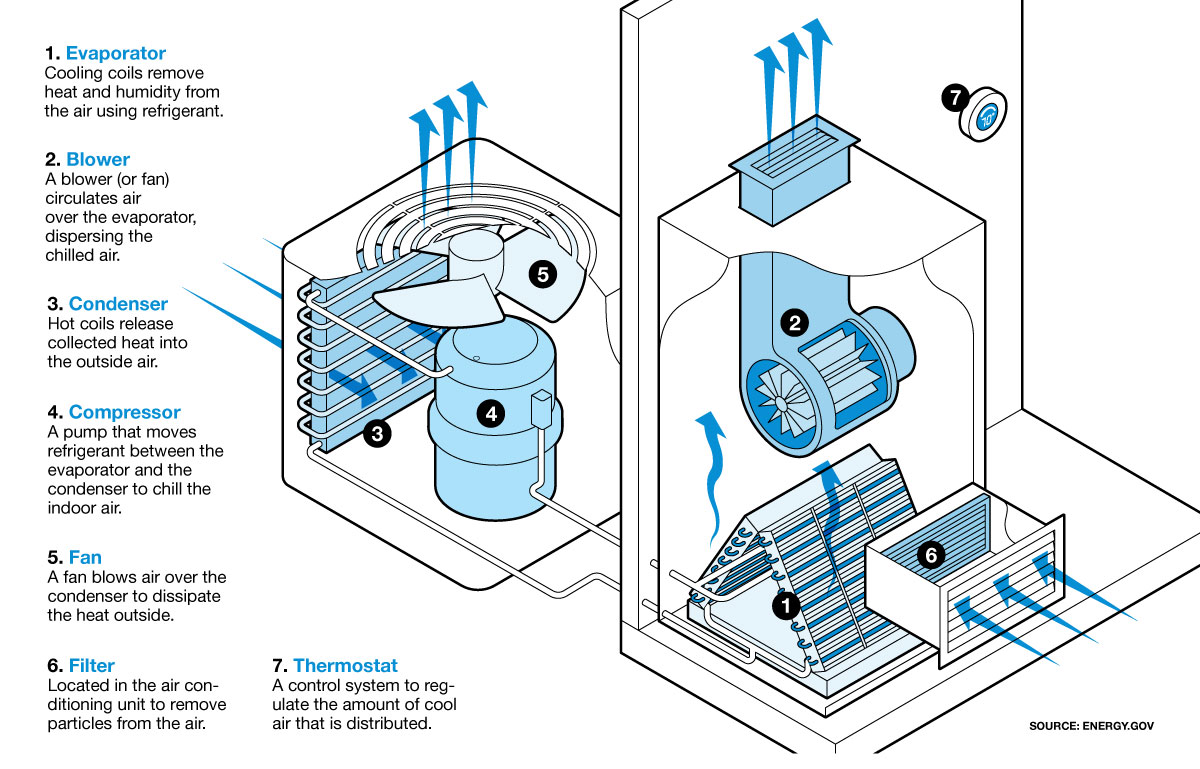
Now, the gaseous refrigerant, full of the heat it just stole from your living room, heads outside to the condenser unit. The condenser compresses the gas, which further increases its temperature.
This super-heated gas then flows through the condenser coil, where a fan blows air across it. The refrigerant releases its heat into the outside air and turns back into a liquid. This is why the air coming off your condenser unit feels so hot – it's all the heat from your house being expelled!
Finally, the liquid refrigerant travels back inside to the evaporator coil, ready to start the cycle all over again. It's a never-ending loop of heat transfer, keeping your home cool and comfortable.
The Supporting Cast: Blower and Thermostat
Of course, our dynamic duo needs some help! That's where the blower fan and the thermostat come in.
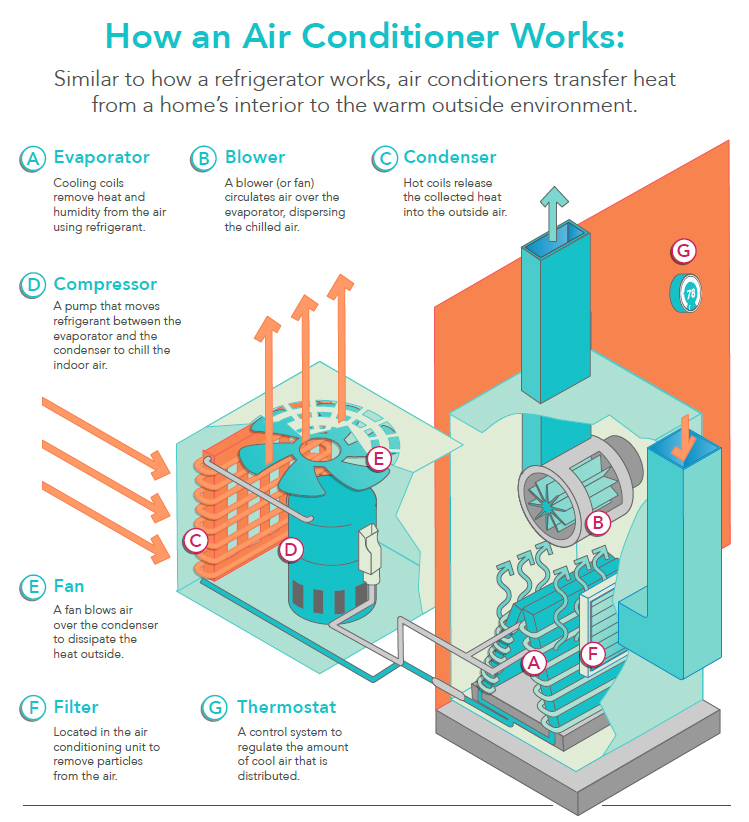
The blower fan, usually part of your furnace or air handler, is responsible for circulating air throughout your house. It sucks in warm air, blows it across the cold evaporator coil, and then sends the now-cool air through your ductwork and out into your rooms.
The thermostat is the brains of the operation. It monitors the temperature in your house and tells the AC unit when to turn on and off. It's like the AC's personal assistant, making sure everything runs smoothly.
Let's Break It Down Even Further
Imagine you're making a giant iced tea. The refrigerant is like the ice, absorbing the heat from the tea (your house). The evaporator coil is the glass holding the tea and ice.
The condenser unit is like taking the warm water (melted ice) outside and pouring it into a hot pavement. The hot pavement is the fan which evaporates water. The fan and the pavement help to evaporate and disperse the water into surrounding, in turn removing the heat.
The blower fan is like stirring the tea, making sure the ice is evenly distributed and the cooling effect is felt throughout the entire drink (your house). And the thermostat is like you, deciding when the tea is too warm and adding more ice.

Keeping It Cool (and Efficient!)
Now that you know how your central AC works, you can appreciate it even more on those hot summer days. But remember, even superheroes need a little TLC!
Regular maintenance, like changing your air filter, can keep your AC running efficiently and prevent costly repairs. It's like giving Batman a fresh set of batarangs – keeps him sharp and ready for action!
Also, consider upgrading to a more energy-efficient model when it's time to replace your old unit. Think of it as giving Robin a super-powered suit – it will save you money on your energy bills and reduce your environmental impact.
So next time you feel that glorious blast of cool air, take a moment to appreciate the complex yet elegant system that's keeping you comfortable. Your central AC is a true marvel of modern technology!

And remember, a well-maintained AC is a happy AC, and a happy AC means a happy (and cool!) you.
Stay cool, my friends!
"Central air conditioning: the ultimate weapon against summer's scorching wrath." - Some Cool Person
Understanding the core components - evaporator coil, condenser unit, and refrigerant - helps you appreciate the engineering marvel that keeps you comfortable.
Don't forget the importance of the blower fan and thermostat in circulating air and controlling the cooling process. They are crucial for optimal performance.
Regular maintenance is key to ensuring your AC runs efficiently and avoids costly breakdowns. A clean filter is a happy filter!