
How Do You Test Mineral Hardness

Ever picked up a particularly sparkly rock or an intriguing pebble and wondered, "What secrets do you hold?" It's a feeling as old as time, a primal curiosity that makes us all amateur geologists at heart. We admire their colors, their shapes, their unique textures, but there's a deeper mystery often hidden in plain sight: how tough are they?
Unraveling this mystery doesn't require a high-tech laboratory or a fancy microscope. In fact, the simplest, most wonderfully hands-on method for understanding a mineral's fortitude is something you might already do without thinking: you give it a friendly little scratch! It's like a tiny, gentle wrestling match between two titans of the earth.
The Scratch Test: A Mineral's First Interview
At its core, testing a mineral's hardness is all about seeing what can scratch what. Think of it like a game of "who's tougher?" If one mineral can leave a lasting mark on another, the scratcher is clearly the harder of the two. It's an intuitive concept, yet profoundly powerful in mineral identification.
Must Read
This delightful method brings out the inner detective in all of us. You become a Sherlock Holmes of the geological world, using common household items as your trusty tools to uncover hidden strengths and surprising weaknesses. It's a playful quest for understanding, one scratch at a time.
Meet Friedrich Mohs and His Wonderful Scale
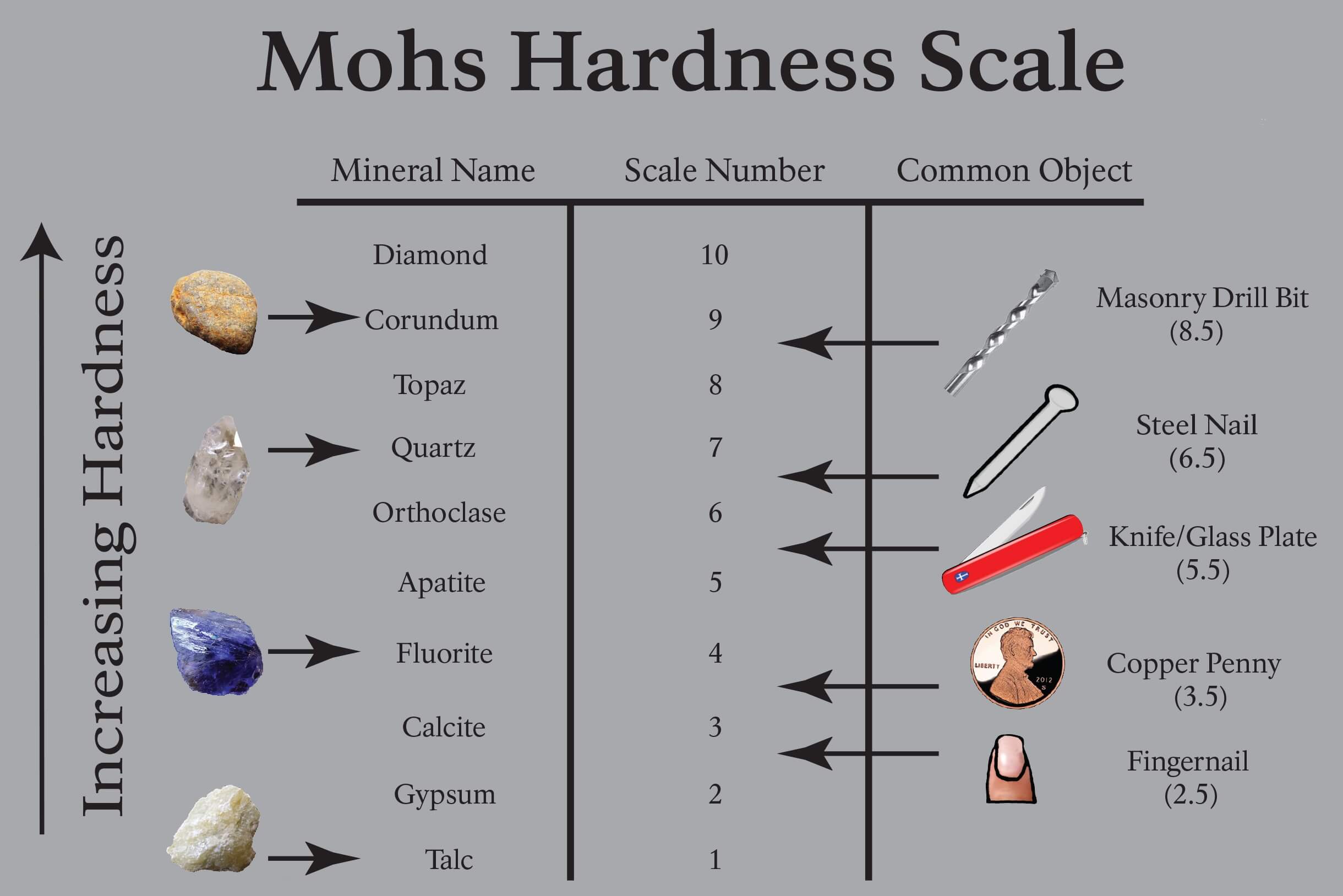
Long ago, a brilliant German geologist named Friedrich Mohs cooked up a fantastic little system to standardize this scratch test. He didn't invent scratching, but he gave us an easy-to-understand scale that helps us compare minerals. This system, affectionately known as the Mohs hardness scale, isn't about how easily a mineral breaks, but purely about its resistance to being scratched.
The Mohs scale has ten minerals, ranging from the softest to the hardest, each with a numerical value from 1 to 10. It’s like a ladder, where each rung can scratch the ones below it but not the ones above. It’s wonderfully simple and surprisingly effective, turning rock identification into a fun, relatable challenge.
"The Mohs scale is less about absolute measurements and more about relative strength. It's about knowing who can push whom around in the mineral world!"
Level 1: Talc – The Gentle Whisper
Imagine a mineral so incredibly soft, it feels like powdered sugar or a baby's cheek. That's talc, number one on our scale, and it’s the mineral equivalent of a fluffy cloud. Your fingernail sails right through it, leaving a noticeable mark without even trying. It almost apologizes in its yielding nature, a true softie of the earth.
This is why talcum powder feels so silky smooth; it's made from this very soft mineral. It’s a wonderful starting point for the scale, showing just how delicate some minerals can be. You can practically dent it with a kind thought!
Level 2: Gypsum – Your Fingernail's Foe
Next up is gypsum, a bit sturdier than talc, but still a gentle giant. This is where your own trusty fingernail truly shines as a testing tool. With a firm, deliberate press, you can leave a tiny groove on gypsum. It feels like a small, satisfying victory, proving your digit's surprising strength against the mineral kingdom.

Think of the satisfying crunch you get when breaking a piece of plasterboard, which is often made of gypsum. It's not super tough, but it puts up enough of a fight to acknowledge your strength. Your fingernail, a common tool indeed, reveals its humble power here.
Level 3: Calcite – The Penny's Partner
Now things get a little more interesting! Enter calcite, a common mineral with a respectable number three hardness. For this, you might need a charming old copper penny. Remember those? A gentle scrape with its edge, and if it leaves a mark on your mystery stone, you've likely found calcite. It’s like a tiny historical detective at work, using a piece of everyday history to solve a geological puzzle.
Calcite is a common component of many rocks, including limestone and marble. So, if your penny scratches it, you're getting a good idea of what you might be holding. It’s a wonderful example of how simple, everyday objects can unlock big secrets.
Level 4: Fluorite – Glass Wants a Word
Climbing the ladder, we meet fluorite. To test this one, you might look around for something a little sharper than a penny: a piece of ordinary window glass. Fluorite itself won't scratch the glass, but a good piece of glass will happily scratch fluorite. There’s a delicate dance here, a moment of suspense as you see which one gives way under pressure.
It’s a turning point where minerals start to get noticeably tougher than our fingernails and pennies. You need a bit more oomph, a bit more grit, to leave a mark. This mineral often comes in beautiful, vibrant colors, adding to its mystique.
Level 5: Apatite – The Knife's Edge
Halfway there! Apatite holds the number five spot, making it a real contender. For this mineral, you often reach for a simple steel knife blade or a strong iron nail. If your mineral can be scratched by the blade but can easily scratch glass, you're likely in apatite territory. It's a satisfying middle ground, a true trooper in the mineral world.
Testing apatite with a knife feels a bit like a secret agent mission, using a common item for an uncommon purpose. The distinct 'ping' or the clear scratch left by the blade gives a real sense of accomplishment. It's robust enough to make you work for it!
Level 6: Orthoclase – The Steel File's Foe
At number six, we have orthoclase, a mineral that truly puts up a serious fight. Your ordinary knife blade will likely bounce right off this one, leaving no mark. To truly test orthoclase, you'll need something tougher: a good, hardened steel file. It’s when you realize your kitchen utensils aren't quite up to the task that the true challenge begins.
This is where minerals start showing their incredible resilience. Orthoclase is a common mineral in many igneous rocks like granite, so understanding its hardness helps you grasp the strength of entire mountains! It's a tough nut to crack, literally.
Level 7: Quartz – The Ubiquitous Powerhouse
Ah, quartz! This ubiquitous mineral is a true powerhouse, sitting proudly at number seven on the Mohs scale. If your mystery rock can scratch that steel file – and definitely scratches glass with ease – you're probably holding quartz. It's the very sand on our beaches, the crystals in our clocks, and a mighty scratcher indeed.
Finding a mineral harder than quartz is a significant discovery. It feels like you've unlocked a secret superpower of the earth, as quartz is so common yet so enduring. It's a mineral that truly earns its respect, standing firm against most daily abrasion.
Level 8: Topaz – Gemstone Toughie
Moving into true gemstone territory, topaz sits proudly at number eight. This is where your everyday tools start to fail dramatically; nothing you typically have lying around the house will scratch it. You’d need a known piece of quartz to try and scratch your specimen. If your mystery stone can scratch quartz, you know you're dealing with something significantly tougher.
This leap in hardness feels almost regal, a whisper of royalty in the mineral world. Topaz is a beautiful gem, and its toughness contributes to its enduring sparkle. It's a mineral that truly stands out from the crowd.

Level 9: Corundum – Sapphire and Ruby's Strength
Just before the king, we have corundum, famous for being the mineral name for sapphire and ruby. This mineral is incredibly hard, possessing a remarkable resilience. Only something as tough as another piece of corundum or the ultimate champion, a diamond, will leave a mark. Imagine the sheer stubbornness!
It’s an unyielding force, a testament to nature's incredible engineering. Rubies and sapphires owe their enduring beauty and resistance to wear to this extreme hardness. This is truly where minerals become nearly impervious.
Level 10: Diamond – The Ultimate Champion
And finally, the reigning champion, the undisputed heavyweight: diamond at number ten. Nothing, absolutely nothing, except another diamond, can scratch it. It's the ultimate show-off, the mineral equivalent of a superhero with an impenetrable shield. Holding a diamond, you feel its invincible, singular spirit.
This peerless hardness is why diamonds are used in cutting tools and abrasives, not just dazzling jewelry. It’s the grand finale of the Mohs scale, reminding us of the astounding variety and strength found within the Earth itself.
The Art of the Scratch: Tips for Your Inner Geologist
So, how do you actually do this delightful little dance of discovery? First, find a fresh, clean surface on your mineral. No dusty edges, weathered bits, or rough patches. You want a true representation of its inner strength.
Hold your mineral steady, and with a test tool—say, your fingernail for starters—press gently but firmly against its surface. Apply consistent pressure as you slide the test tool across, making sure you’re trying to make a permanent groove.

Then, here’s the crucial step: wipe away any powder that might appear. Did your tool leave a definite, permanent groove that you can feel with your fingernail? Or did it simply leave a powdery streak that wipes right off? That distinction is key! If it wipes off, the test tool was simply crushed by the harder mineral; it didn't scratch it.
The Joy of Discovery: More Than Just a Scratch
There's a wonderful, almost childlike joy in this process. Each scratch, or lack thereof, tells a story, revealing a small piece of the Earth's autobiography. It's like being a detective, gathering clues with the simplest of instruments, solving a tiny puzzle with your bare hands and a few pocket treasures.
You might find yourself giggling when a tough-looking rock turns out to be a softie, easily scratched by a penny. Or you might let out a small cheer when a humble pebble stands its ground against a steel nail, revealing an unexpected inner strength. It's surprising how much personality minerals seem to gain when you test their mettle!
Remember those rock collections from childhood? The ones filled with shiny bits and curious shapes, each one a mystery waiting to be solved? Testing mineral hardness brings that innocent wonder right back. It's a heartwarming reminder that some of the greatest scientific insights can come from observations as basic as "Does this scratch that?"
No fancy equipment, just curiosity, observation, and a few everyday items. It teaches us that true understanding often comes from direct, hands-on interaction with the world around us. It's accessible, empowering, and utterly delightful.
Your Next Rock Adventure Awaits!
So next time you stumble upon a captivating stone, don't just admire its sparkle or guess at its identity. Grab your fingernail, a penny, an old knife, or even a piece of scrap glass. You're not just testing a rock; you're engaging in a charming, age-old conversation with the Earth.
You're unraveling its secrets, one playful scratch at a time, and connecting with a tradition that spans centuries. Who knew that being a geologist could be so wonderfully hands-on, utterly delightful, and bring back so much childhood wonder?