
How Do You Know The Charge Of A Transition Metal

Okay, so you're staring at a chemical formula, right? Something with a transition metal lurking in there, all mysterious and… well, transitional. And you're thinking, "Ugh, how do I figure out its darn charge?" Don't worry, we've all been there. It's not as scary as it looks, promise!
Think of it like this: the compound is a chill party. Everyone needs to balance out. No one wants to be the awkward, unbalanced guest, right? We need the positives and negatives to cancel each other out.
Cracking the Code: Using Anions Like a Pro
First things first: you need to know your anions. Anions are the negatively charged ions, and they're usually the key to unlocking the transition metal's secret. Luckily, a lot of them are super common. We’re talking about the cool kids of the periodic table.
Must Read
Let's play a quick "Name That Anion!" game. Ready?
- Chloride (Cl⁻): -1 charge. Super popular. Think table salt (NaCl).
- Oxide (O²⁻): -2 charge. Loves to bond with metals, making rust, for example!
- Sulfide (S²⁻): -2 charge. Smells like rotten eggs... avoid that party!
- Nitride (N³⁻): -3 charge. A bit less common, but still shows up.
Memorize those. Seriously. They'll be your best friends. (Maybe not sulfide, unless you really like rotten eggs.) There are others, of course (hydroxide (OH⁻), sulfate (SO₄²⁻), phosphate (PO₄³⁻)), but you can always look them up, can’t you?
The Balancing Act: It's All About Zero
Now, the magic happens! Remember that chill party analogy? The total charge of the compound has to be zero. So, all the positive charges (from the transition metal – our mystery guest!) must equal all the negative charges (from the anions – the reliable regulars).
Let's do an example. Say we have copper(something) oxide: CuO. We know oxide has a -2 charge (O²⁻). Since there's only one oxide ion, the total negative charge is -2. What does that mean for copper? (Cue dramatic music!).

It means the copper must have a +2 charge (Cu²⁺) to balance it out! Ta-da! We just solved the mystery! See? Not so scary.
What if we have something a little more complicated? Like Iron(something) Oxide: Fe₂O₃. We still know oxide is -2 (O²⁻). But this time we have three of them! That's a total negative charge of -6 (3 * -2 = -6).
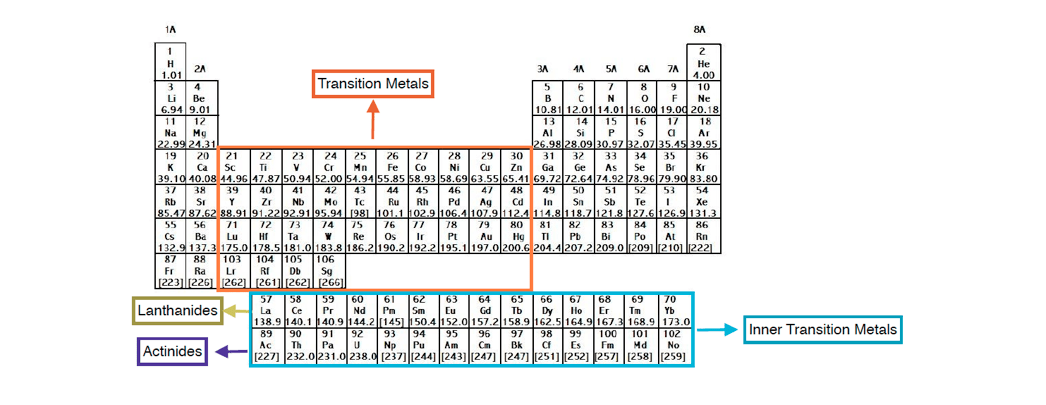
Now, we have two iron ions (Fe). To balance out the -6, the two iron ions together must have a +6 charge. So, each individual iron ion has a +3 charge (Fe³⁺). Simple division, people! We're basically math wizards now.
Roman Numerals: A Metal's Way of Bragging (Sort Of)
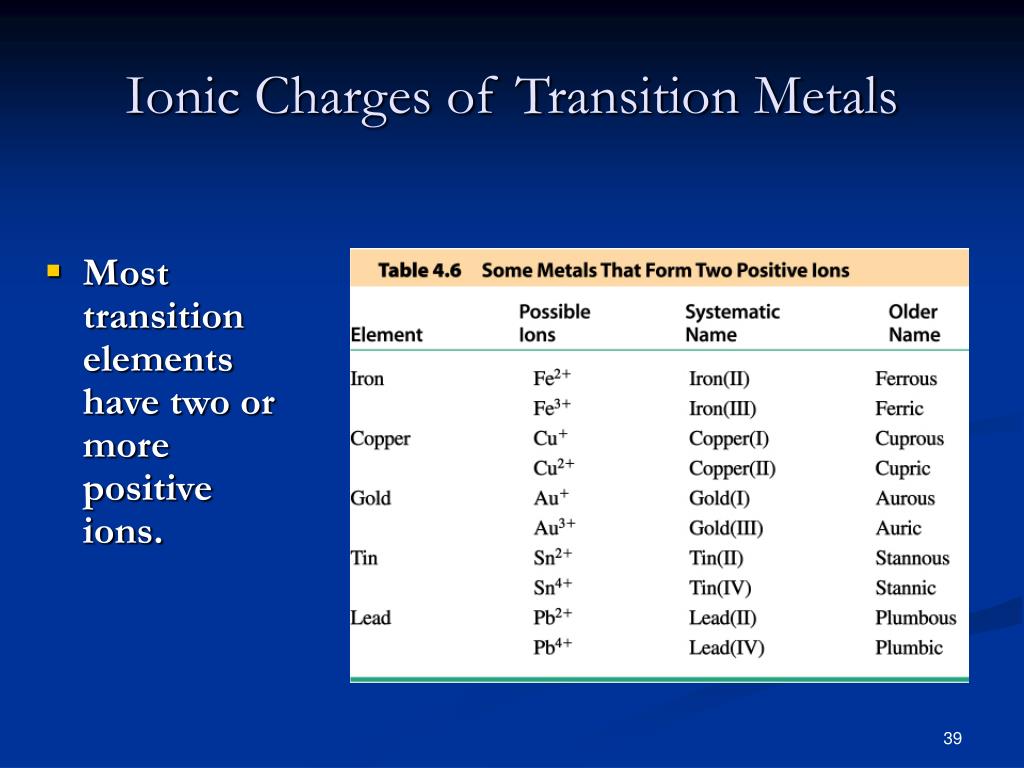
You'll often see transition metals with Roman numerals in their names. Iron(III) oxide, for example. Those Roman numerals are exactly the charge of the metal. So, Iron(III) means the iron ion has a +3 charge. It's like a little badge of honor (or a way to avoid confusion, more likely).

A Few Caveats (Because Chemistry Isn't Always Simple)
Okay, a couple of things to keep in mind. Some transition metals always have the same charge. Zinc (Zn²⁺) and Silver (Ag⁺) are good examples. They're like the predictable people at the party. Always bring the same dish, always tell the same stories.
Also, some compounds are more complex, with polyatomic ions and brackets and subscripts galore. Don't panic! Just break it down piece by piece. Figure out the charge of each component, and then balance everything out. You got this!
So, there you have it! Unlocking the secrets of transition metal charges. Now go forth and confidently tackle those chemical formulas! You're practically a chemist now... almost. Maybe grab another cup of coffee first.