
How Do You Find The Sum Of A Series
Ever feel like life's just one long series of… well, stuff? Bills, errands, streaming queues, that never-ending to-do list. Sometimes it feels like we're just adding it all up, one day at a time. But what if you could find a shortcut, a formula to understand the bigger picture? Turns out, you can, at least when it comes to numbers. Let's dive into the surprisingly cool world of series and how to find their sum!
What Exactly is a Series, Anyway?
Think of a series as a queue of numbers patiently waiting to be added together. Each number is a term, and the way these terms are generated can follow a pattern, or not (but we're focusing on the patterns today!). For instance, 1 + 2 + 3 + 4... is a simple series, and so is 2 + 4 + 6 + 8.... See the pattern? We're adding consecutive integers and consecutive even integers, respectively. These are arithmetic series.
Then, we have geometric series. These are sequences where each term is multiplied by a constant value. Imagine: 1 + 2 + 4 + 8... Each number is being doubled. Geometric series are all over the place, from compound interest calculations to the spread of viral videos (hopefully the informative kind!).
Must Read
The Magic Formulas (Don't Panic!)
Okay, okay, formulas. Don't let that word scare you. These are our shortcuts, our cheat codes to summing things up quickly. Let's look at a couple:
Arithmetic Series: To find the sum (S) of an arithmetic series, we use the formula: S = n/2 * [2a + (n - 1)d], where n = number of terms, a = the first term, and d = the common difference (the amount each term increases by).
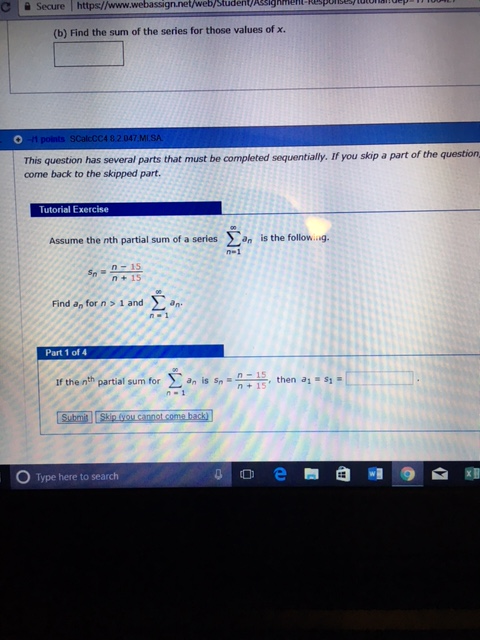
Let’s say we want to sum the first 10 natural numbers (1 + 2 + 3 + ... + 10). Here, a = 1, d = 1, and n = 10. Plugging those values in: S = 10/2 * [2(1) + (10 - 1)1] = 5 * [2 + 9] = 5 * 11 = 55. Boom! Easy peasy.
Geometric Series: For a geometric series, the formula is S = a(1 - r^n) / (1 - r), where a = the first term, r = the common ratio (the number each term is multiplied by), and n = the number of terms.
Consider the series: 2 + 6 + 18 + 54 (n=4). Here a = 2 and r = 3. Putting it together: S = 2(1 - 3^4) / (1 - 3) = 2(1 - 81) / (-2) = 2(-80) / (-2) = 80.
Pro Tip: Keep a cheat sheet handy! Even the greatest mathematicians rely on reference materials. Think of it as your digital "Cliff's Notes" for the series world.
Infinite Possibilities (and Sums!)
Here’s where things get a little mind-bending. Some series go on forever. Yes, infinitely. But surprisingly, some infinite series can still have a finite sum! This is where the concept of convergence comes into play. A convergent series "settles down" towards a specific value as you add more and more terms. Think of it like a hummingbird trying to reach a flower. It gets closer and closer but never quite touches it.

Example: The series 1/2 + 1/4 + 1/8 + 1/16 + … converges to 1. Cool, right?
Beyond the Textbook: Practical Applications
These aren't just abstract concepts. The math behind series is used everywhere! From calculating loan payments (thanks, geometric series!) to optimizing algorithms in computer science. Understanding series can even help you analyze trends in social media or predict the spread of a new meme (the ultimate modern series!).
For instance, consider compound interest. The future value of your investment is a sum of a geometric series! Each period, you earn interest on the previous period's balance, leading to exponential growth – exactly the behaviour you observe in geometric series.
Finding Your Sum
Learning how to find the sum of a series isn’t just about crunching numbers. It’s about understanding patterns, recognizing relationships, and appreciating the elegance of mathematics. It shows you how to take a big, seemingly endless list of items and boil it down to a single, meaningful value. Just like you can break down a complex problem into manageable steps and systematically solve for a definitive answer.
So, next time you're faced with a daunting task, remember the principles of series. Break it down, find the patterns, and don't be afraid to use a formula or two. You might just find the sum, the solution, is closer than you think. And who knows, maybe you'll even start seeing series everywhere – in the rhythm of your favorite song, the growth of your favorite plant, or even the ebb and flow of your own life. The world is a series of moments, after all. It's up to you to find the beauty in the sum.