
How Do You Find Amps From Watts
Ever find yourself staring at a charger, a light bulb, or maybe even a hefty appliance, and notice all those cryptic numbers? You know, the "watts," the "volts," and sometimes, if you're really looking, the "amps." It’s like a secret language of electricity, right? And while it might seem like something only engineers care about, understanding just a little bit of it can actually be pretty cool – and even useful! Today, we're going to demystify one of those head-scratchers: how do you figure out amps from watts?
Don't worry, we're not diving into advanced physics. Think of it more like learning to read a map to understand the hidden river of power flowing all around us. It’s less about complicated math and more about understanding what’s happening behind the scenes when you flick a switch.
Meet the Electric Crew: Watts, Amps, and Volts
Before we jump into the "how," let's quickly get acquainted with our main characters. Imagine electricity as a river, and these terms help us describe different aspects of that river.
Must Read
First up, Watts (W). This is probably the most familiar one. Watts tell you about the total power an electrical device uses or produces. Think of it as the device's "oomph" or how hard it's working. A big, bright floodlight uses a lot of watts, while a tiny LED night light uses very few. It's the overall strength or energy output. When you buy a light bulb, you're often thinking about its wattage – how much light power it puts out!
Next, we have Amps (A), short for amperes. This one describes the current – basically, how many electrons are flowing through the wire at any given moment. Going back to our river analogy, amps are like the volume of water flowing past a certain point per second. Is it a gentle trickle or a gushing torrent? That's what amps tell us. Too many amps flowing through a wire that's too thin can be a big problem, like trying to push a whole river through a tiny straw!
And finally, a quick mention of Volts (V). While not the star of our show today, volts are crucial. They represent the electrical pressure or "push" that makes the electrons move. In our river analogy, volts are like the steepness of the riverbed – the greater the drop, the faster and harder the water wants to flow. In most homes, your wall outlets have a fairly consistent voltage (like 120V in North America or 230V in many other parts of the world).
Why Should You Even Care? (Hint: It's Kinda Cool!)
Okay, so we have watts (power), amps (flow), and volts (pressure). Why does connecting these dots matter to you, a normal human who just wants their coffee maker to work?
Well, knowing how to find amps from watts is like having a superpower to understand your gadgets better. It’s not just about textbook knowledge; it's about real-world application. For instance:
- Safety First! Ever blown a fuse or tripped a circuit breaker? Understanding amps helps you avoid overloading circuits. You don't want to plug your high-wattage hair dryer, microwave, and toaster into the same extension cord if it can't handle the combined amps!
- Gadget Geekery: When you're buying a power bank, an extension cord, or even deciding which outlet to use for your new gadget, knowing the amperage can guide you to make smarter, safer choices.
- Energy Smart: Want to be more mindful of your energy consumption? Knowing the amps can give you a deeper appreciation for how much juice your devices are really pulling.
- DIY Confidence: Tackling a home improvement project? Understanding these basic electrical concepts can empower you and give you a better grasp of what your home's electrical system can handle.
It's about having a little more control and understanding in a world full of invisible energy!
The Grand Reveal: The Super Simple Formula!
Alright, drumroll please! Here's the cool part. These three buddies – watts, amps, and volts – aren't just random numbers. They're all connected by a wonderfully straightforward relationship, often called "Ohm's Law" (but let's keep it friendly, not scary).
The core idea is this:
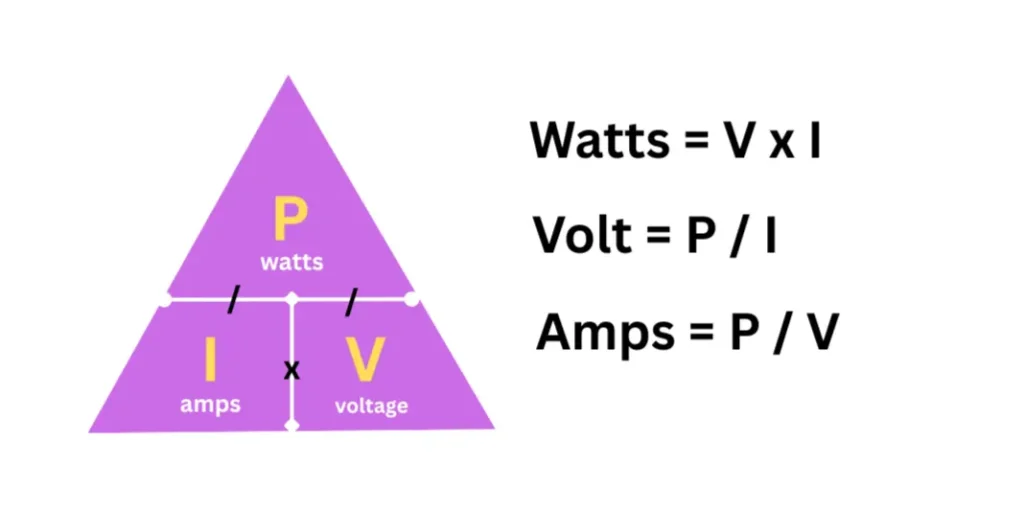
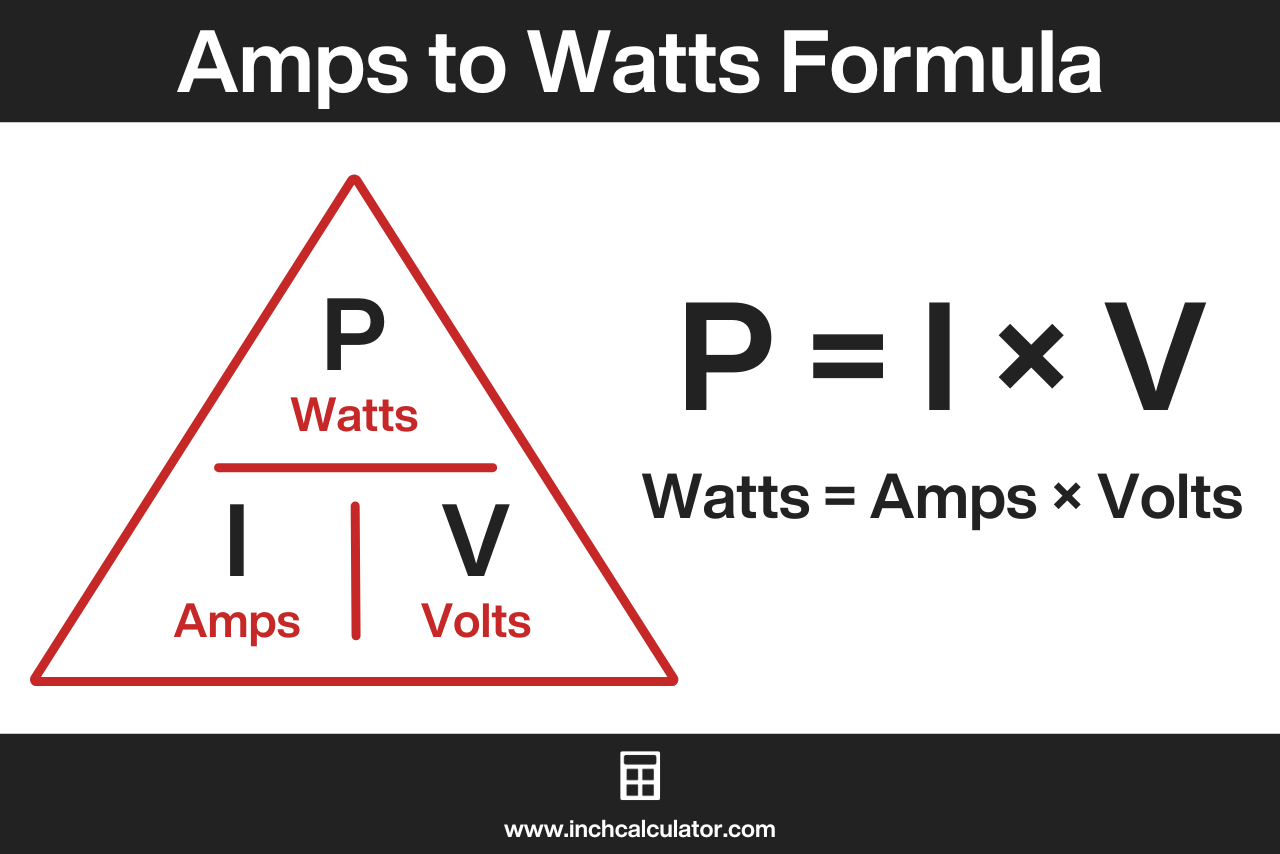
Watts = Amps × Volts
Or, in shorthand that makes electrical engineers smile: P = I × V (where P is power in Watts, I is current in Amps, and V is voltage in Volts).
See? Simple multiplication! It’s like saying: the total power of the river (watts) depends on how much water is flowing (amps) and how much pressure is pushing it (volts).

But we want to find amps from watts, right? So, we just do a little bit of algebraic magic (which is just rearranging the puzzle pieces):
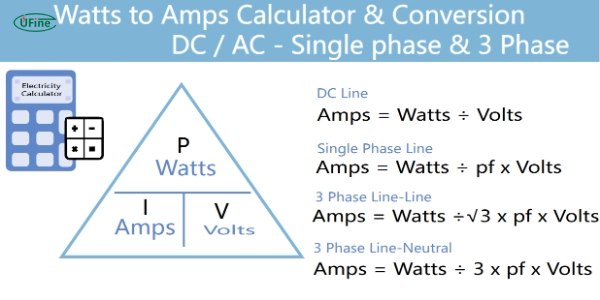
To find amps, you simply divide the watts by the volts:
Amps = Watts ÷ Volts
Or: I = P ÷ V
That's it! That's the secret sauce. You just need to know the power (watts) of your device and the voltage (volts) of your power source, and you can calculate the current (amps) it will draw.
Let's Play with Some Numbers!
Let's put this into practice with a couple of everyday examples. For most standard wall outlets in North America, we'll use 120 Volts.
Example 1: Your Trusty Microwave
Imagine your microwave is rated at 1200 Watts. This is a pretty common wattage for a powerful microwave.
- Watts (P) = 1200W
- Volts (V) = 120V (standard household outlet)
- Amps (I) = ?
Using our formula: Amps = Watts ÷ Volts
Amps = 1200W ÷ 120V
Amps = 10A
So, your microwave pulls about 10 amps. This is quite a lot! If your kitchen circuit is rated for 15 amps, plugging in a 10-amp microwave means you only have 5 amps left before you risk tripping the breaker if you add another high-power appliance.
Example 2: A Bright LED Light Bulb
Now, let's look at something more efficient, like a modern LED light bulb that provides plenty of light but only uses 10 Watts.

- Watts (P) = 10W
- Volts (V) = 120V
- Amps (I) = ?
Using our formula: Amps = Watts ÷ Volts
Amps = 10W ÷ 120V
Amps ≈ 0.083A
Wow! See the difference? A light bulb barely sips electricity compared to a microwave. You could plug in dozens of these LED bulbs before you'd even come close to the amperage of a single microwave!
The Takeaway: You're Electrically Savvy Now!
Isn't that neat? With just a tiny bit of curiosity and one simple division, you've unlocked a deeper understanding of the electrical world around you. You can now look at a device's wattage and, with a quick mental calculation, get a sense of how much "juice" it’s really drawing.
This knowledge can help you make smarter decisions about how you power your home, keep your electronics safe, and maybe even impress your friends at your next gathering. So go ahead, peek at the labels on your appliances. You now have a secret decoder ring to understand a little more about the amazing invisible forces that make our modern lives possible. Stay curious!