
How Do You Convert Kw To Amps
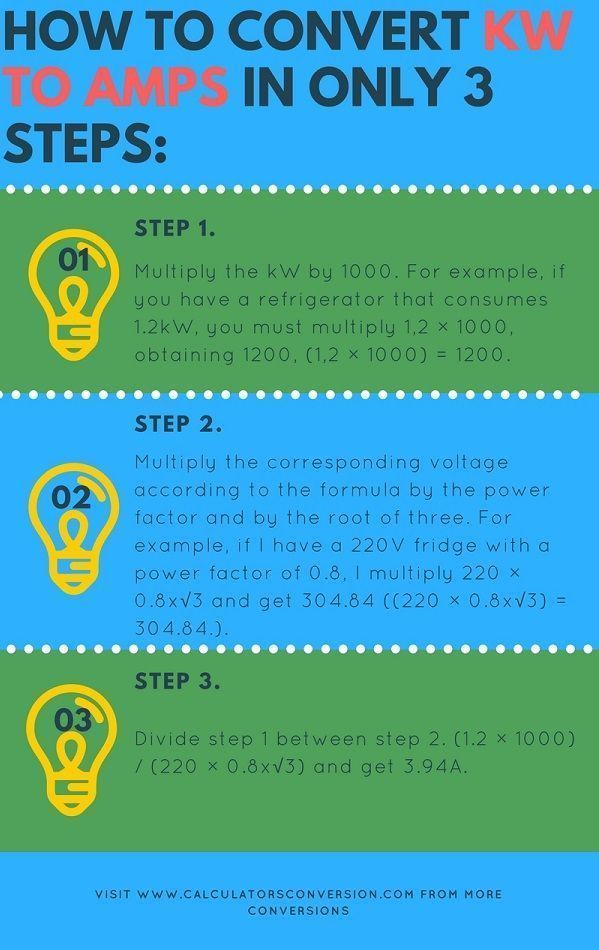
Ever gazed at the back of an appliance or a generator and seen those mysterious letters and numbers – kW, Amps, Volts – and felt a tiny pang of "Huh?" Maybe a little voice whispered, "Wish I understood what all that meant!" Well, guess what? You're about to unlock a super cool secret that isn't just for electricians. It's for you, the everyday superhero who just wants to power their life with a bit more confidence and a lot more fun!
Understanding how to convert kilowatts (kW) to amps (A) might sound like something out of a science textbook, but trust me, it’s like learning a secret handshake for the electrical world. It empowers you to be smarter about everything from plugging in your toaster to setting up an epic outdoor movie night. Isn't that exciting?
Why Bother with Watts, Amps, and Volts? (The Fun Part!)
Think about it. You're planning a fantastic camping trip, and you want to bring a small heater for chilly nights, or maybe run a coffee maker from your portable power station. How do you know if your power station can handle it without tripping a breaker or, worse, running out of juice too quickly? Or perhaps you're eyeing a new kitchen gadget, and you want to make sure your circuit won't protest with an angry pop and darkness.
Must Read
This isn't just about safety (though that's a huge bonus!); it's about empowerment. It’s about being able to look at a generator's rating, then at your power tools, and confidently say, "Yep, this will work!" without needing to call an expert. It’s about taking control of the invisible energy that powers our modern lives. Suddenly, electrical specifications aren't intimidating squiggles but helpful clues!
The Dynamic Trio: Power, Current, and Voltage
Before we dive into the conversion magic, let's quickly introduce our stars:
- Kilowatts (kW): This is our measure of power. Think of it as the appliance's appetite – how much "oomph" it needs to do its job. One kilowatt is 1,000 watts. When you see "1.5 kW," that's 1,500 watts.
- Amps (A): This is our measure of current. Imagine electricity flowing like water in a pipe. Amps tell you the volume of water flowing through that pipe at any given moment. A higher amp draw means more "water" is needed.
- Volts (V): This is our measure of voltage. Staying with our water analogy, volts are like the pressure pushing the water through the pipe. In most homes in North America, you'll encounter 120 volts (V) for standard outlets and 240V for larger appliances like dryers or ovens. Other regions might use 230V or 240V as their standard.
These three aren't independent; they're in a beautiful, mathematical relationship! The key formula we're looking for connects them all. Ready for it?
The "Aha!" Formula: Amps from Watts and Volts
Here’s the simple, elegant secret:
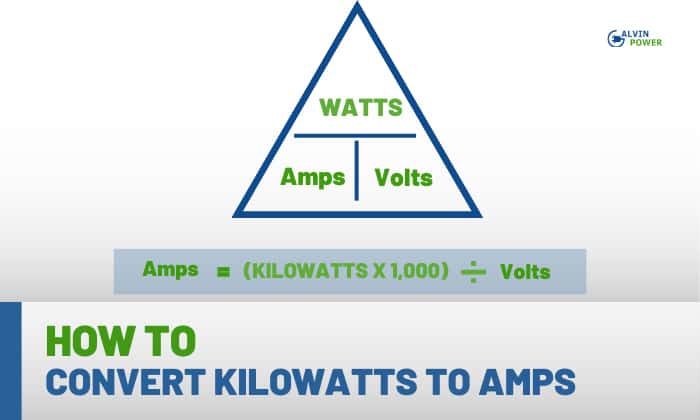
Amps = Watts / Volts
That's it! No complex calculus, no ancient incantations. Just division! But wait, we usually start with kilowatts, not watts. No sweat, that's the easiest part:
Watts = Kilowatts (kW) x 1000
So, our full superhero formula becomes:
Amps = (Kilowatts x 1000) / Volts
Isn't that neat? You're practically an electrical engineer already!
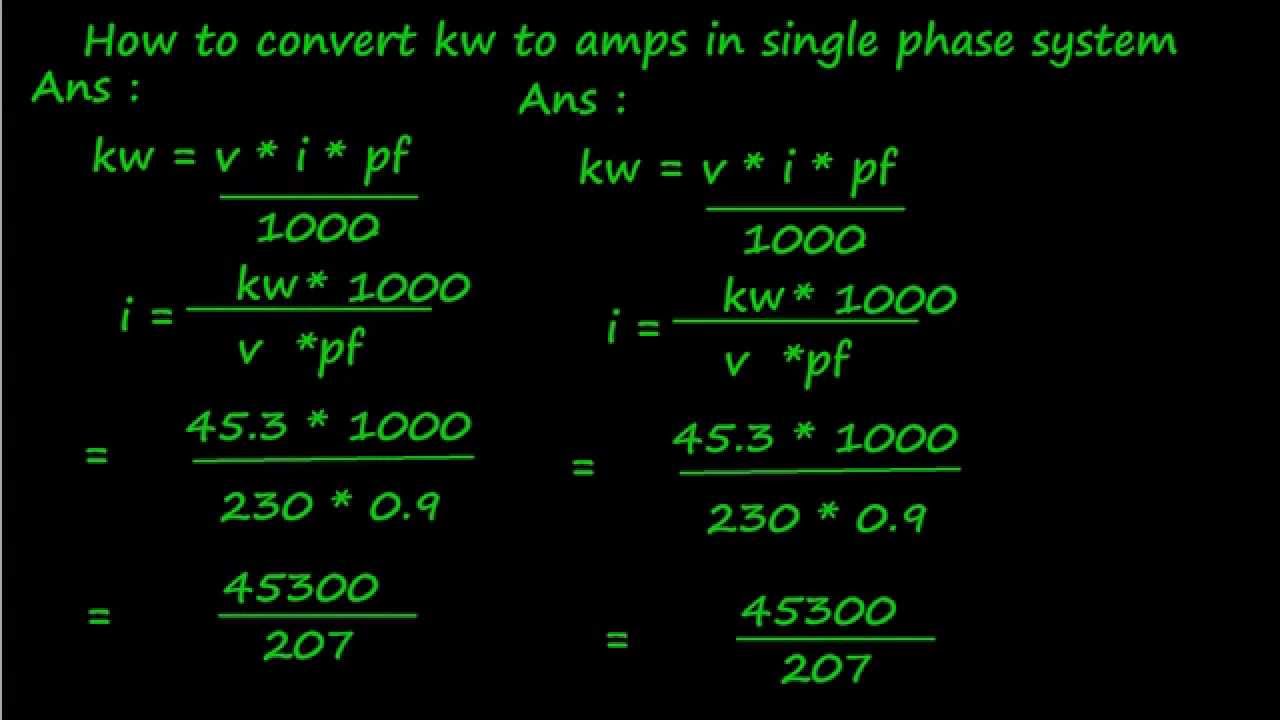
Let's Do an Example (It's Easier Than You Think!)
Imagine you have a powerful space heater that draws 1.5 kW, and you're plugging it into a standard home outlet, which is typically 120 Volts.
Step 1: Convert kilowatts to watts.
1.5 kW x 1000 = 1500 Watts
Step 2: Apply the Amps formula.
Amps = Watts / Volts
Amps = 1500 / 120
Amps = 12.5 A
So, your 1.5 kW space heater on a 120V circuit will draw 12.5 Amps. Now you can check if your circuit breaker (usually 15A or 20A for standard outlets) can handle that without tripping. If you plug in a few other things on the same circuit, you might quickly exceed its capacity. This knowledge helps you avoid those inconvenient power outages!
What if you were running that same heater from a portable generator that outputs 240 Volts (common for larger equipment)?
Amps = 1500 Watts / 240 Volts

Amps = 6.25 A
See? The higher voltage means lower amperage for the same amount of power. This is why power lines carry electricity at super high voltages – to minimize current and therefore energy loss over long distances!
Beyond the Numbers: The Empowerment
This simple conversion isn't just about math; it's about understanding the hidden flow of energy that shapes your world. It means you can:
- Plan better: Know what appliances you can safely run on your generator during a blackout, or which tools your workshop circuit can handle.
- Make informed decisions: When buying a new appliance, you'll understand why a high-wattage item might need a dedicated circuit.
- Spark curiosity: Once you understand this, you might start wondering about other things – how solar panels work, the magic of batteries, or even the grand scale of the power grid!
This is just the beginning of your journey into the wonderfully practical world of electricity. With this simple formula, you've gained a superpower – the ability to decode the electrical language all around you.
So, go forth! Look at the labels on your devices with new eyes, calculate the amps for your blender, or figure out what size inverter you need for your next adventure. The world of watts, amps, and volts is no longer a mystery but a playground of possibility. You've got this, and a little bit of knowledge truly makes life more interesting, more efficient, and undeniably, more fun!