
How Do I Convert Kva To Amps

Ever found yourself staring at a generator, a piece of industrial equipment, or even just a hefty appliance, and seen "KVA" splashed across it? Maybe you’ve even muttered, "What on earth does KVA mean, and how does it relate to the good old 'Amps' I keep tripping my circuit breaker with?"
Well, my friend, you're not alone! It sounds like a secret handshake among electricians, but understanding how to convert KVA to Amps is actually super handy. Think of it as learning the secret code that unlocks a whole new level of understanding your power, whether it's for your home, your workshop, or your next epic camping trip.
So, What's KVA Anyway? (The Big Picture Power)
Let's start with KVA. It stands for Kilo-Volt-Amperes. Sounds fancy, right? But just think of it as the total potential power a system has. Imagine you have a giant water tank. The KVA is like the size of that tank – how much water it could hold if you filled it up. It tells you the maximum power output a system, like a generator or a transformer, is designed to deliver. It’s the "before-tax" or "gross" power, if you will, without getting bogged down in how efficiently it's actually being used.
Must Read
And Amps? (The Flowing Power)
Now, Amps (short for Amperes). These are probably more familiar. Amps measure the rate of flow of electricity. If KVA is the size of our water tank, then Amps are like the speed and volume of water actually gushing out of a pipe connected to that tank. When you plug in your toaster, your hair dryer, or your monstrous gaming PC, they all "draw" a certain number of Amps. Too many Amps for the circuit, and BAM! - goodbye lights, hello reset button.
Why Should You Even Care About Converting Them? (The Fun Part!)
This isn't just for electrical engineers in lab coats, I promise! Knowing how to convert KVA to Amps is like having a superpower for everyday situations:
-
Generator Genius: You're eyeing a shiny new generator for your RV or home backup. It's advertised as "7 KVA!" But can it run your fridge (which needs 5 Amps) and your microwave (10 Amps) and your air conditioner (15 Amps) all at once? Converting KVA to Amps will tell you if your generator is a humble workhorse or a power-hungry beast, helping you pick the right one without overspending or being underpowered. No more guessing games!
-
Appliance Alchemist: Ever wonder why some heavy-duty appliances need a special outlet? Understanding Amps helps you know if your existing wiring can handle that new industrial-strength espresso machine without causing a brownout or, worse, a mini-fire. (Okay, maybe not a fire, but definitely a tripped breaker and a frown.)
-
Home Helper: Planning a big workshop in your garage or installing a hot tub? Your main electrical panel has a certain Amperage capacity. Knowing the KVA of your new equipment and converting it helps you figure out if you need to call an electrician for an upgrade, or if your current setup can handle the sizzle. Nobody wants to blow a fuse mid-soak!
In short, it helps you make sure your power source and your power users are playing nicely together, keeping everything safe and running smoothly.
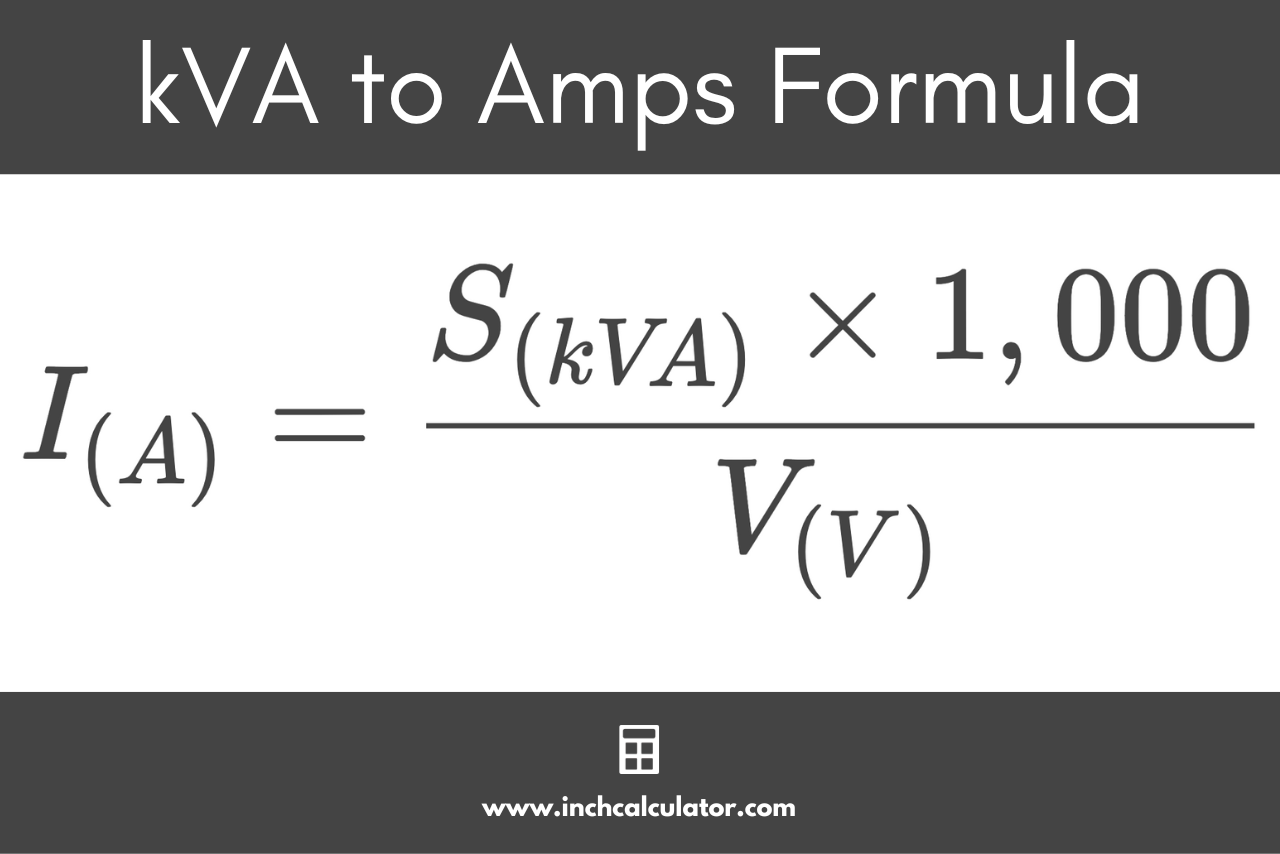
The (Surprisingly Simple!) Formula
Okay, deep breath. Here's the magic. It involves one crucial piece of information: Volts. Think of Volts as the "pressure" or "push" behind the electricity. In most homes, you'll see 120V or 240V.
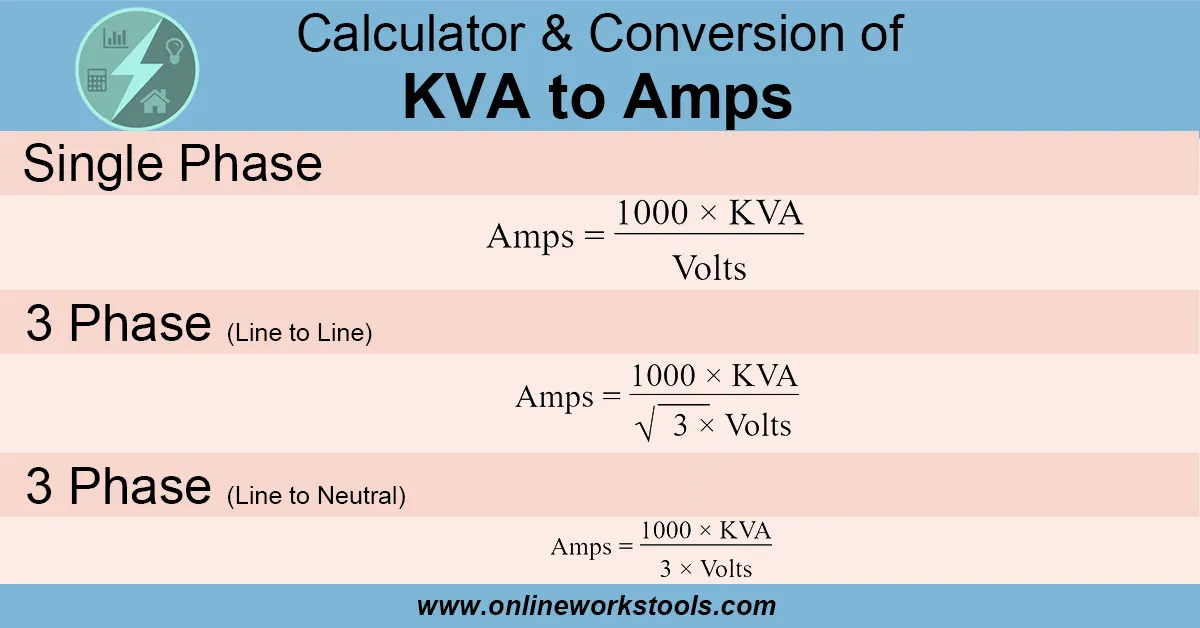
For Single-Phase Systems (Most Homes & Small Businesses):
This is what you'll typically find in your house. Think of a single road for traffic flow.
Amps = (KVA * 1000) / Volts
Why "1000"? Because "Kilo" in KVA means 1000. So KVA is just 1000 VA. We convert KVA to VA first to get the right units.
For Three-Phase Systems (Larger Buildings, Industry):
This is like a highway with three separate lanes for traffic. More efficient for bigger loads.
Amps = (KVA * 1000) / (Volts * √3)
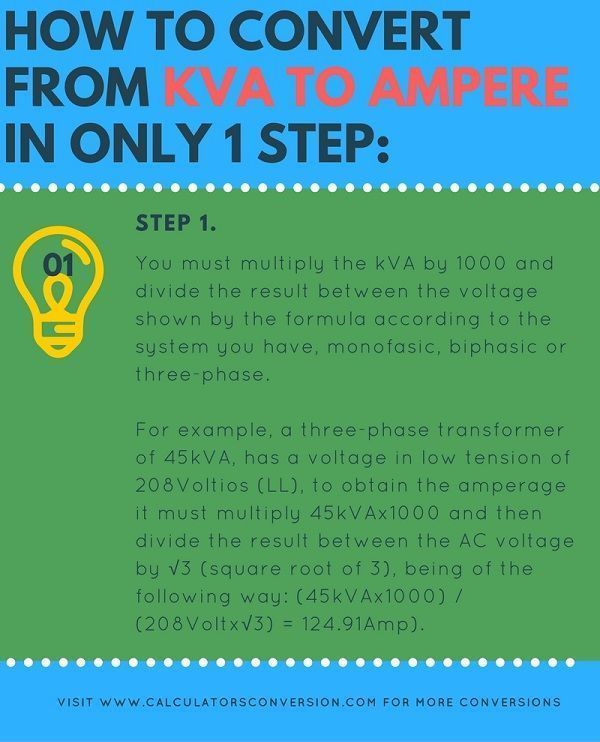
Don't let the "√3" (square root of 3, which is approximately 1.732) scare you! It's just a number that accounts for the different way three-phase power works. Your calculator has a button for it, usually labelled "sqrt" or "√".
Let's Try It Out! (Mini Stories)
Time for some real-world applications!
Example 1: Your Camping Generator (Single-Phase)
You bought a 6 KVA generator for your weekend adventures. Your camping appliances (like that glorious coffee maker and mini-fridge) run on 240 Volts (common for bigger camping generators). How many Amps can you safely draw?
Amps = (6 KVA * 1000) / 240 Volts
Amps = 6000 / 240
Amps = 25 Amps

So, your generator can handle up to 25 Amps of stuff running at the same time. Time to check those appliance labels!
Example 2: The Mighty Workshop (Three-Phase)
Your friend is setting up a serious woodworking shop. The big main machine needs a power supply that's rated at 45 KVA, 480 Volts, and it's a three-phase system. How many Amps will it pull?
Amps = (45 KVA * 1000) / (480 Volts * √3)
Amps = 45000 / (480 * 1.732)
Amps = 45000 / 831.36
Amps ≈ 54.1 Amps
This tells your friend what size circuit breaker and wiring they'll need for that beast of a machine. See? Not so scary!
A Few Friendly Reminders:
-
Always Check the Voltage: This is the most important variable. Voltage can be 120V, 208V, 240V, 277V, 480V, etc. Look at your equipment's nameplate or your utility bill.
-
Don't Max Out: Just like you wouldn't drive your car with the accelerator pinned to the floor all the time, don't run your electrical system at 100% of its capacity. Electricians often recommend only loading circuits to about 80% to prevent overheating and premature wear. Give it some breathing room!
-
When in Doubt, Call a Pro: While knowing these conversions is great for understanding, for any actual wiring or installation, always consult a qualified electrician. Safety first, folks!
You've Got This!
See? Converting KVA to Amps isn't some dark art. It's a practical skill that helps you understand the electrical world around you a little better. It empowers you to make smarter decisions about your appliances, generators, and even home projects, saving you headaches (and potentially preventing tripped breakers) down the line.
So next time you see "KVA," give it a little nod. You now know its secret, and you're ready to translate it into plain old "Amps" to figure out exactly how much power is flowing!