
Generator Watts To Run A Refrigerator
Hey there, fellow power-outage-phobe! So, the lights flicker, then poof – darkness. Your first thought, after finding a flashlight (or your phone!), is probably something like, "Oh no, my food!" Am I right? Because let's be real, a fridge full of rapidly warming perishables is a special kind of dread. Nobody wants to toss a week's worth of groceries, right?
That's where a trusty generator comes in! But then the brain starts whirring: "How big of a generator do I even need for just the fridge?" It's a fantastic question, and honestly, it’s not quite as simple as "X watts." But don’t worry, we’ll break it down like we're just chilling over a cup of coffee. Grab a mug!
The Tale of Two Watts: Running vs. Starting
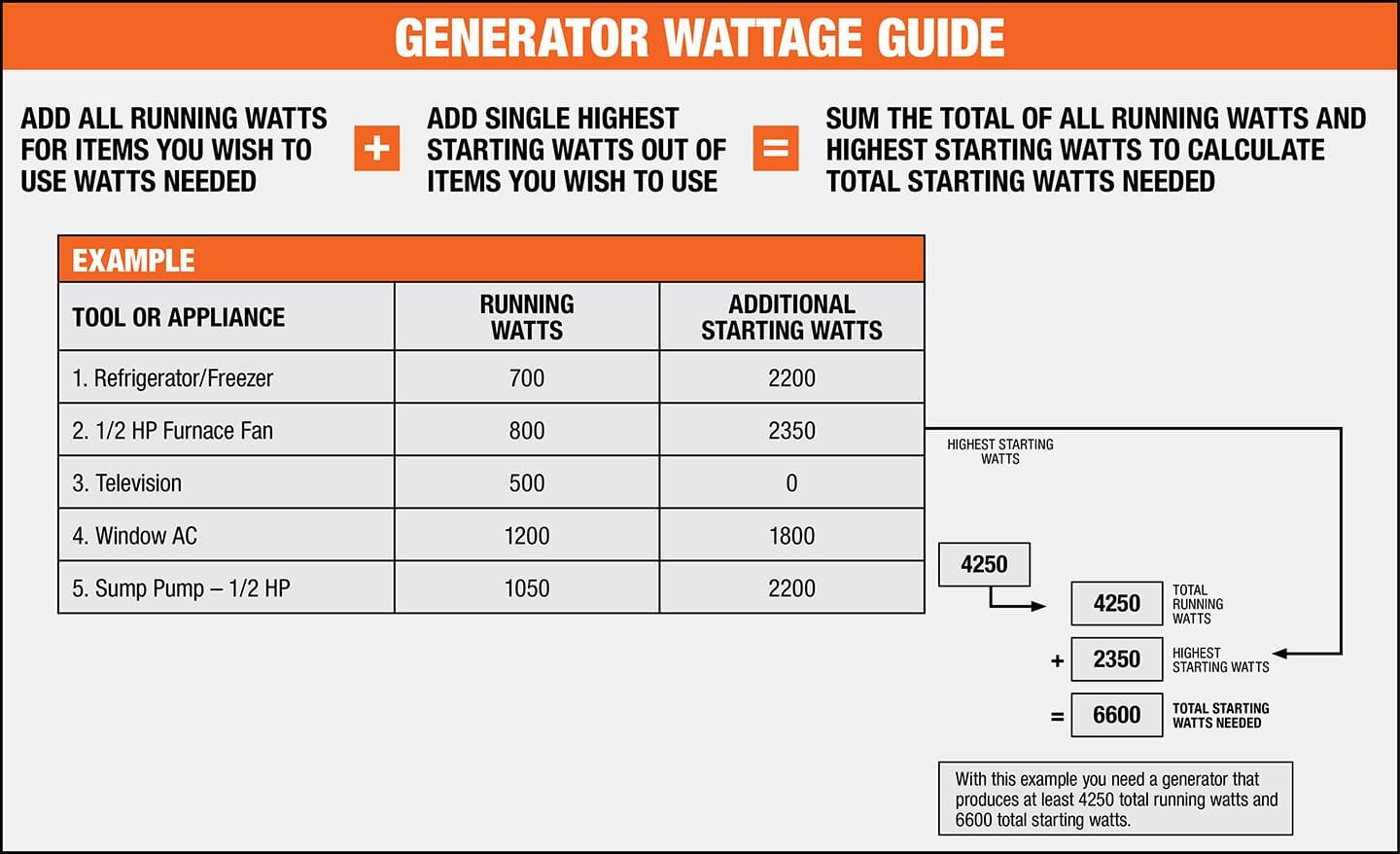
Okay, so here's the dealio, and this is probably the most important part of our little chat. Refrigerators, like many motor-driven appliances, have two different wattage ratings you need to care about. Two! Not just one, which would be too easy, wouldn't it?
Must Read
First up, we have running watts (sometimes called operating watts). This is the power your fridge sips on a regular basis to keep everything delightfully chilled. It's the wattage it uses for most of its life, just humming along, doing its job. Think of it as its cruising speed.
But then, there's the rockstar of power consumption: starting watts (or surge watts). This is the big gulp of electricity your fridge needs for a fleeting moment, usually just a second or two, when its compressor first kicks on. That little motor needs a serious jolt to get going. This surge can be three to five times higher than its running watts! Wild, right? And this is the number that often trips people up when choosing a generator.
Finding Your Fridge’s Power Personality
So, how do you figure out these mysterious numbers for your fridge? Easy peasy! Most fridges have a little data sticker. It’s usually inside, often on the side wall or ceiling of the fridge compartment, or sometimes on the back. It’s like finding a secret menu!
Look for terms like "Max. Power," "Rated Amps," or "Watts." If it only gives you amps and volts (common in North America, usually 120V), you can do a super simple math trick: Volts x Amps = Watts. So, if it says 120V and 5 Amps, that’s 600 running watts. For the starting watts, you’ll often need to estimate. A common rule of thumb is to multiply the running watts by 3 or even 4 to be safe. So, our 600-watt fridge might need a generator that can handle a 1,800 to 2,400-watt surge for that split second!
Now, some newer fridges are super efficient. An Energy Star rated model might only run at 100-200 watts. Older fridges, however, can be power hogs, chugging 500-800 running watts or more! So, that sticker is your best friend. Don't skip it!

Size Matters (For Your Fridge, That Is!)
Not all fridges are created equal in the power-drawing department. A dinky mini-fridge in your office corner? It’ll barely make a dent. A standard top-freezer model? That’s your average Joe. But a fancy-pants side-by-side with an ice maker, water dispenser, and all the bells and whistles? Oh, baby, that's going to demand a bit more juice, especially on startup. French door models often fall into this higher-demand category too.
So, when you're generator shopping, you need to make sure its starting watt capacity is greater than your fridge's starting watt requirement. If the generator can’t handle that initial jolt, your fridge simply won't turn on. Total bummer. Then, of course, the generator's running watt capacity needs to be enough to keep it going once it’s running.
Generator Styles: What’s Your Vibe?
You’ve got a couple of main choices when it comes to generators:

Traditional Generators
These are often your more budget-friendly options. They’re usually louder – think roaring lawnmower – and produce what's sometimes called "dirty power." While perfectly fine for your fridge, which isn't a super sensitive electronic device, it might not be ideal for charging your laptop or phone. But for keeping the beer cold? Absolutely!
Inverter Generators
Ah, the quiet champions! Inverter generators are generally more expensive but run significantly quieter. They also produce "cleaner" power, which is much safer for sensitive electronics. Plus, they're often more fuel-efficient, which is a big win if you're looking at a longer outage. Many are also really portable, great for camping too!
A Few Handy Tips (Because Safety First, Always!)
Okay, serious moment time. Please, please, please run your generator outdoors! Never in a garage, never near a window or door. Carbon monoxide is an invisible killer, and we want you safe. Got it?
Also, use proper, heavy-duty extension cords. Don't daisy-chain thin cords; your fridge is drawing significant power. And keep the generator itself dry and protected from the elements. A little common sense goes a long way here, friend.
The Grand Finale: You Got This!
So, to wrap up our little coffee chat: when you’re thinking about generator watts for your fridge, remember the golden rule: Focus on the starting watts! That’s the critical hurdle. Find your fridge’s sticker, do a quick calculation if needed, and then look for a generator whose surge capacity can handle it.
Getting the right generator means peace of mind when the power inevitably decides to take a vacation. No more stressing about spoiled food! Just nice, cold drinks and solid-as-a-rock ice cream. Now, go forth and be prepared!