
Elastic Modulus Of Steel In Mpa
Ever tried to bend a steel spoon with your bare hands? Good luck with that! Now, imagine bending a rubber band. Super easy, right? There's a secret superpower behind why some things snap back and others just... don't. And today, we're diving into the ridiculously cool world of steel's elastic modulus.
It sounds like a super-serious engineering term, but honestly, it's just about a material's personality. Specifically, how much it resists getting stretched or squished, and how much it loves to bounce back to its original shape. Think of it as a material's stubbornness, its refusal to stay deformed.
What Even Is This "Elastic Modulus" Thing?
Okay, let's break it down. Imagine you have a Slinky versus a steel bar. You pull the Slinky, it stretches a lot. You let go, it springs back. Now, try that with a steel bar. You'd need a Hulk-level grip to even make it budge a tiny bit! That difference? That's the elastic modulus at play.
Must Read
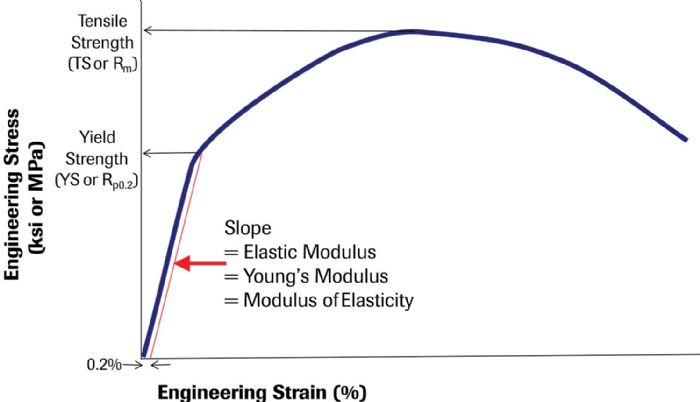
It's a measure of a material's stiffness or rigidity. How much force do you need to apply to get a certain amount of elastic deformation? When we say "elastic," we mean it snaps back. It has a memory! Like when you stretch a rubber band, it doesn't stay stretched forever; it remembers its original size. Steel has that same amazing memory, but it needs a LOT more convincing to even budge a little.
Steel: The Unyielding Champion!
This is where steel truly shines. It’s one of the stiffest common materials out there. It's the reason skyscrapers stand tall and bridges don't wobble like jelly. Steel says, "Nope! I'm staying right here, thanks!" when you try to push it around.

It’s not just about how strong it is before it breaks. That’s a different story. This is about how much it resists bending or stretching without breaking, and without permanently changing its shape. It's the ultimate "bounce-back" factor.
The Magic Number: 200,000 MPa!
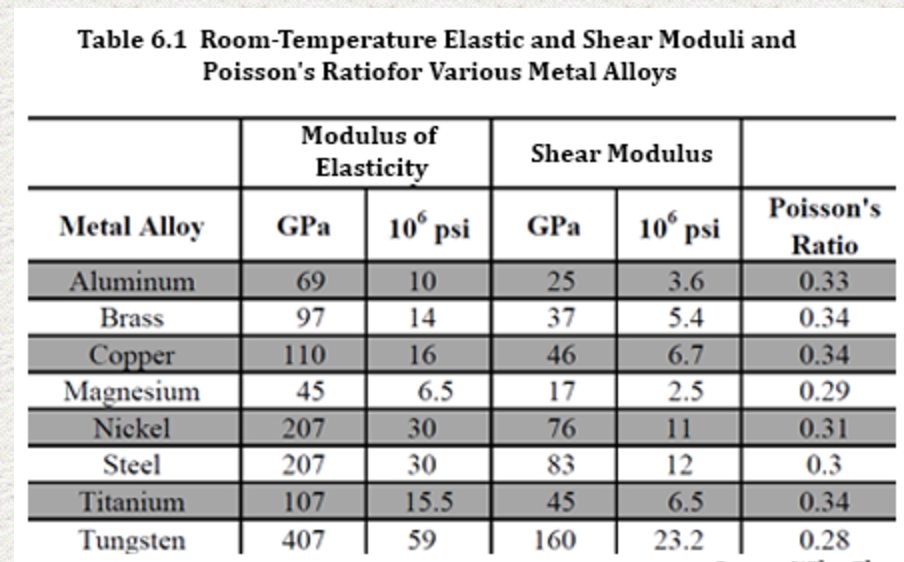
Are you ready for the big reveal? For steel, this incredible stiffness, this elastic modulus, is approximately 200 Gigapascals. Now, that's a mouthful, right? Let's make it even punchier, and in the units we're talking about: that's around 200,000 MegaPascals (MPa)!

Yes, two hundred thousand! That's a huge number. To put it in perspective, a MegaPascal (MPa) is a unit of pressure. Imagine a million Newtons of force (that's roughly 100 metric tons, or about the weight of a blue whale!) pressing down on a single square meter. That's a lot of oomph!
So, steel requires an absolutely enormous amount of pressure to achieve even a tiny bit of elastic stretching or compression. It's like trying to flex a mountain. It just won't give easily.
Quirky Facts and Funny Details!
Why is this fun? Because it explains so much of the world around us! That tiny paperclip you're fiddling with? Its ability to hold its shape after being bent (and then straightened) is all thanks to that magnificent 200,000 MPa. It has incredible "snap-back" power!

Imagine if bridges were made of gummy bears. Fun, maybe, but not exactly structurally sound! The low elastic modulus of gummy bears (probably closer to 0.001 MPa, if we're guessing wildly!) means they'd just stretch and droop. Steel, on the other hand, says, "I got this!"
If steel were a person, it'd be that super-disciplined yoga instructor who can bend just enough to touch their toes but always returns to perfect posture, instantly. It’s got an incredible memory for its original form, and it's fiercely protective of it.
This huge elastic modulus is also why steel structures can resonate at high frequencies. Tap a steel beam, and it rings with a clear, high-pitched tone. Tap a wooden beam, and it's a dull thud. That ringing is a direct consequence of its immense stiffness and ability to transfer vibrations efficiently while still wanting to snap back into place.
Why It's Just Plain Cool
Understanding steel's elastic modulus helps us build amazing things. From the frames of your car to the colossal cranes lifting heavy loads, to the very backbone of modern architecture – it's all thanks to this fundamental property. Engineers don't just guess; they use this number to calculate how much a beam will sag, how much a column will compress, and ensure everything stays exactly where it should.
It’s a foundational concept that underpins so much of our engineered world. So, the next time you see a towering bridge or a sleek building, give a little nod to that incredible number: 200,000 MPa. It’s not just a number; it's the secret sauce that makes steel the undisputed champion of stiffness, letting us build bigger, stronger, and bolder than ever before!