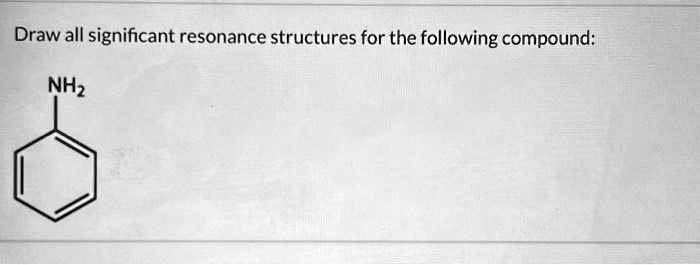
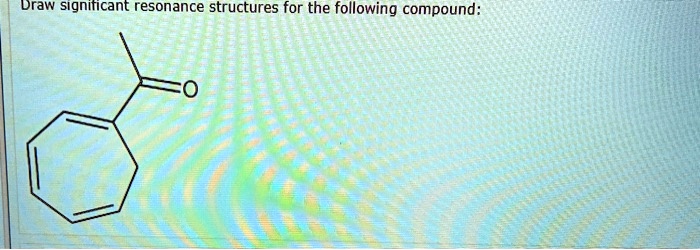
Draw All Significant Resonance Structures For The Following Compound:
Mike Johnson
Alright, buckle up, chemistry adventurers! We're diving headfirst into the wild world of resonance structures! Think of it like this: your favorite superhero has not one, but multiple cool costumes. They're all slightly different, but they all represent the same awesome hero. That's resonance in a nutshell!
Now, I know what you might be thinking: "Resonance? Sounds complicated." Fear not! We're going to make this ridiculously easy, like explaining why cats are obsessed with boxes (they just are, okay?).
Let's say we have a chemical compound… let's call it "Bob." Bob is feeling a little…electronically indecisive. He's got electrons buzzing around, and sometimes they decide to chill out in one spot, and sometimes they're like, "Nah, let's party over HERE!" Resonance is all about showing those different electron hangouts.
Imagine you're throwing a pizza party (because who doesn't love pizza?). Your friends (the electrons) are super mobile. Sometimes they're all gathered around the pepperoni pizza (that's one resonance structure!), and sometimes they're swarming the veggie delight (another resonance structure!). The pizzas themselves never change fundamentally – they're still pizza! – but the distribution of your friends shifts.
That’s the key idea. We're not breaking any bonds. We’re not adding or subtracting atoms. We're just rearranging where those negative electrons are hanging out. Like a microscopic game of musical chairs, but with electrons instead of chairs, and attraction instead of awkward small talk.
SOLVED: Draw significant resonance structures for the following compound:
How to Draw the Party Guests (aka Resonance Structures)
Okay, so how do we actually draw these different electron arrangements? Simple! We use a super-special, double-headed arrow ( ↔ ). This arrow is like saying, "Hey, Bob can look like this, OR he can look like that." It's the official symbol of electron indecision!
The whole point of resonance is that the actual molecule is a blend, a hybrid, of all the possibilities. It’s like saying Bob is wearing a blurry combination of all his costumes at the same time! So the first step is always drawing the lewis structure for the compound. If you do not draw the lewis structure, you will not be able to assign the correct formal charges.
Example:
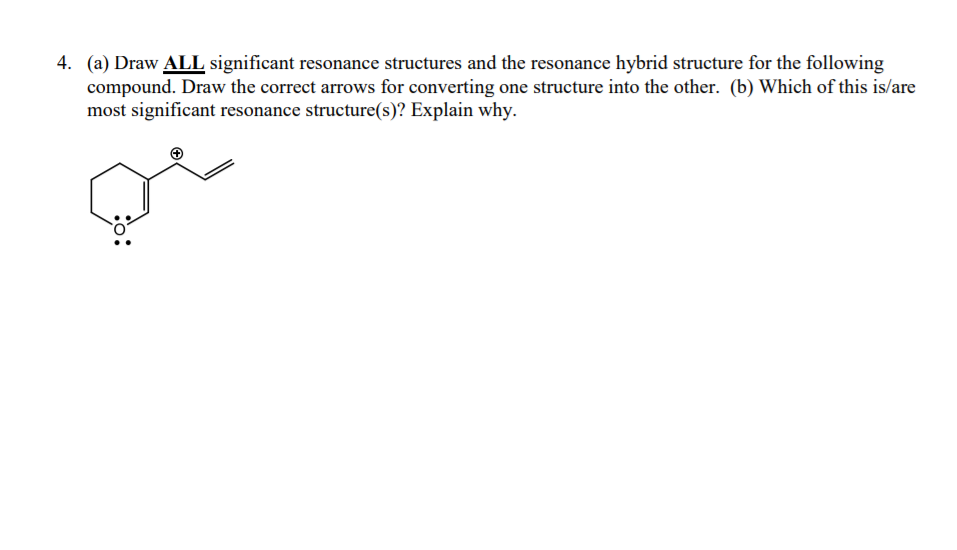
Solved (a) Draw ALL significant resonance structures and the | Chegg.com
Let's pretend we have some imaginary molecule, let’s call it X-Y-Z. And let's say we can shift some electrons around, so we have two possibilities:
X=Y-Z ↔ X-Y=Z
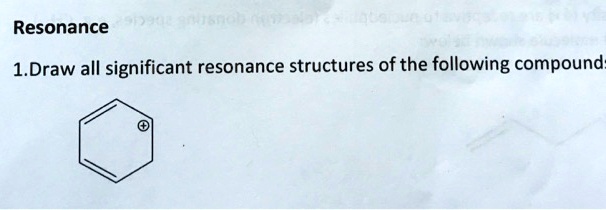
SOLVED: Resonance 1.Draw all significant resonance structures of the
See that? The only thing that changed was where the double bond was located. We didn't move any atoms, just rearranged some electrons. Like rearranging the furniture in your room. Your room is still your room, but it looks a little different.
Things to Keep in Mind (aka Party Rules!)
Drawing resonance structures isn't just about willy-nilly moving electrons. There are a few ground rules, like making sure everyone gets a slice of pizza (octet rule!).
Don't break the octet rule! (Unless you really know what you're doing and your molecule is a rebellious exception.) Each atom (except hydrogen, which likes to keep it simple with just two electrons) generally wants eight electrons buzzing around it.
Only move electrons in pi bonds or lone pairs! Sigma bonds? Off limits! Think of it like this: the electrons in pi bonds and lone pairs are the most flexible, the most willing to relocate for a better view.
Conserve the total charge! If your original molecule has a +1 charge, all your resonance structures need to have a +1 charge overall. The amount of positive and negative charge must remain constant.
Formal Charges: Keeping Track of the Guests
Sometimes, when you move electrons around, atoms end up with a formal charge. Think of it as a little electronic "IOU." An atom with a formal charge of +1 is like it’s missing an electron, while an atom with a formal charge of -1 is like it's got an extra. These charges help us keep track of where the electrons are supposed to be versus where they actually are in a given resonance structure.
[GET ANSWER] draw significant resonance structures for the following
Don't stress too much about the math involved in calculating formal charges. Think of it more like a friendly reminder of who's holding onto electrons a little more tightly in each structure.
So, Why Does All This Matter?
Good question! Resonance helps us understand the actual behavior of molecules. It shows us that electrons aren't always stuck in one place, and that molecules are often more stable and less reactive than we might expect if we only looked at a single Lewis structure.
In the end, resonance isn't about memorizing rules. It's about embracing the fact that electrons are dynamic, constantly shifting, and adding their own special flair to the chemical world. So go forth, draw those resonance structures, and let your inner chemist shine!

![[GET ANSWER] draw significant resonance structures for the following](https://cdn.numerade.com/ask_images/af8eb1a894274c15bc8a16f70e7b1c11.jpg)