
Do All Planets Orbit The Sun In The Same Direction

Hey there, space explorers! Ever looked up at the night sky and wondered what all those twinkling lights are really doing? I mean, beyond just being pretty, of course. Well, grab your cosmic popcorn, because we're about to dive into a fascinating fact about our solar system!
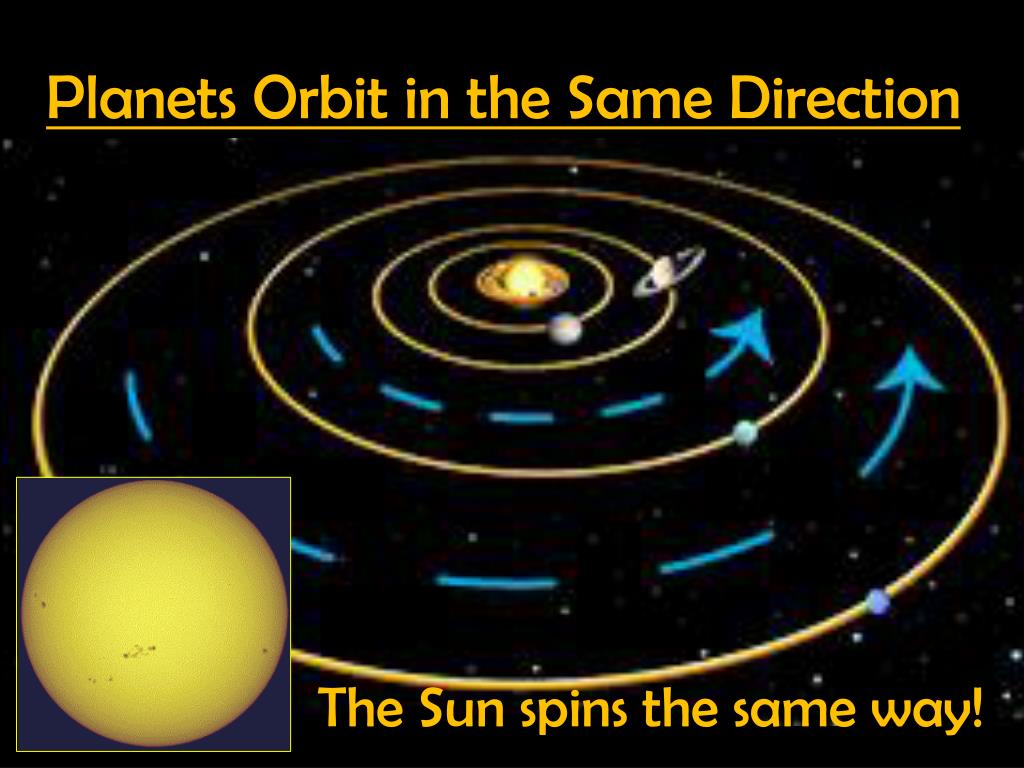
Today’s burning question: Do all the planets in our solar system orbit the Sun in the same direction? Ready for the spoiler? The answer is a resounding... Yes!
A Cosmic Merry-Go-Round
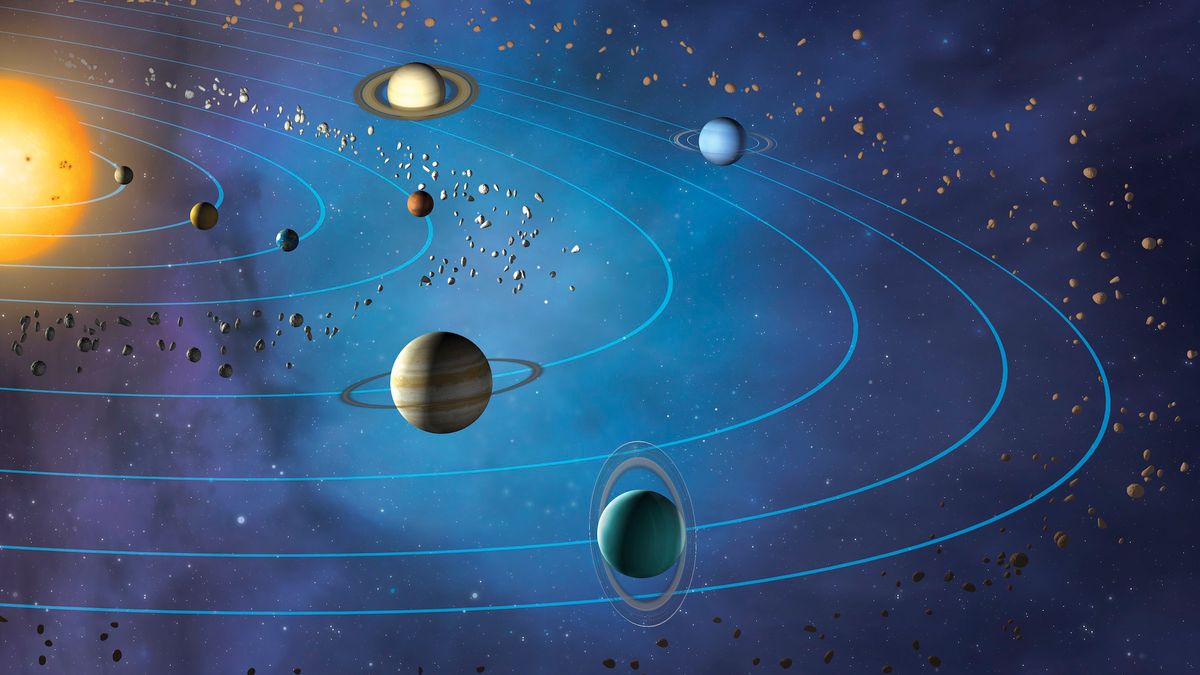
Think of it like this: imagine a cosmic merry-go-round with the Sun at the center. All the planets – Mercury, Venus, Earth, Mars, Jupiter, Saturn, Uranus, and Neptune (sorry Pluto, you're still cool!) – are spinning around that center in the same general direction. And that direction, my friends, is called prograde. Which, in simple terms, means they're all going the same way!
Must Read
But why? Why this synchronized cosmic dance? Is there some universal DJ spinning the planets in perfect harmony?
Well, not exactly a DJ, but more like a cosmic baker. Let me explain!

The Birth of a Solar System (and a Baked Good Analogy!)
Billions of years ago, our solar system wasn’t much more than a giant, swirling cloud of gas and dust. This cloud, thanks to gravity (that sneaky force that keeps us all grounded), started to collapse in on itself. As it collapsed, it began to spin faster and faster – think ice skater pulling their arms in for a faster spin! And guess what? That original spin determined the direction that everything would eventually orbit.
It's like making a pizza. You start with a ball of dough, and you spin it out flat. The direction you spin the dough determines the direction everything else will move on top of it – pepperoni, cheese, the works! (Okay, maybe that’s not a perfect analogy, but you get the idea, right?) The Sun formed at the center, gobbling up most of the material, and the remaining dust and gas coalesced into the planets, all spinning in the same direction as the original cloud.
Pretty neat, huh?
A Few Cosmic Curveballs
Now, before you start thinking everything in space is perfectly aligned and predictable, let's throw in a few curveballs. While the planets themselves orbit the Sun in the same direction, some of their moons are a bit rebellious.
Some moons, like Triton orbiting Neptune, have what's called a retrograde orbit – meaning they orbit in the opposite direction of their planet’s rotation. Scientists believe these rogue moons were likely captured asteroids or other celestial bodies that wandered into the planet's gravitational pull.
Think of it like finding a stray cat in your house. It wasn't born there, but it decided to stick around and do its own thing.

And speaking of doing their own thing, Venus is a bit of a weirdo too. It rotates on its axis in the opposite direction of most other planets (a retrograde rotation). Why? Well, that's still a topic of scientific debate, but it might have something to do with a major collision early in its history. Space is messy!
Why Should You Care? (Besides Being Really Cool)
So why does it matter if all the planets orbit the Sun in the same direction? Well, besides being an awesome fact to whip out at parties (trust me, it works!), it tells us a lot about the formation of our solar system. By understanding these orbital patterns, we can learn more about the forces that shaped our cosmic neighborhood and, ultimately, how we came to be here on Earth.
Understanding these cosmic rules gives us a sense of place, a connection to something bigger than ourselves. Plus, let’s be honest, learning about space is just plain fun! It’s like unlocking a secret code to the universe.
Think about it: every time you look up at the stars, you're not just seeing random points of light. You're seeing worlds in motion, dancing to an ancient rhythm that started billions of years ago. And you, my friend, are now in on the secret!
So, keep looking up, keep asking questions, and keep exploring the wonders of the universe. Who knows what other amazing discoveries are waiting to be made? The cosmos is vast, mysterious, and ready to be explored. And the best part? It's all there for you to discover. Happy stargazing!
Ready to learn more? Dive deeper into astronomy and astrophysics! There are tons of books, documentaries, and online resources just waiting to be explored. Your next cosmic adventure awaits!