
Differentiate Between Real Gas And Ideal Gas
Hey there, gas enthusiast! Ever wondered why your chemistry teacher kept droning on about "ideal gases" when, let's be honest, nothing in life is ever really ideal? Well, grab a comfy chair (or maybe inflate a balloon – gas-themed, get it?) because we're about to dive into the wonderfully wacky world of real versus ideal gases. It's less complicated than you think, promise!
What's This "Ideal Gas" Thing Anyway?
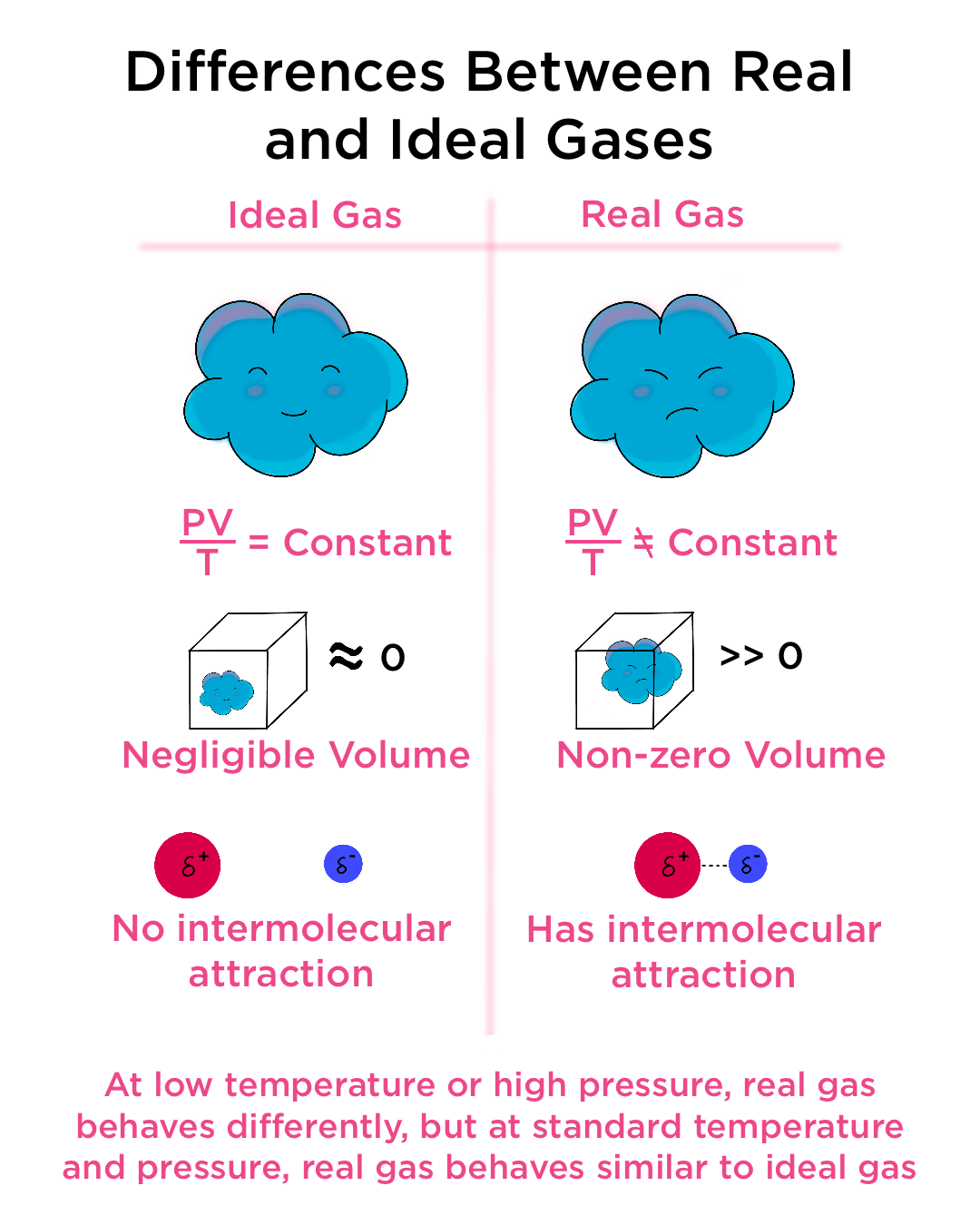
Think of an ideal gas as a perfectly behaved gas. It's the prom queen of the gas world – always following the rules. The ideal gas law (PV=nRT, remember that gem?) paints a picture of these gases behaving oh-so-predictably. Basically, it assumes two key things:
First, that the gas particles themselves have no volume. Zip. Nada. They're like tiny, weightless ghosts floating around. Obviously, that's not true in reality; even the smallest gas molecules take up some space. But for simplification, we ignore it. Think of it as politely overlooking someone's slightly questionable fashion choice. We just pretend it's not there!
Must Read
Second, it assumes there are no intermolecular forces between the particles. No attraction, no repulsion – just pure, unadulterated independence. They're all social distancing experts, even before it was cool. Real gases, however, are a bit clingy. They have these weak, attractive forces (Van der Waals forces, if you want to get fancy) that influence their behavior. It's like when you try to walk through a crowded room – people bumping into you slows you down, right? Same idea!
Real Gases: The Rebel Alliance
Now, let's talk about real gases. These are the gas molecules that actually exist in the real world (shocking, I know!). They’re the rebels, the rule-breakers, the ones who don’t quite fit the ideal gas mold. They're the cool kids who wear their jeans ripped and their lab coats slightly askew.

Unlike their ideal counterparts, real gas molecules do have volume. Imagine trying to pack a suitcase with absolutely nothing inside taking up space. Impossible! And these molecules do interact with each other. These interactions are small, but they matter.
So, when do real gases deviate from ideal behavior? Good question! Typically, at high pressures and low temperatures. Let’s break that down:
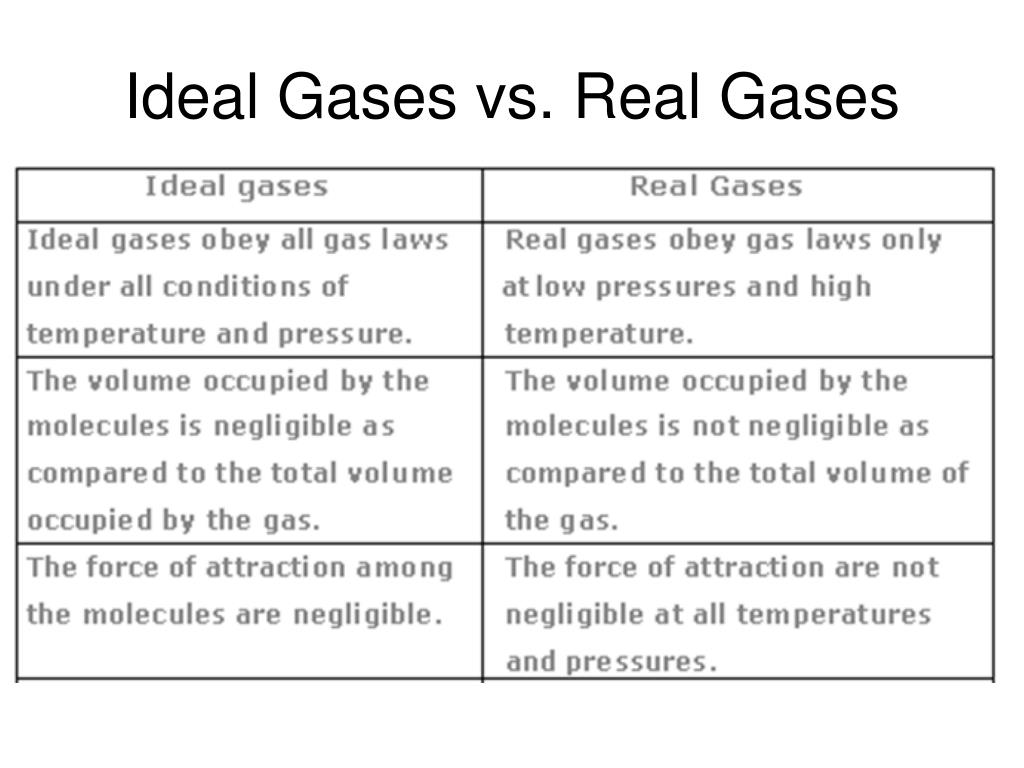
- High Pressure: When you squeeze a gas into a small space, the molecules get closer together. The volume of the molecules becomes a more significant percentage of the total volume, and intermolecular forces start to play a bigger role. It’s like being crammed into a subway car during rush hour – personal space goes out the window!
- Low Temperature: When you cool a gas down, the molecules move slower. This gives the intermolecular forces more time to exert their influence. They start to stick together more, deviating from the ideal assumption of complete independence. Think of it as everyone huddling together for warmth in the winter.
The Key Differences: A Quick Recap
Let's summarize the main differences in a nice little table because everyone loves a good table!
Ideal Gas:
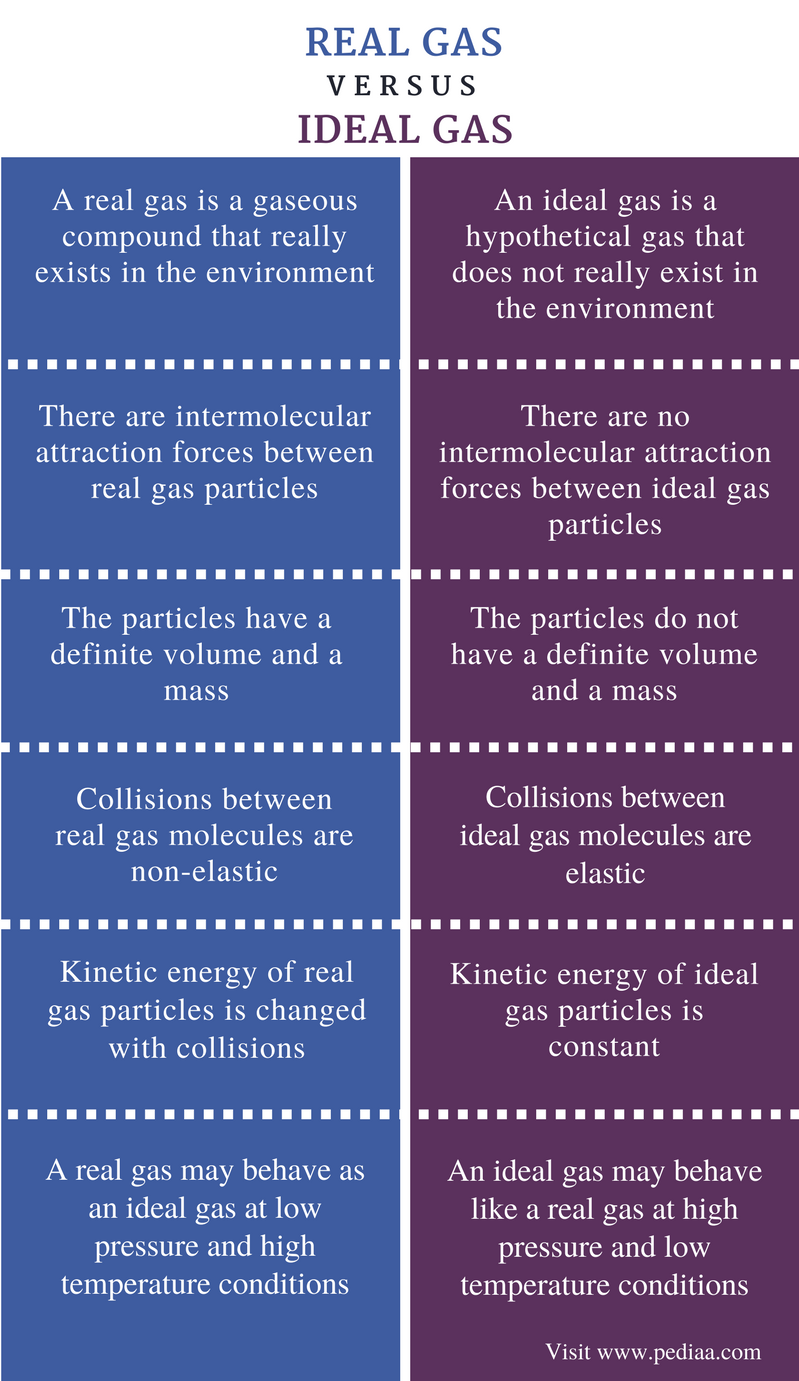
- Particles have no volume.
- No intermolecular forces.
- Follows PV=nRT perfectly.
- Behaves ideally at all conditions.
Real Gas:
- Particles have volume.
- Intermolecular forces exist.
- Deviates from PV=nRT, especially at high pressure and low temperature.
- Behaves more like an ideal gas at low pressure and high temperature.
Important Note: No gas is truly ideal! The ideal gas is a theoretical concept that helps us understand and predict gas behavior under certain conditions. Real gases approach ideal behavior at low pressures and high temperatures.

So, What's the Point?
Why do we even bother with this real vs. ideal gas stuff? Well, understanding the differences helps us to make more accurate predictions about how gases will behave in different situations. This is crucial in fields like engineering, chemistry, and even meteorology. It also allows us to design better processes, whether it's optimizing a chemical reaction or predicting the weather. Who knew gas laws could be so powerful?
Plus, knowing the limitations of the ideal gas law helps you understand how the world actually works, not just how we wish it did. It's a reminder that even in science, things aren't always as simple as they seem. Which, honestly, is what makes it all so fascinating!
And that, my friend, is the gist of the real gas versus ideal gas debate. It's a bit of a simplification, sure, but hopefully, it's made the concept a little less intimidating and a lot more...well, palatable. Now go forth and impress your friends with your newfound gas knowledge! You've got this!