
Copper Number Of Protons Neutrons And Electrons
Alright, gather 'round, folks! Let's talk about copper. Yeah, that shiny stuff in your pennies (well, mostly pennies these days, thanks to inflation!), your pipes, and that weird bracelet your aunt swears cures her arthritis.
We're diving deep into the atom-ic, not the an-a-tomic, because let's be honest, who wants to dissect anything after lunch? We're talking protons, neutrons, and electrons. The VIPs of the copper universe. Think of it like the tiny, invisible party happening inside every single piece of copper. And trust me, it's a rager!
The Protons: The Bosses of the Operation
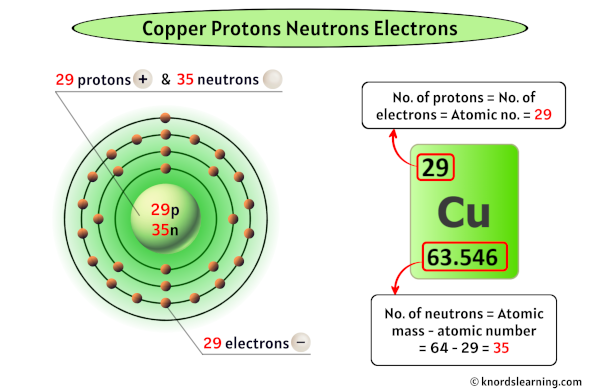
First up, the protons. These guys are the absolute rulers of the atomic kingdom. Why? Because they decide what element we're even talking about! Copper's got 29 protons. Change that number, and suddenly, you've got zinc, or maybe gallium… something totally different. It's like changing the lead singer of a rock band. Suddenly they're playing polka!
Must Read
So, 29 protons = Copper. Write it down! Tattoo it on your arm! (Just kidding... mostly.) It's the magic number. They’re all crammed into the nucleus, which is like the VIP section of the party. Positively charged (because who wants a negative vibe?), and they're generally pretty chill, just vibing in the center. Don’t try to move them; things get explosively weird if you start messing with nuclear physics, and we're just trying to have a pleasant chat over coffee, not accidentally invent the next doomsday device.
Neutrons: The Neutral Party Animals (Literally)
Next, we've got the neutrons. These guys are also hanging out in the nucleus with the protons. They're neutral – get it? – like Switzerland at an atom party. They don't have a charge, and their main job is to keep the protons from repelling each other and completely ruining the party. Because, let's face it, positively charged protons hate being close to each other. Neutrons are the peacemakers, the zen masters of the nucleus.
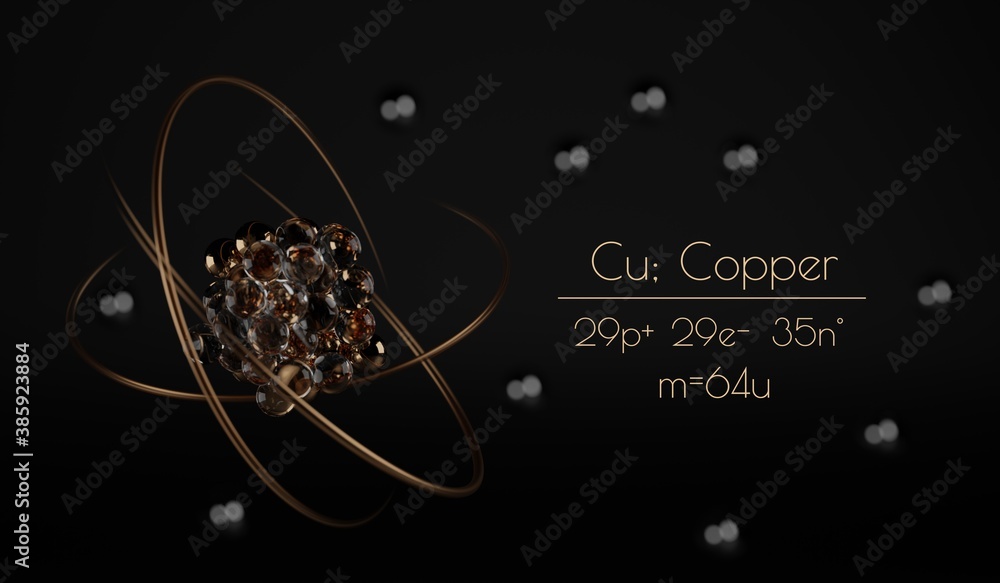
Now, here's where it gets a little tricky. Copper can have different numbers of neutrons. This is what we call isotopes. Copper-63, the most common type, has 34 neutrons. If you add two neutrons, you get Copper-65. Same copper, just a slightly heavier version. It's like getting a slightly larger slice of pizza. Still pizza, just more pizza. Some isotopes are stable, some are radioactive and basically throw tiny little atomic tantrums. Copper's stable isotopes are the well-behaved ones.
Think of it like this: The protons are the band members, always the same in a Copper band. The neutrons are the roadies. Sometimes there are more, sometimes less, but they’re always there to keep the show running smoothly.
Electrons: The Wild Ones Orbiting the Nucleus
Finally, we have the electrons. These guys are way more exciting than the protons and neutrons. They're tiny, they're negatively charged, and they're constantly zipping around the nucleus in what we call "orbitals". Think of them as super-fast, super-hyperactive squirrels on an atomic-sized racetrack.

In a neutral copper atom, there are 29 electrons. Why 29? Because the number of electrons must equal the number of protons to keep the whole atom electrically balanced. It's like needing the same number of Republicans and Democrats to pass a bill (okay, maybe not the best analogy these days…but you get the idea!).
These electrons aren't just randomly flying around. They're arranged in specific energy levels or "shells". The electrons closest to the nucleus have the lowest energy, and the ones farther away have higher energy. The outermost electrons, also known as valence electrons, are the ones that do all the interesting stuff like forming chemical bonds. They’re the social butterflies of the atomic world!

Copper’s valence electrons are the reason why it’s such a great conductor of electricity. They’re pretty loosely held, which means they can easily jump from one atom to another, creating an electric current. That's why your phone charger uses copper wires, and not, say, wool socks. Imagine trying to charge your phone with a wool sock... good luck!
Copper in a Nutshell (or a Penny, Rather)
So, there you have it! Copper, broken down to its atomic core. 29 protons defining its very existence. Varying numbers of neutrons providing stability (and pizza). And 29 electrons, buzzing around, conducting electricity, and generally making the magic happen.
The next time you see a copper pipe, remember this little atomic party we discussed. All those tiny particles, zipping and buzzing around, making the world a little bit more conductive, a little bit more useful, and a whole lot more interesting. Now, who wants another coffee? This atomic physics stuff is thirsty work!
