
Coefficient Of Thermal Expansion 6061 Aluminum

Ever wondered why bridges have little gaps in them? Or why power lines sag a bit on a hot day? It's not just bad construction! It's all thanks to a sneaky little property of materials called the coefficient of thermal expansion!
Basically, everything expands when it gets warmer and shrinks when it gets colder. It's like magic, but it's actually just physics!
Aluminum: The Star of Our Show
Today, we're shining the spotlight on a specific type of aluminum: 6061 aluminum. This isn't your average, run-of-the-mill aluminum foil. 6061 aluminum is the workhorse of the aluminum world.
Must Read
It's strong, it's weldable, it's corrosion-resistant… it’s basically the superhero of metals! You'll find it in everything from airplane parts and bike frames to scuba tanks and even camera tripods.
But how does 6061 aluminum deal with temperature changes?
What's the Magic Number?
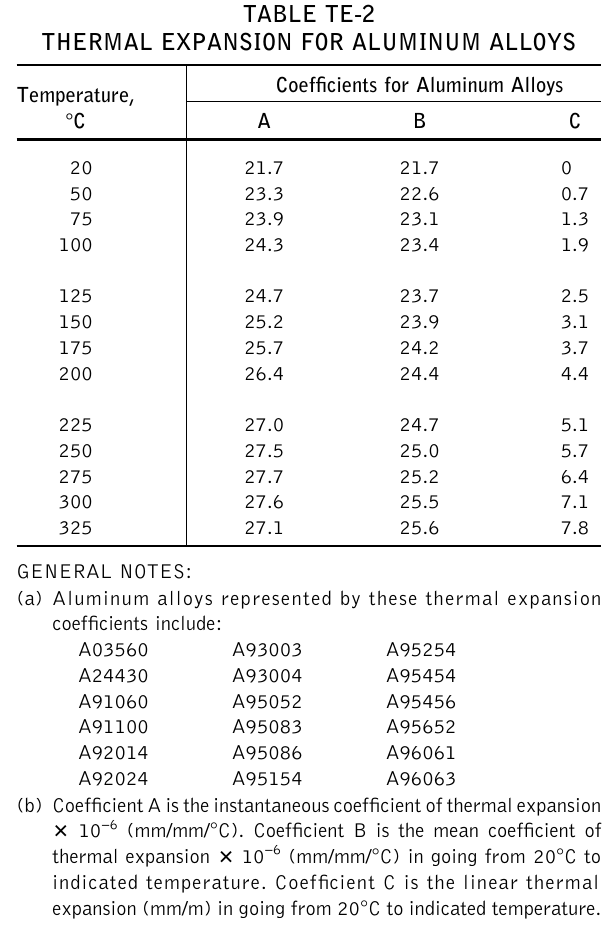
Okay, let's get down to brass tacks. The coefficient of thermal expansion for 6061 aluminum is approximately 13.1 x 10⁻⁶ per degree Fahrenheit (or 23.6 x 10⁻⁶ per degree Celsius).
Hold on, don't run away screaming! Those numbers might look scary, but they're actually pretty easy to understand once we break them down.
Think of it this way: for every degree Fahrenheit that 6061 aluminum heats up, it expands by 0.0000131 times its original length. That's a tiny, tiny amount!

Real-World Examples (With a Pinch of Exaggeration!)
Let's say you have a 10-foot (120-inch) long piece of 6061 aluminum. If you heat it up by 100 degrees Fahrenheit, how much will it expand?
Well, 120 inches x 0.0000131 x 100 = 0.1572 inches. So, it'll expand by about a sixth of an inch. Not a whole lot, right?
Imagine a bridge made entirely of 6061 aluminum (a very strong bridge, mind you!). Without those expansion joints, on a scorching summer day, the bridge could theoretically try to grow a few inches longer.
Those few inches of growth, fighting against the unyielding supports, could create tremendous stress! The bridge wouldn't necessarily explode like in a cartoon, but it could definitely buckle or crack. Yikes!
Now, let's picture a super-long 6061 aluminum pipeline carrying hot liquid across the desert. If engineers didn't account for thermal expansion, that pipeline could snake around like a caffeinated earthworm on a trampoline!
Okay, maybe not that dramatically. But it could definitely put a strain on the joints and supports, leading to leaks and other problems. The reality is that 6061 aluminum expansion is real and needs to be accounted for in any engineering design.
Why Does It Matter? (Even to You!)
You might be thinking, "Okay, that's interesting and all, but I'm not building bridges or pipelines." And that's perfectly fine! But thermal expansion affects you in more ways than you might realize.
Think about the fillings in your teeth. Dentists carefully choose materials that have a similar coefficient of thermal expansion to your teeth. Otherwise, you'd experience excruciating pain every time you drank something hot or cold!
Or consider your car engine. It's made of various metals, each with its own expansion rate. Engineers need to design the engine so that all the parts fit together perfectly, even when they're subjected to extreme temperature changes.
Even the humble aluminum can of your favorite beverage relies on an understanding of thermal expansion!
6061 Aluminum vs. the Competition
So, how does 6061 aluminum stack up against other materials when it comes to thermal expansion? Well, compared to steel, 6061 aluminum expands almost twice as much per degree of temperature change.

This is why you often see expansion joints used more frequently in structures made of aluminum compared to steel. But that's not necessarily a bad thing! It just means engineers need to be aware of the difference and design accordingly.
Compared to some plastics, 6061 aluminum expands much less. Some plastics can have coefficients of thermal expansion that are 10 times greater than aluminum! This is why you wouldn't want to build a precision instrument out of flimsy plastic that will deform just by the temperature change.
Controlling the Expansion: Clever Engineering
Engineers have all sorts of clever tricks up their sleeves to deal with thermal expansion. Expansion joints are the most obvious example, but there are others too.
One technique is to use materials with low coefficients of thermal expansion in critical areas. Invar, for example, is an alloy of nickel and iron that expands very little with temperature changes.
Another approach is to design structures in a way that allows them to flex and move without putting stress on the joints. This is often done in bridge design, where the deck is allowed to slide slightly on its supports.
Sometimes, expansion can be a good thing! Bimetallic strips, made of two different metals with different expansion rates, are used in thermostats and other temperature-sensitive devices.

The Takeaway: Respect the Expansion!
The coefficient of thermal expansion might seem like a dry, technical concept, but it's actually a fundamental property that affects everything around us.
Understanding how materials like 6061 aluminum behave under different temperatures is crucial for designing safe, reliable, and long-lasting structures.
So, the next time you see a bridge with expansion joints, or a power line sagging in the heat, remember the amazing world of thermal expansion and give a little nod to the engineers who work tirelessly to keep everything running smoothly!
And remember, when dealing with temperature changes and 6061 aluminum, it's always better to expect the expansion! Designing for thermal expansion is always a great idea.
So, go forth and appreciate the wonders of material science! Now you have at least an understanding of 6061 aluminum!