Ceiling Fans Clockwise Or Counter Clockwise

Ever stared up at your ceiling fan and wondered if it's spinning the right way? It's a surprisingly common question, and the answer can actually make a real difference in your comfort level, and even your energy bill! It's one of those little details we often overlook, but understanding which way your ceiling fan should be spinning depending on the season is a simple way to take control of your indoor environment. It's like a mini-science lesson happening right over your head!
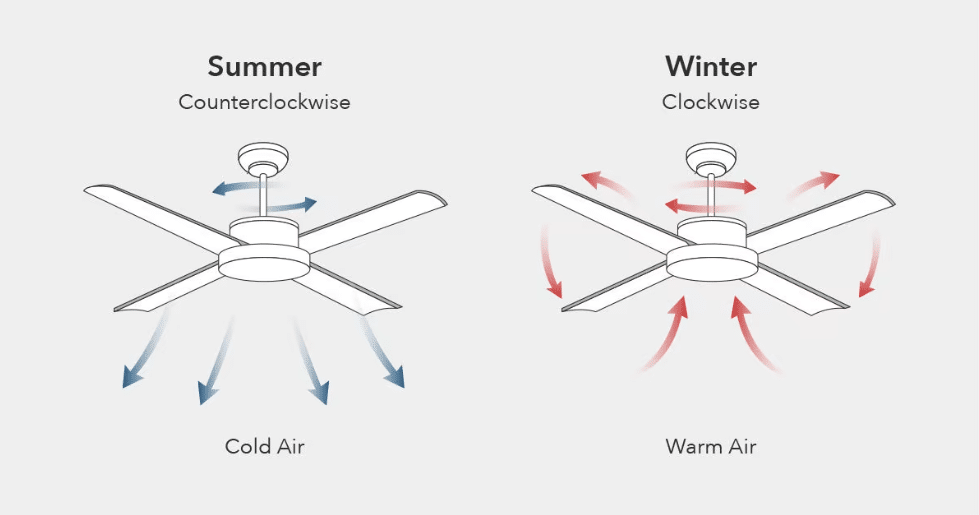
So, what's the deal with clockwise versus counter-clockwise? The purpose of adjusting your fan's direction is all about air circulation. In the summer, you want the fan to spin counter-clockwise. This creates a downdraft, pushing air straight down, which creates a cooling breeze. That breeze helps evaporate moisture from your skin, making you feel cooler and more comfortable. In the winter, the goal isn't to create a breeze, but rather to distribute warm air that naturally rises to the ceiling.
During the colder months, you'll want your fan to spin clockwise (at a low speed, mind you). This creates an updraft, gently pushing that warm air down the walls and back into the living space. It's not about feeling a breeze; it's about equalizing the temperature throughout the room. This allows you to potentially lower your thermostat and save energy, as your heating system doesn't have to work as hard to maintain a consistent temperature.
Must Read
You might not think about it, but the principle behind ceiling fan direction is used in various applications. Consider classrooms: understanding convection and air circulation, illustrated by something as simple as a ceiling fan, helps students grasp fundamental physics concepts. In daily life, knowing this trick can be a great conversation starter, impressing your friends with your unexpected knowledge of thermodynamics (even if you just learned it here!). Think about how many times you've been too hot or too cold inside despite the thermostat setting, this simple tweak could make a difference.
Ready to explore this in your own home? First, locate the direction switch on your ceiling fan. It’s usually located on the motor housing. Once you've found it, experiment! Try setting it to counter-clockwise in the summer and see if you feel a difference in the airflow. Similarly, try clockwise in the winter. Pay attention to how the room feels. A simple way to visualize the effect is to hold a lightweight streamer (like a ribbon or even a piece of tissue paper) under the fan at different speeds and directions. Observe the direction of the airflow. Is it creating a cooling breeze downwards, or gently pushing air outwards from the center? Have fun with it, and you might just find that you're a ceiling fan direction expert in no time!