
Can You Test A Spark Plug With A Multimeter

Okay, so your car is acting up. Maybe it's sputtering like it's trying to speak a foreign language it hasn't quite mastered. Or perhaps it's just plain refusing to start, leaving you stranded like a penguin in the Sahara. Chances are, somewhere in the back of your mind, a little voice is whispering, "Could it be the spark plugs?"
And you're thinking, "Spark plugs? Those little things that look like metallic Tic Tacs?" Yeah, those guys. They're responsible for igniting the fuel in your engine, which, you know, is kind of a big deal. They’re like the tiny, explosive cheerleaders of your car, constantly yelling "Ignite! Ignite!" (Except with electricity, not pom-poms.)
Now, you could just blindly replace them all. That's like using a bazooka to kill a fly. Effective, maybe, but a bit overkill (and expensive!). So, is there a way to know for sure if a spark plug is kicking the bucket? Enter the multimeter, your new best friend (or at least a handy acquaintance).
Must Read
What's a Multimeter, Anyway?
Think of a multimeter as a doctor's stethoscope for your car's electrical system. It measures things like voltage, current, and resistance. It's got more settings than your microwave, but don't worry, we're only going to use one of them today. We're keeping it simple, folks. Like making toast, not baking a soufflé.
We're interested in measuring resistance. Resistance is how much a component fights against the flow of electricity. A good spark plug should have very little resistance (a smooth path for the electricity to flow). A bad one? Well, it’ll be putting up a fight like a toddler refusing to eat broccoli.
Testing Your Spark Plug: The Lowdown
First, a warning: Disconnect the spark plug from the wire that's feeding it power! Electricity is nothing to mess with, so treat it with the respect it deserves. Pretend it's a grumpy badger that bites.
Next, set your multimeter to the "Ohms" setting (Ω). This is the setting that measures resistance. If your multimeter has different Ohm ranges, start with a low range and work your way up.

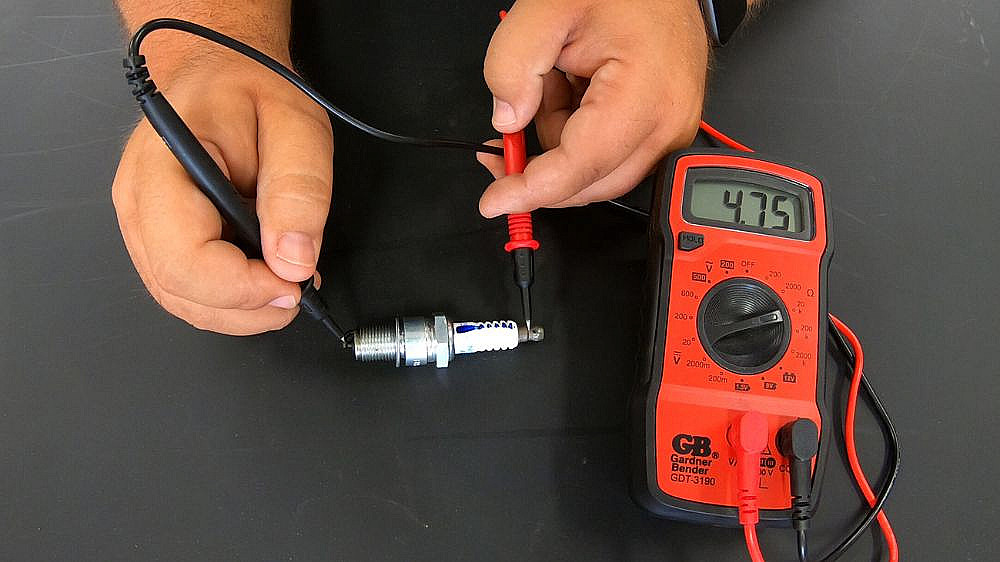
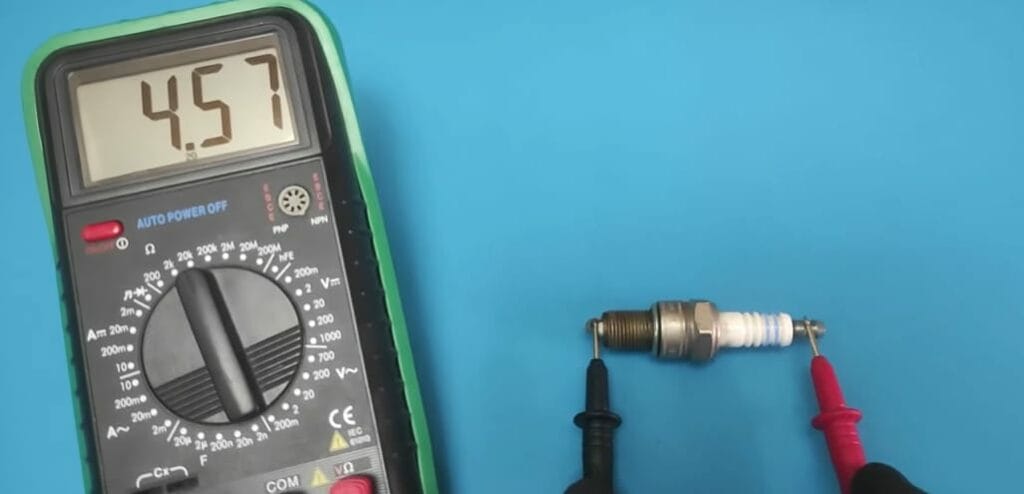
Now, touch one probe of the multimeter to the terminal of the spark plug (the metal part that connects to the spark plug wire) and the other probe to the metal casing of the spark plug (the part that screws into the engine).
Watch the multimeter. What does it say? Ideally, you're looking for a reading of around 5,000 to 15,000 Ohms (or 5 to 15 kΩ). This is considered the normal resistance for most spark plugs.
If the multimeter reads zero (or very close to zero), that means there's virtually no resistance. That might sound good, but it could indicate a short circuit within the spark plug. Think of it like a water pipe with a massive hole – all the water (electricity) just rushes straight through without doing any work. Not ideal.
If the multimeter reads infinity (or shows a "1" on the left side of the display), that means there's a massive amount of resistance, like trying to run a marathon in quicksand. The spark plug is completely blocked, and no electricity is getting through. This spark plug is deader than a doornail.
Interpreting the Results: Sherlock Holmes Time!
So, what do your readings mean? Here's a cheat sheet:

- Good: 5,000 - 15,000 Ohms (5-15 kΩ) – The spark plug is probably fine.
- Zero Ohms: Possible short circuit – Replace the spark plug.
- Infinity Ohms: Open circuit – Replace the spark plug.
Keep in mind that a multimeter test isn't foolproof. It can tell you if a spark plug is definitely bad, but it can't always guarantee that a spark plug is 100% good. Sometimes, a spark plug can work intermittently, causing problems that are difficult to diagnose.
But hey, at least you've narrowed down the possibilities! You've armed yourself with knowledge and a multimeter, ready to tackle your car troubles. And if all else fails, there's always YouTube. Just be careful not to fall down a rabbit hole of automotive repair videos. You might end up rebuilding your entire engine when all you needed was a new air filter.
So go forth, diagnose, and conquer! And remember, even if you mess things up, at least you'll have a good story to tell. (And maybe a slightly smoking engine.)