Alright, gather 'round, folks! Let's talk electricity. Now, I know what you're thinking: "Electricity? Sounds boring!" But trust me, this is gonna be shocking...ly interesting. We're diving into the great debate: Alternating Current (AC) vs. Direct Current (DC) – a battle that raged in the late 1800s and has shaped the world we live in today.
Think of it like this: AC and DC are like two rival gangs fighting over who gets to power your toaster. And let me tell you, it was a *heated* competition! Get it? Heated? Because electricity...? Okay, I'll show myself out... eventually.
What's the Difference, Anyway?
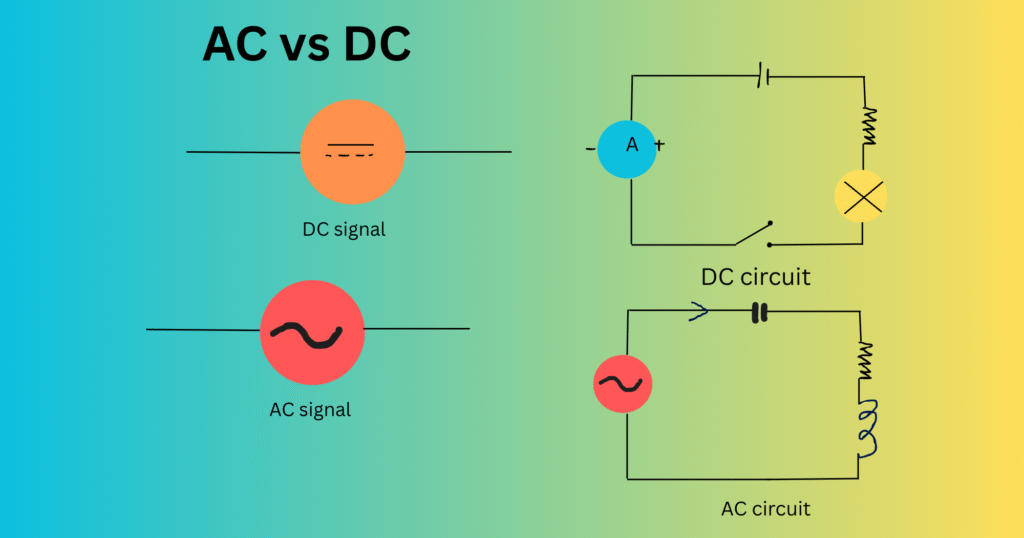
First things first, what *are* these currents, anyway? Imagine you're a tiny electron, zipping along a wire. With DC, you're like a diligent little worker, marching in a single file line, always moving in the same direction. Think of a battery. It steadily pushes electrons in one direction, powering your flashlight. Predictable, reliable... a little boring, frankly.
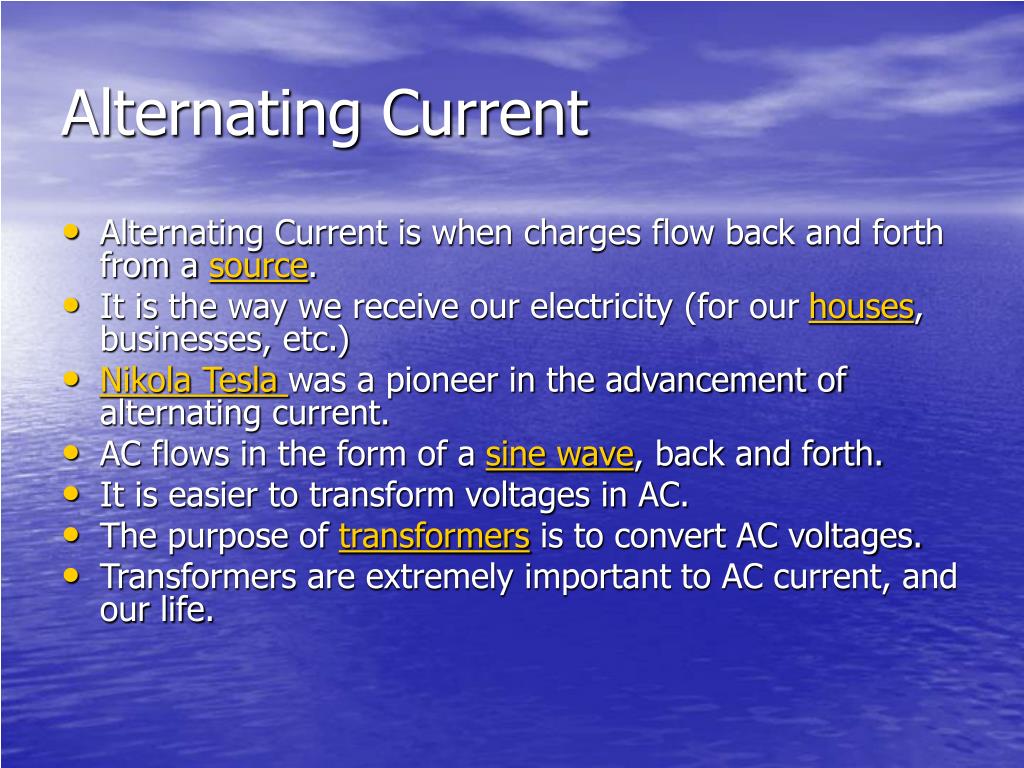
Now, AC? AC is like a rave for electrons! They're not just moving, they're dancing! They change direction constantly, oscillating back and forth. Picture a mosh pit – electrons shoving each other around, sometimes going forward, sometimes going back. It sounds chaotic, but it’s incredibly useful. The voltage flip-flops, too – hence the 'alternating' part.
The frequency of this back-and-forth, measured in Hertz (Hz), is like the speed of the rave music. In the US, it's usually 60 Hz, meaning the electrons change direction 60 times per second! That's a lot of headbanging!
The Great Current War: Edison vs. Tesla (Spoiler: Tesla Won)
So, why all the fuss? Well, in the late 1800s, Thomas Edison championed DC power, and Nikola Tesla (backed by George Westinghouse) pushed for AC. Edison had already built a DC power grid in New York City, but there was a problem: distance.
DC power *loses energy* very quickly as it travels. Imagine trying to shout a message across a football field. By the time the person at the other end hears you, they’ll only catch a few garbled words. Same with DC – after a short distance, it gets weak and useless. This meant you’d need a power plant every square mile or so. Imagine the sheer amount of noisy power plants to cover the whole of America!
Here's where Tesla's genius came in. He understood the power of AC's ability to be easily transformed to a high voltage with transformers. Transformers, you see, only work with AC. High voltage is like shouting through a megaphone! High voltage means you can transmit power over long distances with very little loss. Think of it like sending your electricity via first class post instead of carrier pigeon. When electricity arrives to where it's needed, the voltage can then be stepped down to a safer voltage, such as 120V found in most US homes.
Edison, bless his heart, wasn't a fan. He even staged public demonstrations where he electrocuted animals with AC to try and scare people (not cool, Edison!). He wanted to show how dangerous AC was, and promoted the term "Westinghousing" as a synonym for electrocution!
But the facts were the facts. AC was more efficient for long-distance transmission. And at the 1893 Chicago World's Fair, Westinghouse and Tesla lit up the entire fair with AC power, completely blowing away Edison's DC system. It was a knockout punch.
So, AC Won. Now What?
Today, almost all of our power grids use AC. That's why those high-voltage power lines crisscrossing the country are such a common sight. They're carrying AC power over vast distances, bringing electricity to your homes and businesses.
But wait! What about batteries? What about laptops and phones? Don't they use DC? Good question! The truth is, many of our electronic devices actually use DC. So, what happens? The chargers and power supplies you use *convert* AC from the wall into the DC that your devices need. Sneaky, right? It's like having an interpreter that speaks both AC and DC.
Even more surprising: modern technology is circling back to high-voltage DC (HVDC) power transmission for very long distances. This is because HVDC can be even more efficient than AC for sending electricity across hundreds or thousands of miles. It's not quite a victory for Edison, but it shows that both AC and DC have their place in the world of electricity. Maybe these two rival gangs can find a way to cooperate after all.
So there you have it! The electrifying tale of AC vs. DC. Next time you flip a light switch, remember the great Current War and the battle for supremacy between dancing electrons and marching electrons. And maybe, just maybe, send a silent thank you to Nikola Tesla for powering your Netflix binge.