Ever sat around, sipping your latte, and wondered what happens when Uncle Sam decides a company is just *too good* at making one thing? Like, so good, they've squeezed everyone else out of the sandbox? Well, grab another croissant, because we're about to dive into a legal heavyweight bout that’s surprisingly dramatic, surprisingly funny, and surprisingly *still* relevant today.
Our story begins in a time when big business was king, and one company reigned supreme in the world of… wait for it… aluminum. Yes, that shiny, lightweight metal that makes your soda cans and airplane wings possible. We're talking about the Aluminum Company of America, or, as it was more famously known, Alcoa.
Picture this: if you wanted aluminum in America, there was pretty much one place to go. Alcoa wasn't just big; they were like the kid on the block who owned all the Legos and refused to share. By the 1930s, they controlled a staggering 90% of virgin aluminum production in the United States. Ninety percent! That’s not just market dominance; that’s practically a royal decree.
Naturally, this kind of industrial muscle flexing eventually caught the eye of the U.S. government, which, bless its heart, has this thing about ensuring healthy competition. They don't like monopolies. They really, really don't like monopolies. And Alcoa, by all appearances, looked like the monopoly poster child.
So, in 1937, Uncle Sam decided enough was enough. The Justice Department launched an antitrust lawsuit, accusing Alcoa of violating the Sherman Antitrust Act. Basically, they said, "Hey, Alcoa, you're so big and so powerful, you're stifling competition, and that's just not fair play."
The Battle Begins: A Cast of Characters
This wasn't just any old lawsuit; it was a marathon. The case, known as United States v. Aluminum Company of America, dragged on for years. Think of it as the legal equivalent of a slow-motion car chase, but with more lawyers and fewer explosions.
Presiding over this epic showdown was a man with a name straight out of a Dickens novel: Judge Learned Hand. Yes, that was his actual name. Not "Judge Pretty Good Hand" or "Judge Okay Hand." *Learned*. The guy was practically a walking, talking legal encyclopedia with a gavel, known for his incisive intellect and beautifully crafted opinions.
The government argued that Alcoa had engaged in all sorts of sneaky tactics to maintain its dominance. They pointed to Alcoa's ownership of virtually all bauxite (the raw material for aluminum) mines, their control over patents, and their aggressive expansion, always making sure they had enough capacity to meet *all* demand, leaving no room for potential competitors.
Alcoa, on the other hand, basically said, "Look, we're not bad guys! We just happen to be really, really good at what we do. We built a better mousetrap, and now everyone only buys our mousetraps. Is it our fault if other people aren't as efficient or innovative?" They argued they hadn't actively tried to exclude competitors but were simply successful due to their superior efficiency and foresight.
The Plot Thickens: A Global Conflict Intervenes
Then, because life loves throwing curveballs, a little thing called World War II happened. Suddenly, America needed aluminum like nobody's business – for planes, ships, and all sorts of wartime machinery. The government, ironically, now *needed* Alcoa to ramp up production, effectively becoming their biggest customer and even funding new plants! Talk about an awkward family dinner.
This war-time demand meant that while the lawsuit was still simmering, Alcoa was absolutely crucial to the war effort. It also meant the government itself was now helping to *expand* Alcoa’s capacity, even as it was suing them for being too big! You can't make this stuff up.
Judge Learned Hand Drops the Mic
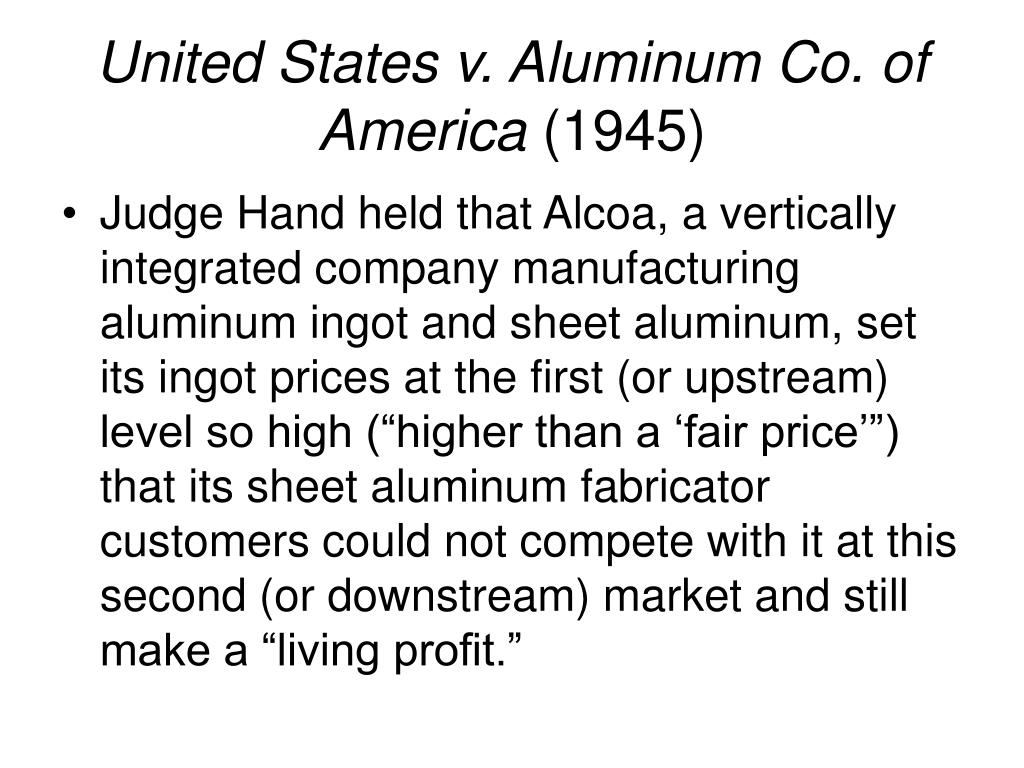
By the time Judge Hand finally delivered his opinion in 1945, the legal world was holding its breath. And what an opinion it was! In a move that forever changed antitrust law, Hand famously declared that even if a company didn't *mean* to be a monopoly, if it still *acted* like one and had the power to exclude competitors, that was enough. He wrote that Alcoa "monopolized the ingot market."
His ruling introduced the idea of an "innocent monopoly" – that a company could grow so large and efficient that it naturally excluded others, even without explicitly predatory behavior. But, Hand argued, even *that* kind of monopoly was bad for competition. He wrote, "The successful competitor, having been urged to compete, must not be turned upon when he wins." But then he clarified that a monopoly formed through sheer excellence, *if* it then took actions to keep others out, was still illegal.
However, thanks to the war and the sheer upheaval it caused in the aluminum market (the government had funded rival plants during the war, creating new competition), the court didn't actually order Alcoa to be broken up. Instead, they essentially left it to the Attorney General to monitor the situation. The goal was to open up the market, not just punish Alcoa for past successes.
The Legacy: Why It Still Matters
So, what did we learn from this epic showdown between Uncle Sam and the aluminum giant? Well, for one, Uncle Sam proved he's not afraid to rumble, even with the biggest corporations. But more importantly, the Alcoa case, and Judge Hand's brilliant opinion, set a new bar for what a monopoly really means.
It wasn't just about *intent* anymore; it was about power and structure. If your company holds such a dominant position that it effectively *precludes* competition, even if you got there by being incredibly clever and efficient, you might still be in Uncle Sam's crosshairs. It put companies on notice: being too good can sometimes be a legal liability.
Today, the Alcoa case is a cornerstone of antitrust law, studied by every law student and debated by economists. It reminds us that competition isn't just about fairness; it's about fostering innovation and preventing single entities from wielding too much economic control. So, the next time you pop open a cold soda, spare a thought for the epic legal battle fought over the very metal in your hand. It was a true American classic, proving that even the most mundane industries can produce the most fascinating legal sagas!