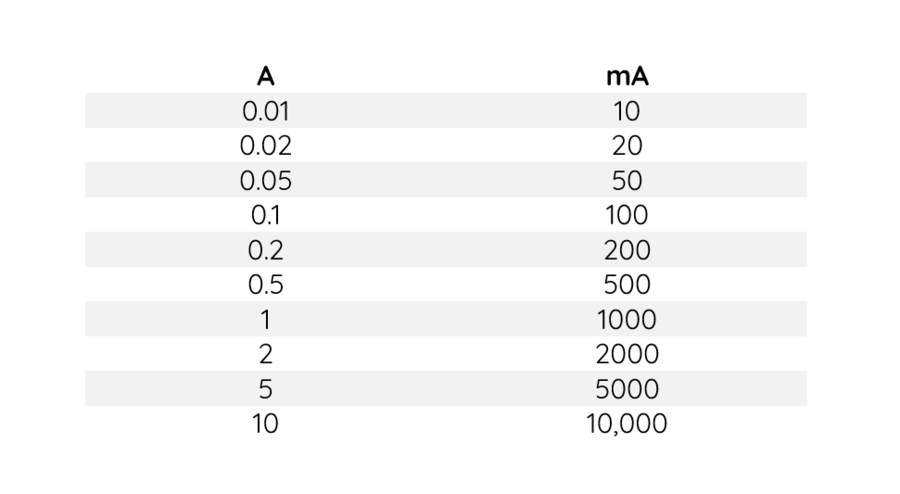
Have you ever seen those mysterious little letters, mA, lurking next to a number on some gadget? Perhaps on your phone charger, or a small battery pack? They seem to whisper tales of complex electrical wizardry, don't they?
For years, society has upheld this grand illusion that converting from milliamps to plain old amps is some arcane secret. A puzzle only solved by those with a doctorate in electrical engineering, perhaps while wearing a very serious lab coat. Well, gather 'round, because I'm about to drop a truth bomb that might just rattle your understanding of the universe.
This is my slightly unpopular opinion, but frankly, it needs to be said. The conversion from mA to A is not just easy; it's almost insultingly simple. So simple, in fact, that it makes you wonder why we ever gave it so much dramatic flair.
The Great Millia-Mystery Unveiled!
Picture this: you have a number like 500 mA. It sounds important, a little technical, maybe even intimidating. But what if I told you it's essentially just a small change of clothes for the number?
The "milli" in milliamps is just a fancy way of saying "one-thousandth." Think of it like "millimeter" or "millisecond." It means you have a thousand tiny bits making up one whole.
So, if you have 500 mA, you actually have 500 of those tiny, tiny current bits. To get to a whole amp, you need a full thousand of them. Are you starting to see where this is going?
The Super Secret Decoder Ring (Not Really!)
Here's the grand reveal, the mind-bending trick, the secret handshake that will open doors to a world of electrical understanding. To convert from mA to A, you simply... move the decimal point. No complex formulas, no calculus, no sacrificing a resistor to the circuit gods.
To convert from mA to A, just slide that decimal point THREE places to the LEFT!
That's it. Seriously. You take your number, let's say 500 mA, find the invisible decimal point at the end (which is 500.), and scoot it over. One, two, three jumps to the left. What do you get? 0.5 A.
Mind blown, right? I know, I know. It's like finding out the monster under your bed was just a dusty sock. All that fear, all that mystique, evaporated with three tiny slides of a decimal.
Everyday Analogies for the Disbelievers
Still skeptical? Let's talk about something everyone understands: money. Imagine you have 500 cents. To convert that to dollars, you don't do complex math, do you?
You simply move the decimal point two places to the left, because there are 100 cents in a dollar. 500 cents becomes $5.00. With milliamps, it's the exact same principle, just with a "milli" meaning "a thousand" instead of a "centi" meaning "a hundred."
Another one: millimeters to meters. If your tiny screw is 25 millimeters long, how many meters is that? You slide the decimal point three places to the left: 0.025 meters. See? You've been doing this kind of thing all your life without even realizing you were mastering electrical conversions!
The "milli" prefix is your friend. It's a little linguistic clue, a whispered hint from the universe, always telling you to think in terms of one-thousandths. Once you grasp that, the conversion is less of a calculation and more of a quick mental adjustment.
Why All The Fuss, Anyway?
This is where my unpopular opinion really comes into its own. Why do we, as a collective human consciousness, allow such a simple conversion to be treated with such gravitas? Is it a conspiracy? A secret handshake among engineers to feel superior?
Perhaps it's the daunting names themselves: Amperes, named after the rather brilliant French physicist André-Marie Ampère. It sounds important. It is important! But the units derived from it don't need to be cloaked in mystery.
I propose we embrace the glorious simplicity. Let's collectively smirk at the idea that this conversion is anything but a delightful decimal shuffle. Imagine the time saved, the brain cells liberated!
Liberate Your Inner Electrician!
Now, when you see a specification like 2500 mA on a power bank, you won't flinch. You'll confidently slide that decimal point three places left. 2.5 A. You'll feel a tiny surge of power – not electrical, but intellectual!
Your phone charger might say 1000 mA output. "Ah," you'll casually observe, "that's just 1 A." You'll sound incredibly knowledgeable, yet you've only performed the simplest of mental gymnastics.
It's like having a secret superpower. You can now translate the language of tiny currents into the language of larger, more familiar currents, without breaking a sweat. No more frantic Googling, no more whispered queries to tech-savvy friends.
So, next time someone makes a big deal about mA to A conversion, just offer them a knowing wink. Perhaps gently remind them that it's as tricky as changing pennies into dollars, only with a slightly larger number for the conversion factor. Then watch their world tilt, just a little.
Embrace the Obvious
This isn't about shaming anyone who found it confusing. It's about shining a spotlight on something that's been unnecessarily complicated. It's about celebrating the joy of simple truths in a world often bogged down by perceived complexity.
So, go forth! Convert with confidence! Let your decimal points slide freely and gracefully. The world of electricity, in its numerical representation, is now your oyster.
And remember, my friends, sometimes the most profound "secrets" are actually the most obvious ones. Especially when they involve just a quick trip for a decimal point. Enjoy your newfound, incredibly easy, power-conversion prowess!