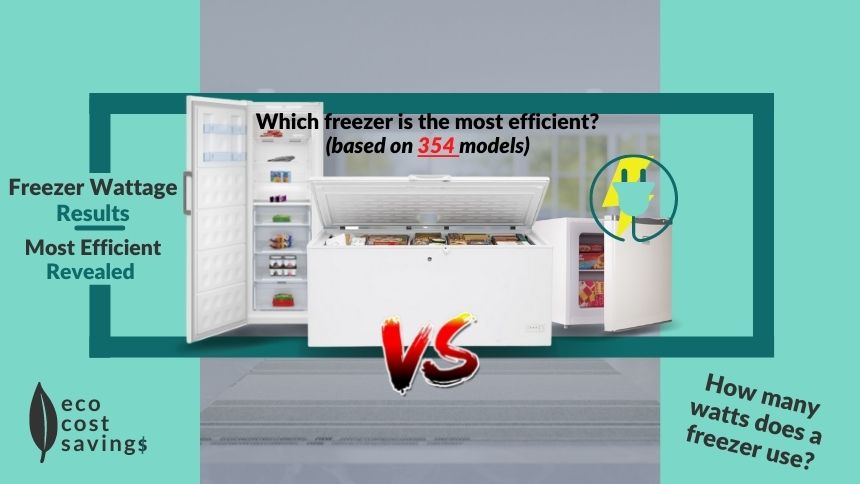
Ever stared blankly at your humming freezer, perhaps while rummaging for that emergency pint of ice cream, and wondered: "How many watts is this frosty behemoth actually devouring?" It’s a perfectly reasonable question! Is it a gentle sipper of electricity, or is it secretly guzzling power like it’s a thirsty dragon guarding frozen peas? Let’s pull back the icy curtain and have a laugh while we figure it out.
The short, unsatisfying answer is: it depends! But don't worry, we're not just going to leave you hanging like a forgotten bag of freezer-burned berries. We're going to dive into the chilly specifics with more enthusiasm than a kid on a snow day.
The Great Wattage Reveal: It's Not a Single Number!
Your freezer isn't a one-trick pony when it comes to power. Its wattage is a dynamic beast, fluctuating based on a few hilarious and surprisingly logical factors. Think of it less as a rigid number and more as a mood ring for electricity consumption.
1. Size Matters (And We're Not Talking About Your Ice Cream Scoop)
Naturally, a tiny mini-freezer, barely big enough for a single frozen pizza and a few forlorn ice cubes, will use significantly less power than a chest freezer designed to store a small woolly mammoth. That little guy, often found in dorm rooms or man caves, might hum along at a mere 50-75 watts. But a full-sized upright or chest freezer? You're looking at something more in the range of 100-400 watts during its running cycles. It’s like comparing a chihuahua to a St. Bernard – both dogs, vastly different appetites!
2. The Age-Old Question: Is Your Freezer a Vintage Relic or a Modern Marvel?
Ah, the classic family heirloom freezer! Passed down through generations, perhaps with a charming dent from that one Christmas party. While nostalgic, these older units are often energy hogs. They were built in a time when electricity was cheap and efficiency wasn't exactly a dinner-table conversation starter. An ancient freezer could easily draw 300-500 watts, maybe even more, and often runs longer than its sleek, modern counterparts. A brand-spanking-new, Energy Star certified model? Those are often lean, mean, frost-fighting machines, often running between 70-150 watts for most of their operation. It's like comparing a gas-guzzling muscle car from the 70s to a sleek, fuel-efficient hybrid.
3. How Full Is Your Frosty Friend?
This is where it gets a little counter-intuitive and quite frankly, brilliant. A full freezer is a more efficient freezer! All those frozen burritos, bags of peas, and forgotten leftovers act as a thermal mass. They help hold the cold. Every time you open the door, less cold air escapes because it's replaced by... more cold stuff! An empty or half-empty freezer has to work harder to keep all that empty space chilly, constantly battling the warmer air that rushes in. So, go ahead, stock up! It’s practically an energy-saving strategy.
4. The Door Dance: How Often Do You Peek?
Every time you open that freezer door to ponder if those mystery items are still edible (spoiler: probably not), a tidal wave of warm air crashes in. Your freezer then has to kick into high gear, drawing more power to restore its frosty equilibrium. It’s like repeatedly opening your front door in winter – you’re just letting all the precious heat out! Try to be decisive, grab what you need, and shut that door like you're guarding a secret family recipe.
5. Ambient Temperature: Is Your Freezer Sweating?
Where your freezer lives makes a big difference. If it's chilling in a cool basement or a climate-controlled kitchen, it doesn't have to work nearly as hard. But if it’s sweating it out in a hot garage during a summer heatwave, its compressor will be running more often and pulling more watts to fight the external heat. Give your freezer a break, don't make it work harder than it has to!
Peak Watts vs. Running Watts: The "Awakening" vs. The "Nap"
Here's a crucial distinction. When your freezer's compressor first kicks on, it experiences a brief, intense surge of power. This is its starting or peak wattage. Think of it as a grumpy teenager rolling out of bed – a lot of effort upfront! This might be anywhere from 400-1000 watts for a split second. Once it's settled into its rhythm and just maintaining the cold, that's its running wattage, which is much lower, typically in the 70-400 watt range we discussed earlier. This difference is important if you're planning to connect your freezer to a generator or an off-grid solar system. You need that initial "oomph!" to get it going.
So, Why Does This Chilly Info Matter?
Beyond being able to impress your friends at your next gathering with obscure appliance facts, knowing your freezer's wattage can actually be pretty useful. It helps you:
- Estimate your electricity bill: A more efficient freezer means happier pockets.
- Plan for power outages: If you're using a generator, you'll know if it can handle the freezer's starting surge.
- Embrace off-grid living: Solar panel and battery sizing relies on knowing your appliance loads.
- Just be generally awesome and informed!
In conclusion, your freezer isn't a mindless power zombie, but a somewhat complex appliance with a fluctuating appetite for electricity. Treat it well, keep it full, and maybe give it a little pat on the side for keeping your ice cream perfect. And next time you're staring at it, you'll know it's not plotting against your wallet, just diligently keeping things frosty. Unless, of course, it's one of those ancient ones – then it definitely has a hidden agenda.