Hey there! So, you’re diving into the wonderful world of air conditioning, huh? And not just any AC, but the *big kahuna*! A 5-ton unit! That’s like, a serious chill-out machine. But then the inevitable question pops up, right? The one that makes your wallet twitch a little: "How many watts for a 5-ton AC?"
It’s a fantastic question, and honestly, it’s not as straightforward as just saying "X watts!" Because, well, things are rarely that simple, are they? It's a bit like asking "How much does a car cost?" You know, it really depends on the car!
First Off: What Even *Is* a "Ton" in AC Lingo?
Okay, let's clear this up super quick, because it's a common little head-scratcher. When we talk about a "ton" in air conditioning, we’re *not* talking about its weight. Phew! Imagine trying to lift that thing. No, a ton here refers to its cooling capacity.
Specifically, one ton of AC power is equivalent to 12,000 BTUs per hour (BTU/hr). BTUs stand for British Thermal Units, and it’s basically a measure of heat. So, a 1-ton AC can remove 12,000 BTUs of heat from your space in an hour. Pretty cool, right?
So, if you’ve got a 5-ton AC, you’re talking about a unit capable of removing a whopping 60,000 BTUs of heat per hour (that’s 5 x 12,000). That’s some serious cooling power! We’re talking about keeping a large home, a commercial space, or maybe even a small indoor ice rink delightfully frosty.
Alright, Let's Talk Watts!
Now for the juicy bit – the watts! Because watts are what your electricity meter cares about. And watts are what your electricity bill is based on. Nobody wants a surprise bill that could fund a small vacation, am I right?
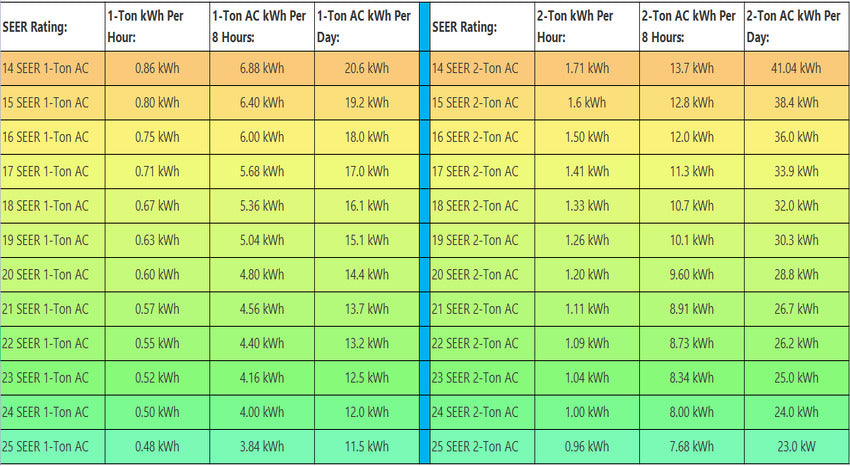
To figure out the watts, we need to introduce a fancy little term: EER (Energy Efficiency Ratio) or its seasonal cousin, SEER (Seasonal Energy Efficiency Ratio), or even the newer SEER2. Don’t panic! It’s just a number that tells you how efficient your AC unit is.
Think of it like miles per gallon for your car. A higher EER/SEER means your AC is more efficient and uses *less* electricity (fewer watts) to produce the same amount of cooling.
The formula is pretty straightforward: Watts = BTUs / EER.
So, What's the Number?
Let's crunch some numbers for our 5-ton (60,000 BTU) beast. The EER of AC units can vary quite a bit based on age and model. Older units might have an EER of 8-10. Newer, more efficient ones can hit 12, 14, even 16+ or much higher with SEER2 ratings (which are calculated a bit differently but generally mean better efficiency).
- If your 5-ton AC has an EER of 10 (which is on the lower, older side):
60,000 BTUs / 10 EER = 6,000 watts. - If your 5-ton AC has an EER of 12 (a pretty standard, decent efficiency):
60,000 BTUs / 12 EER = 5,000 watts. - If your 5-ton AC has an EER of 15 (a really good, energy-efficient unit):
60,000 BTUs / 15 EER = 4,000 watts.
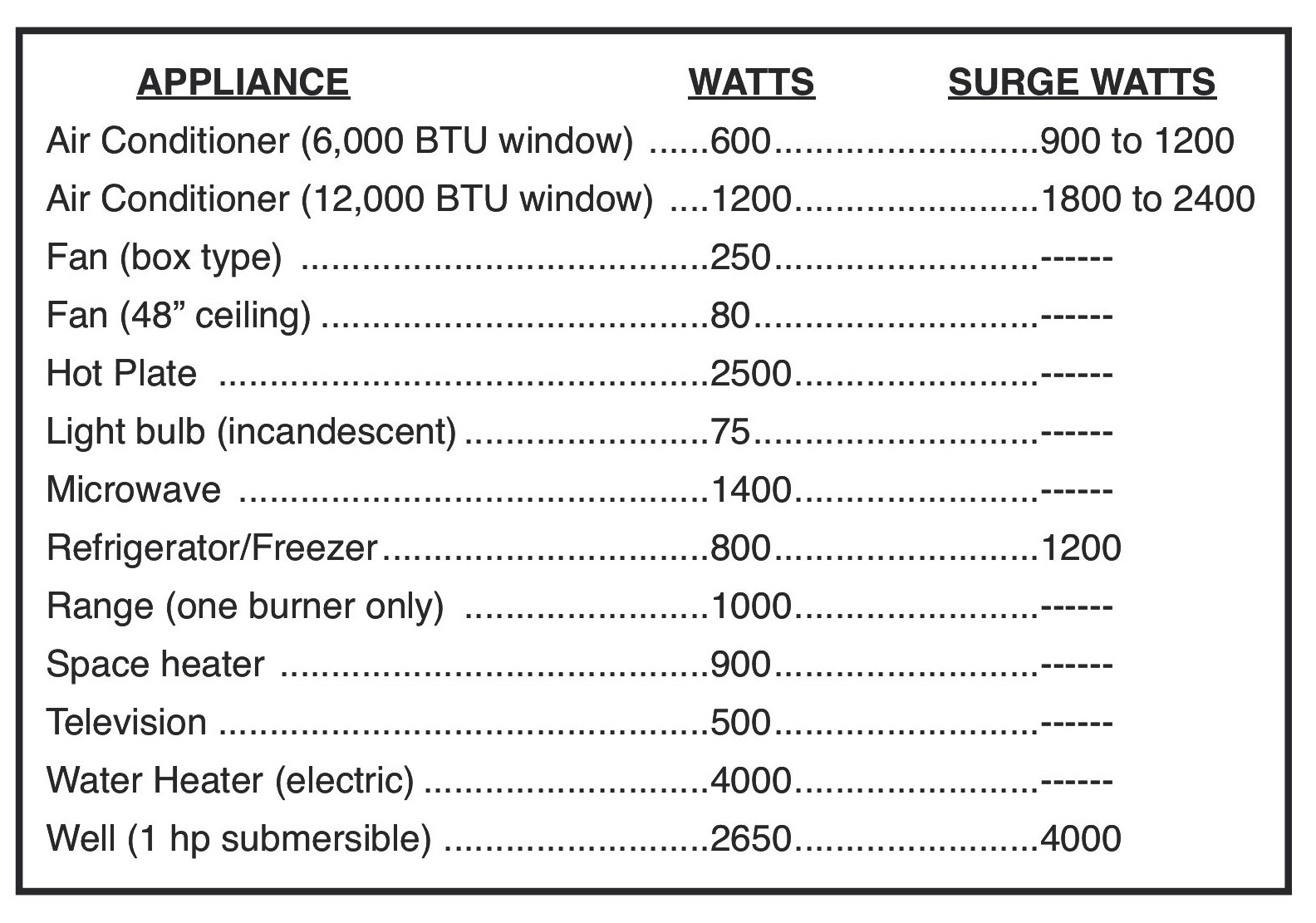
So, as a general rule of thumb, a 5-ton AC unit will typically draw anywhere from 4,000 to 6,000 watts when it’s humming along and doing its job. That’s for the compressor and the main fan running. Remember, the startup current (the initial surge when it first kicks on) can be higher for a brief moment, but we're mostly talking about continuous running watts here.
Why Does This Matter Beyond Your Wallet?
Well, beyond the obvious (your electricity bill!), knowing these wattages is super important for a couple of other reasons:
- Electrical Panel Capacity: A 5-ton AC is a hefty load. You need to make sure your home’s electrical panel and wiring can handle that kind of wattage without tripping breakers or, heaven forbid, causing more serious issues. This is why you should always consult a professional electrician for installation!
- Generator Sizing: If you’re thinking about backup power, you need a generator strong enough to kick-start and run your AC. And trust me, you’ll need a pretty beefy one for a 5-ton unit!
The Takeaway? Check Your Specs!
While those 4,000-6,000 watt numbers are a great starting point for a 5-ton AC, the absolute best way to know for *your specific unit* is to check the manufacturer's specifications. It’s usually on a sticker right on the outdoor unit or in the owner's manual. Look for the "rated watts," "power consumption," or even the EER/SEER rating.
So there you have it! A 5-ton AC isn't just a powerful cooling machine; it's a significant power consumer. Understanding its wattage helps you appreciate its mighty capabilities and plan accordingly, both for comfort and your budget. Now go forth and conquer that summer heat, my friend!