Ever found yourself staring at an electricity bill, or maybe just pondering the little labels on your gadgets, and seen words like "watt" or "kilowatt" float by? You're not alone! These terms are super common, yet sometimes they feel like secret codes only electricians understand. But here's a little secret: they're actually pretty simple and super cool once you get the hang of them.
Today, we’re going to unravel one of those seemingly complex riddles: How many kilowatts are in a watt? Let's dive in with a relaxed vibe and make some sense of it all!
What's a Watt, Anyway?
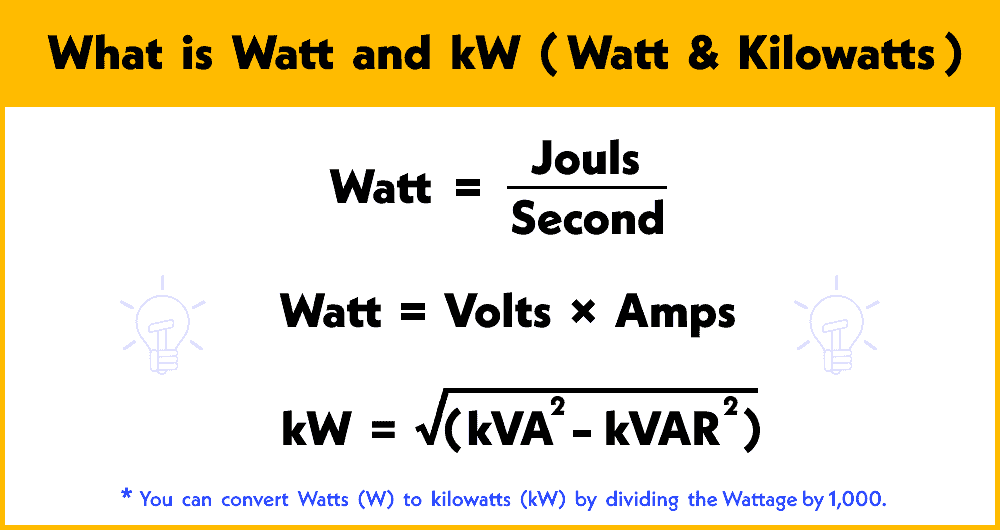
Let's start with the basics. Imagine electricity is like water flowing through a hose. A watt (often abbreviated as W) is essentially a measure of power. It tells you how much work electricity is doing at any given moment, or how fast energy is being used or produced.
Think of it as the "oomph" factor. A light bulb uses watts, a laptop charger uses watts, and even your trusty old toaster has a watt rating. The higher the watt number, the more power that device demands (or supplies!).
It's named after James Watt, a brilliant Scottish inventor who significantly improved the steam engine. So, when you see "watt," give a little nod to history and the power of innovation!
And the Mighty Kilowatt?
Now, enter the kilowatt (kW). If you've ever heard of kilograms (1,000 grams) or kilometers (1,000 meters), you might already be sensing a pattern here. The prefix "kilo" literally means "thousand."
So, if a watt is a measure of power, then a kilowatt is just a bigger, more convenient unit to talk about lots of power. It's like switching from counting individual grains of sand to talking about buckets of sand.
This is where we get to the heart of our question! Because "kilo" means thousand, it immediately tells us the relationship:
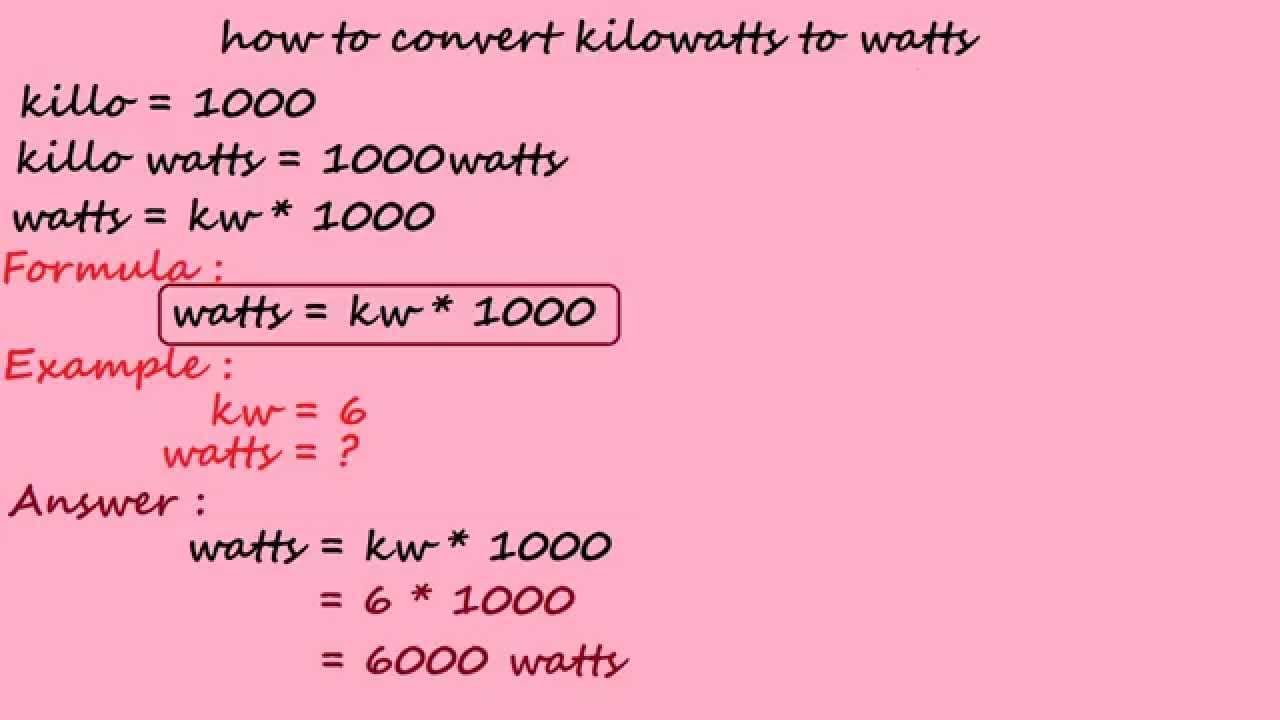
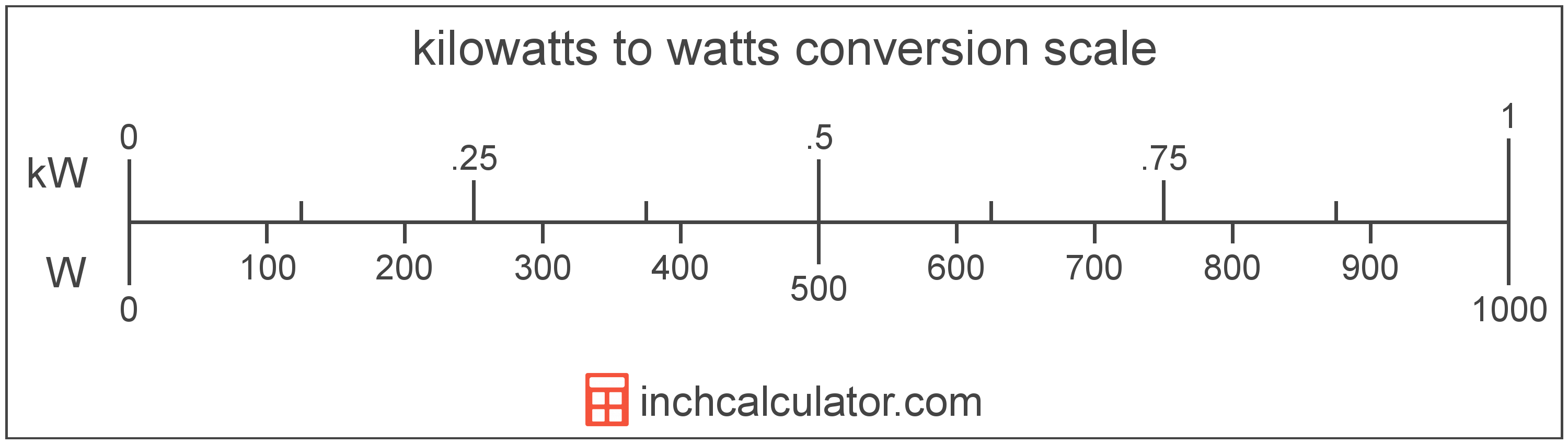
One kilowatt (1 kW) is equal to one thousand (1,000) watts.
Pretty straightforward, right? So, if you have a device that uses 1,500 watts, that's 1.5 kilowatts. If something is rated at 500 watts, that's half a kilowatt (0.5 kW).
And to flip our initial question around: how many kilowatts are in a single watt? Well, a single watt is a tiny fraction of a kilowatt. Specifically, one watt is 0.001 kilowatts. It's usually easier to think the other way around: 1,000 watts in 1 kilowatt.
So, Why Does This Matter to You?
This isn't just some abstract science fact; understanding watts and kilowatts can actually be quite empowering!
For starters, your electricity bill often charges you by kilowatt-hour (kWh). A kilowatt-hour measures how much energy you've used over a period of time (one kilowatt of power used for one hour). Knowing the difference between watts and kilowatts helps you decode that bill and understand where your money is going.
Think about comparing appliances. Why does your tiny phone charger barely warm up, but your hair dryer can feel like a mini jet engine and definitely heats up the bathroom? It's all about the watts! A phone charger might use around 5-20 watts, while a hair dryer can easily blast out 1,500-2,000 watts (or 1.5-2 kilowatts!). That huge difference in power directly relates to their energy consumption and how much heat they generate.
Understanding these units also helps you make more informed choices when buying new electronics. Want to be more energy-efficient? Look for devices with lower wattages for the same task. Thinking of getting solar panels? Their output will be measured in kilowatts, letting you know how much power they can generate.
Thinking Big, or Small?
Let's put this into perspective with some fun comparisons:
Imagine a single raindrop. That's like a watt – small, but it contributes. Now, imagine a full-on shower. That's a kilowatt – a collection of a thousand raindrops making a much bigger impact!
Or think about LEGOs. A single LEGO brick might represent a watt. You can build something small with just a few. But to build that epic LEGO castle you've always dreamed of, you're going to need thousands of bricks – that's your kilowatt!
This concept of scaling up with "kilo" isn't unique to electricity. It's the same reason we talk about our weight in kilograms rather than individual grams, or measure long distances in kilometers instead of just meters. It just makes the numbers more manageable and easier to grasp.
Your Superpower of Understanding!
So, the next time you see "W" or "kW" on an appliance, or glance at your electricity bill, you can now confidently say, "Aha! I know what that means!" You've got a little superpower of understanding that helps demystify the world of energy.
It's not just about a simple conversion; it's about seeing the bigger picture of how we use power in our homes and in the world. So, stay curious, keep asking questions, and enjoy the satisfaction of unraveling everyday mysteries!