Alright, grab another coffee, because we're about to dive into one of those questions that sounds simple but makes your brain do a little tango. You know the one: "How many BTUs are in a Watt?"
And if you just squinted and thought, "Wait, aren't those two different things?" – congratulations, you've already won half the battle! This isn't like asking "How many apples are in a banana?" It's more like asking "How many miles per hour are in a mile?" See? We're already in brain-tickling territory.
Meet Our Contenders: Watt and BTU
First, let's get to know our energy celebrities. On one side, we have the Watt. The Watt is like the hyperactive squirrel of the energy world. It's a unit of power. It tells you how fast energy is being used or produced at a given moment. Think of your light bulb: a 60-Watt bulb is constantly using 60 Watts of power when it's on. It's the speed limit for energy.
On the other side, we have the BTU, which stands for British Thermal Unit. Sounds incredibly fancy and important, right? Like it should be worn with a monocle. But really, it’s just the amount of energy needed to raise the temperature of one pound of water by one degree Fahrenheit. Yes, really! It's an old-school unit, but it's still king in the world of heating and cooling, especially for things like air conditioners and furnaces. The BTU measures total heat energy, like the total distance you've traveled, not how fast you're going.
Why the Confusion is Totally Valid (and a Little Funny)
So, we have the Watt, which is all about power (how fast), and the BTU, which is all about heat energy (how much). Trying to directly convert one to the other without a crucial missing piece is like asking how many teaspoons of laughter are in a happy sigh. They're related, sure, but not directly interchangeable in that way.
The core issue is that a Watt is a measure of rate. It's energy per unit of time (specifically, one Joule per second). A BTU is a measure of a quantity of energy. It's like asking "how many gallons per minute are in a gallon?" You need time to bridge that gap!
The Big Reveal: Time is the Secret Ingredient!
This is where our story gets exciting! To connect Watts and BTUs, we need to bring in the concept of... drumroll please... time! Because if a Watt is a rate, then to get a quantity of energy out of it, you need to know *how long* that rate was sustained.
So, instead of "Watts," we talk about "Watt-hours" or, more commonly for our BTU friends, "Watts over a specific time period." And when we do that, the universe suddenly makes sense! Specifically, we're usually talking about BTUs per hour when comparing to Watts.
The Magic Number (Don't Blink!)
Alright, you've waited patiently, you've sipped your coffee, you've navigated the conceptual minefield. Here's the number that finally connects these two titans of thermodynamics:
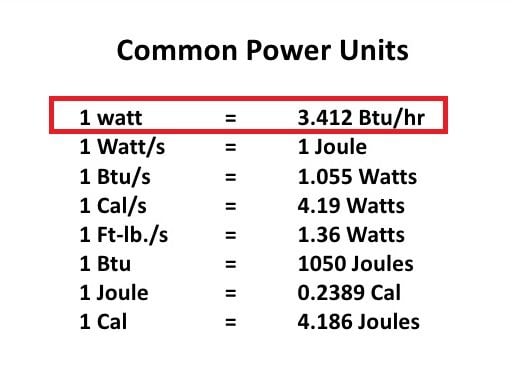
1 Watt of power, sustained for one hour, generates approximately 3.412141633 BTUs of heat.
Let's round that down for sanity, shall we? We'll call it approximately 3.41 BTUs per hour for every Watt of continuous power.
There it is! The conversion factor! It’s not some mystical ancient riddle after all, just a bit of clever accounting for time. So, how many BTUs are in a Watt? The technically precise (and slightly frustrating) answer is: "Zero, because they measure different things, unless you add time, in which case it's about 3.41 BTU/hr per Watt." See why we needed the café chat?
Real-World Examples (Where the Rubber Meets the Road, or the Heat Meets the Air)
Let's put this into practice, because numbers are always more fun when they're heating your house or cooling your beer.
Electric Heaters: The BTU Powerhouses
Ever look at a space heater? Many are rated at 1500 Watts. Now you can calculate their BTU output! If a 1500-Watt heater runs for an hour, it generates:
1500 Watts * 3.41 BTUs/Watt-hour = ~5115 BTUs of heat per hour!
That's why those little heaters can make such a difference in a chilly room! They are just churning out the heat.
Air Conditioners: The Heat Bouncers
AC units are usually rated in BTUs per hour. A typical bedroom AC might be 5,000 to 10,000 BTUs per hour. This means it's *removing* that much heat from your room every hour. While we can't directly convert BTUs/hr of cooling *to* the Watts it consumes (that involves efficiency ratings like EER or SEER, which is a whole other coffee break), you now understand what that 10,000 BTU/hr actually *means* in terms of heat energy.
Light Bulbs: The Warm Glow
Remember those old incandescent light bulbs? A lot of their wattage went into making heat, not just light. A 100-Watt incandescent bulb, when running for an hour, would pump out a hefty 341 BTUs of heat! No wonder they felt hot to the touch. This is also why modern LED bulbs are so much more efficient – they convert a much higher percentage of their Watts into light, and much less into those pesky, unwanted BTUs of heat.
The Takeaway: You're Smarter Now!
So, the next time someone casually tosses out "BTU" or "Watt," you can confidently nod, perhaps with a knowing glint in your eye, and understand the dance they do with time. Watts are about the *rate* of energy, BTUs are about the *amount* of heat energy, and that magical ~3.41 factor links them when you add an hour to the Watt.
It's not just trivia; it's understanding how your appliances work, how your home stays warm or cool, and why that old light bulb was basically a tiny, expensive heater. You've officially leveled up your energy literacy. Go forth and amaze your friends at your next café visit with your newfound wisdom!