Ever found yourself staring blankly at the back of an appliance, wondering what on earth "1200W, 10A" means, or why your hairdryer suddenly decides to plunge your entire kitchen into darkness? You're not alone! Electricity can feel like a secret language, full of mysterious terms. And one of the trickiest questions that often pops up is: "How many amps are in a watt?"
Well, buckle up, because we're about to demystify it with a smile, a few analogies, and maybe even a chuckle!
The Dynamic Trio: Volts, Amps, and Watts
First things first, let's meet our electric dream team. Think of electricity like water flowing through a garden hose. It helps to keep them separate in your mind, because they each describe a different part of the action.
Volts (V): The "Push" or "Pressure"
Imagine your garden hose. The voltage is like the water pressure pushing the water through. More voltage means more "oomph" behind the electricity. In most homes in the US, you'll find outlets supplying about 120 volts, while in many other parts of the world, it's closer to 240 volts. It's the force that makes the electrons want to move.
Amps (A): The "Flow" or "Current"
Now, amps are like the actual amount of water flowing through that hose at any given moment. It's the volume, the intensity of the electric current. A big river has a lot of amps; a tiny trickle has very few.
Watts (W): The "Work Done" or "Power"
And finally, watts are the grand result – the actual "work" being done by that electricity. It's the total power. Think of it this way: the pressure (volts) and the amount of water flowing (amps) combine to determine how powerfully that water can spin a little water wheel. That spinning power? That's your watts!
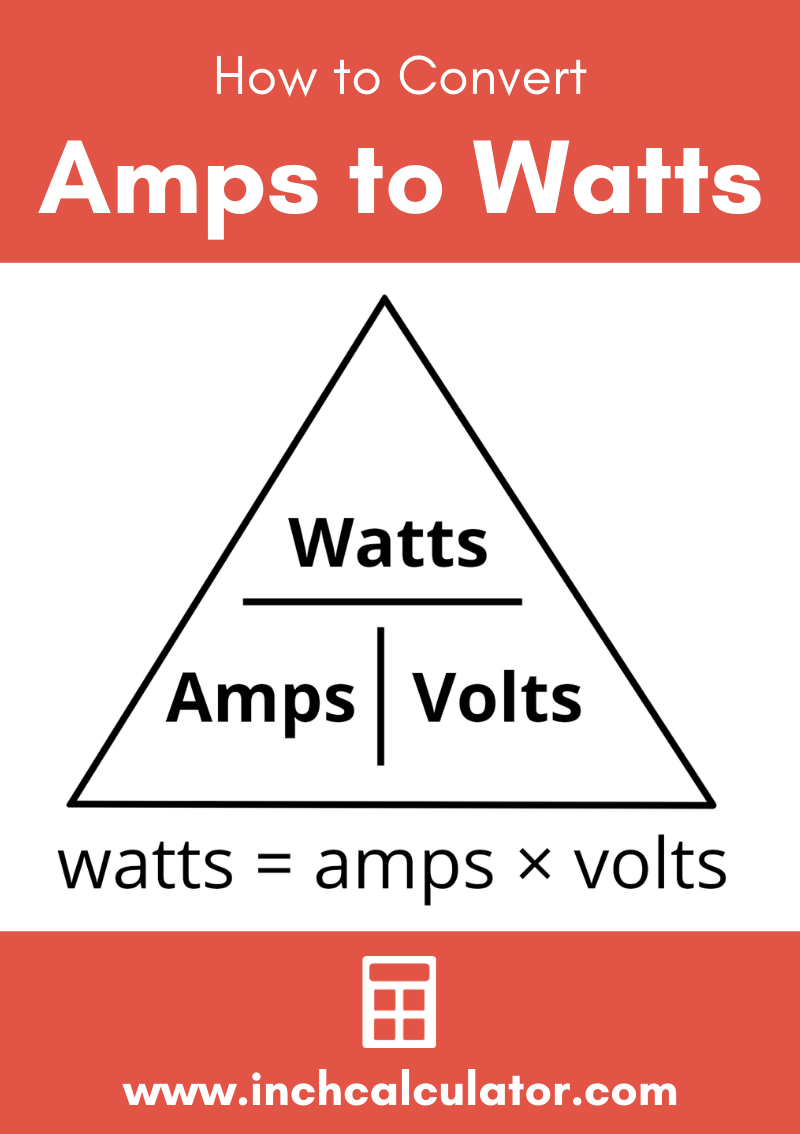
The magic formula that connects them all is wonderfully simple:
Watts = Volts × Amps.
It’s like saying: Pressure × Flow = Power!
Unpacking the "How Many Amps in a Watt?" Mystery
So, back to our original question: "How many amps are in a watt?"
Here's the quirky truth: it's a bit of a trick question! You see, amps aren't "in" a watt any more than the "flow" of water is "in" the "power" it creates. They are connected, but they describe different things.
Think of it like asking, "How many miles are in a gallon of gas?" It depends entirely on the car, the road, and how fast you're driving, right? You need more information!
Similarly, to figure out the amps for a given watt, you *always* need to know the voltage. Without the volts, the question is incomplete.
From our formula (Watts = Volts × Amps), we can easily rearrange it to find amps:
Amps = Watts / Volts.
See? The voltage is the missing puzzle piece that tells you how many amps are involved for a specific amount of power.
Let's Get Real: Everyday Examples
This is where it gets fun and practical!
The Hairdryer Hero (or Villain, depending on your circuit)
Let's take a common hair dryer. It's a powerful beast, often around 1500 watts. If you're in the US (where voltage is typically 120V):
Amps = 1500 Watts / 120 Volts = 12.5 Amps
But what if you're traveling in, say, Germany (where voltage is typically 240V)? For the same 1500-watt hairdryer:
Amps = 1500 Watts / 240 Volts = 6.25 Amps
See? The *same hairdryer* (same watts, same power) draws *fewer amps* at a higher voltage. It's like the water pressure is higher, so you don't need as much water flowing to get the same powerful spray!
The Humble Phone Charger
Now consider your phone charger. It's a low-power device, maybe 10 watts. At 120V:
Amps = 10 Watts / 120 Volts = 0.08 Amps
Tiny, right? That's why you can plug a dozen phone chargers into one outlet without batting an eye, but two hair dryers might trip a breaker!
Why Should You Even Care, Really? (Beyond Just Being Smart!)
Okay, so it's not just for impressing your friends at parties. Understanding this dynamic trio is actually super handy for your everyday life!
Circuit Breakers Are Your Best Friends
Ever had the lights go out because you plugged in too many things? That's your circuit breaker doing its job! Each circuit in your home can only handle a certain amount of amperage (often 15 or 20 amps). If you try to pull more amps than it can handle (like two 12.5-amp hair dryers on a 15-amp circuit), the breaker says, "Nope! Too much current!" and safely shuts off the power to prevent overheating and potential fires. Knowing your appliance's watts (and your home's voltage) lets you calculate amps and avoid overloading.
Travel Adventures and Appliance Safety
Heading overseas? You'll notice many travel adapters are labeled with voltage ratings. If you try to plug a 120V appliance directly into a 240V outlet without a voltage converter, you're essentially doubling the "pressure" without adjusting the "flow" it's designed for. This can lead to a very unhappy (and potentially smoking!) appliance. Knowing that *watts* are the fundamental power lets you compare apples to apples across different voltages.
Choosing the Right Tools (and Cords!)
When you buy an extension cord or a power strip, they have an amperage rating. If you're running high-wattage tools (like a power saw or a space heater), you need a heavy-duty cord that can handle the higher amperage without overheating. Again, knowing Watts = Volts × Amps helps you make smart, safe choices.
Saving Energy (and Money!)
While watts represent power, the amount of power consumed over time (kilowatt-hours) is what your electricity bill measures. Higher watt appliances use more power. Understanding this relationship helps you be more mindful of your energy usage, especially with those energy-hogging items. The fewer watts you consume, the more pennies stay in your pocket!
So, the next time you look at an appliance, remember our dynamic trio: Volts (the push), Amps (the flow), and Watts (the power). They're not just numbers; they're the key to safely and smartly navigating the wonderful world of electricity. And now you know that amps aren't "in" watts; they're a team, working together to get the job done!