Alright, gather 'round, folks! Let's talk about something that sounds super complicated: nuclear power. You probably imagine labs full of people in white coats, giant blinking machines, and maybe a faint hum of something truly mysterious. Well, what if I told you it's... kind of like making really, really hot tea? Or maybe just an extremely fancy way to boil a kettle?
My perhaps "unpopular" opinion is this: at its heart, getting nuclear power isn't about cosmic rays or alien technology. It's about a special rock, some controlled chaos, and a whole lot of steam. Seriously.
The Star of the Show: Our Heavy, Shy Rock
First up, we need our main ingredient. It’s not dragon’s breath or unicorn tears, though that would be cool. It's a rather hefty metal called Uranium. Think of Uranium as the shy, quiet kid in class who, when gently prompted, can put on an absolutely spectacular show. It’s a bit unstable, you see. Its atoms are naturally quite large and, frankly, a little fed up with staying perfectly intact.
We dig this special rock out of the ground. It’s processed into neat little pellets, about the size of a pencil eraser. These tiny pellets pack an astonishing punch. Like a miniature, sleepy giant just waiting for its alarm to go off.
The Gentle Nudge: Splitting the Atom (Not Your Head!)
Now for the "magic trick." How do we get this sleepy Uranium to wake up and produce power? We don’t hit it with a hammer, thankfully. We give it a very polite, very tiny nudge.
We fire a tiny particle, called a neutron, at a Uranium atom.
It’s like flicking a domino. When that tiny neutron hits the big Uranium atom, the atom gets excited. So excited, in fact, that it splits into two smaller atoms. And guess what else it does? It spits out more neutrons! Plus, a rather significant burst of heat. This process is called fission.
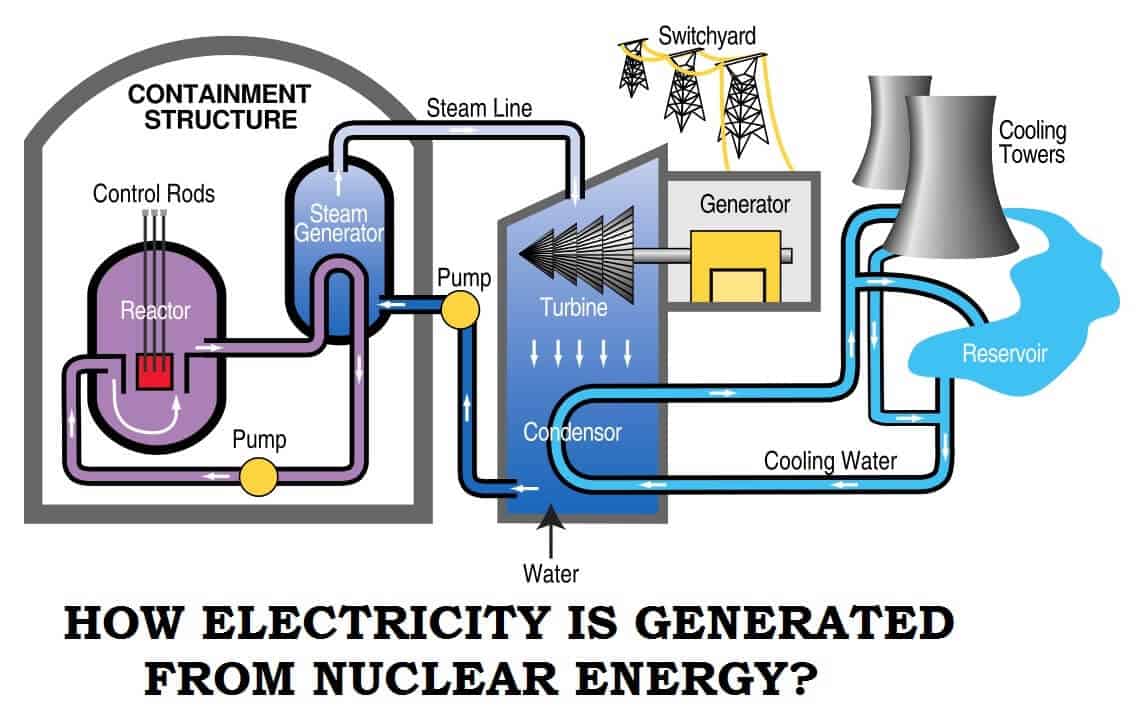
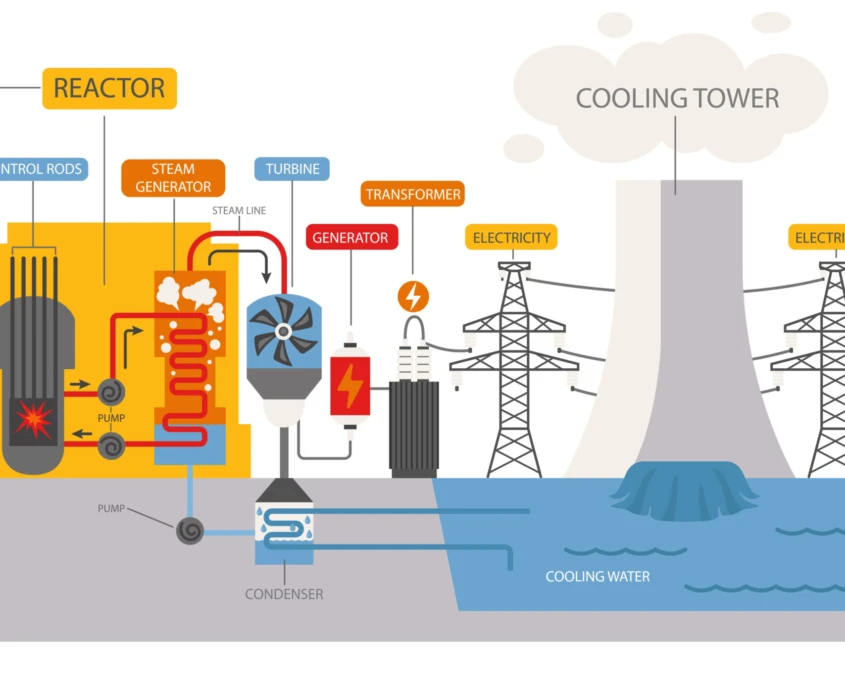
Those newly ejected neutrons then go on to hit other Uranium atoms, causing them to split, release heat, and spit out *more* neutrons. You get the picture. It’s a chain reaction! But before you panic and imagine a scene from a disaster movie, remember: we keep it incredibly well-behaved and controlled. We have special rods, often made of cadmium or boron, that love to gobble up extra neutrons. These are called control rods. They're like the chaperones at a wild party, ensuring things don't get too out of hand.
The Big Secret: Making Things Hot!
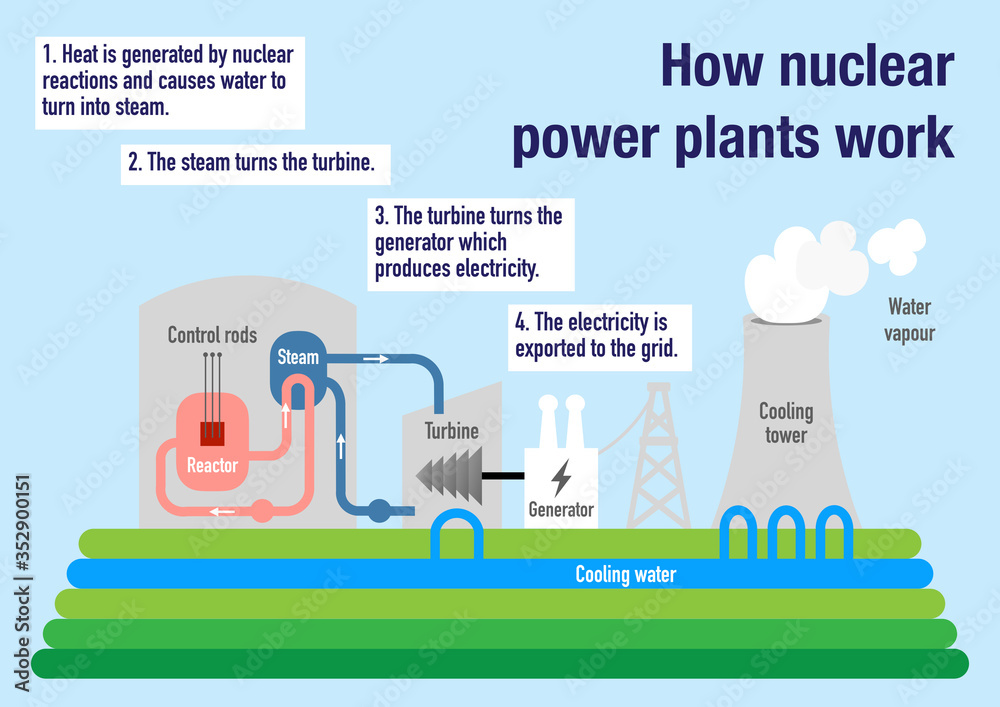
So, we've got our Uranium atoms busily splitting and releasing a phenomenal amount of heat. This is the real secret. Nuclear power, at its core, is just a super-efficient way to generate heat.
All that incredible atomic energy? Its main job is to heat up a whole lot of water.
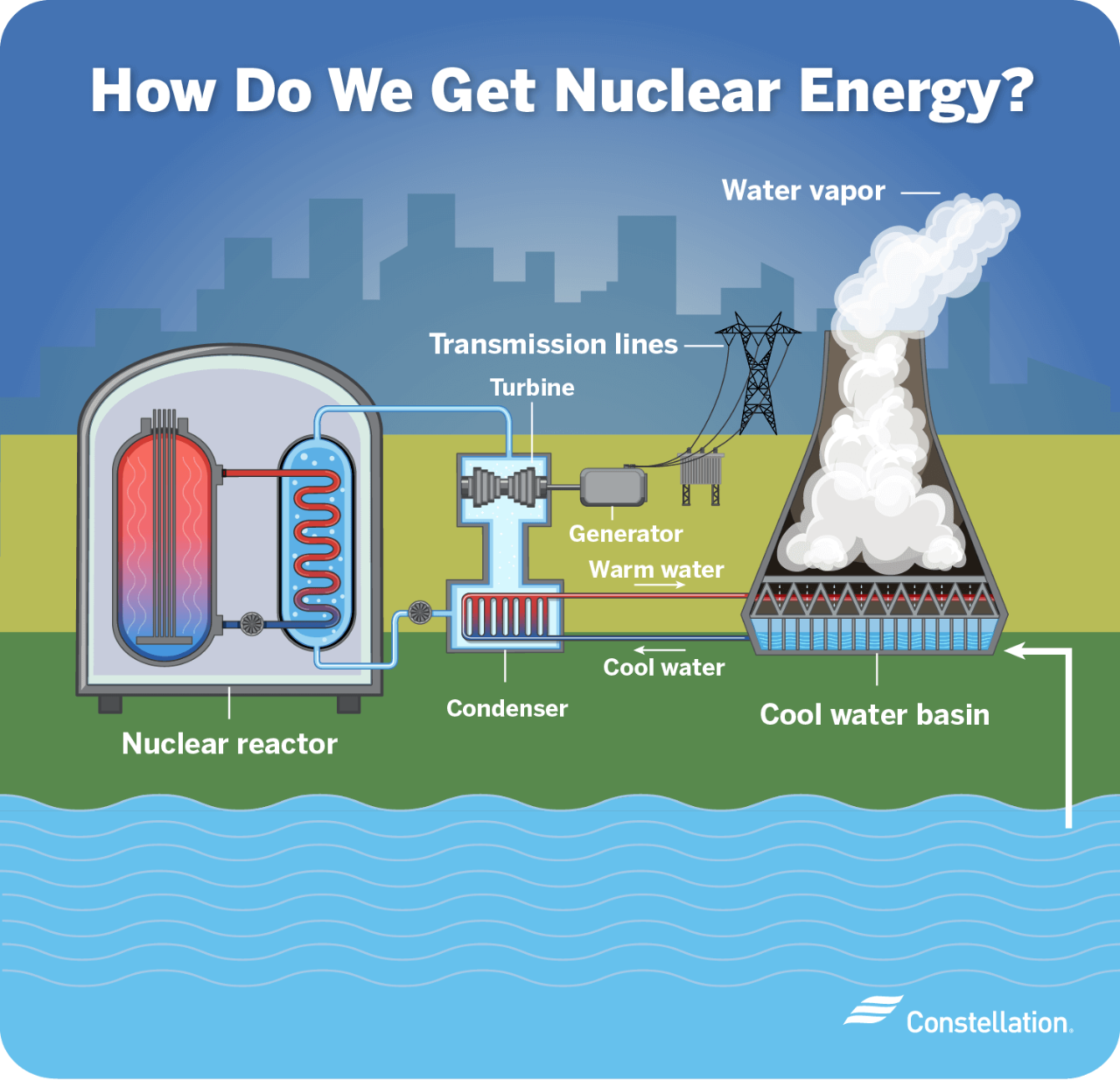
Yes, you heard that right. We're using the power of the atom to, essentially, boil water. This boiling happens in a super-strong container called a reactor vessel. Inside, a coolant (often just plain old water, but kept under immense pressure to stay liquid even at super high temperatures) circulates around the hot Uranium fuel. This water gets screamingly hot.
Steam Power: The Ancient Trick
Now, for the part that would make a steam engine inventor from the 1800s nod sagely. We take that incredibly hot, high-pressure water from the reactor. It doesn't actually touch the water that turns into steam for electricity. Instead, it flows through a heat exchanger, which is basically a giant coil. This coil heats up another, separate loop of water.
The second loop of water, being under less pressure, instantly flashes into incredibly powerful steam. Think of a pressure cooker, but on an industrial scale. This isn't just a gentle kitchen kettle puffing; this is a roaring, energetic torrent of superheated vapor.
The Grand Finale: Spinning for Power
What do you do with a roaring torrent of superheated steam? You use it to push things! Specifically, you direct this steam at massive fan-like devices called turbines. The steam shoves the blades of the turbine, making them spin incredibly fast.
And when something spins really fast in electricity generation, what happens? That spinning motion is connected to another ingenious device called a generator. The generator uses magnets and coils of wire to convert that mechanical spinning energy into, you guessed it, electricity!
After it’s done its job, the steam cools down, turns back into water, and gets pumped back to be heated all over again. It's a wonderfully circular system.
So, How Do We Get Nuclear Power?
If you cut through all the jargon and intimidating science, it really boils down to this:
We gently prod a special, heavy rock (Uranium) until its atoms split (fission). This makes a tremendous amount of heat. We use that heat to boil water and make super powerful steam. Then, that steam spins a giant fan (a turbine), which turns a magnet-powered contraption (a generator) to create electricity.
It’s elegant, it’s controlled, and it’s surprisingly simple in its core objective: make steam, spin a wheel. Next time you flip a light switch, maybe give a little nod to that shy, heavy rock and its incredible ability to heat up water. Who knew cutting-edge energy was so... kettle-like?