Ever found yourself staring blankly at an appliance label, one eyebrow doing a little confused dance, muttering, "Kw? Amps? What fresh wizardry is this?" Or maybe you're trying to figure out if your new mega-toaster-oven will trip the circuit breaker every time it decides to brown your bagels? Welcome, my friend, to the wonderfully bewildering world of electricity. Don't worry, it's not as scary as it sounds. Think of me as your friendly, slightly-caffeinated guide through the electrical jungle.
So, you want to convert kilowatts (Kw) to amps (Amps)? You've come to the right place. This isn't just about numbers; it's about understanding the secret language your home's wiring speaks. And frankly, it's a lot cheaper than calling an electrician every time you buy a new gadget that hums a little too loudly.
Why on Earth Do I Need to Know This?
That's a fair question! You're probably not trying to build a particle accelerator in your garage (unless you are, in which case, call me!). More likely, you're trying to:
- Hook up a generator after a power cut and avoid accidentally turning your house into a giant glow stick.
- Install a new, beefy electric car charger without blowing every fuse in a five-mile radius.
- Simply understand if that new air fryer is going to play nicely with your existing kitchen circuit, or if it's going to stage a hostile takeover.
In essence, you want to make sure your stuff plays well with your existing electrical setup and doesn't demand more juice than it can safely handle. Think of it as electrical manners.
The Holy Trinity of Electrical Power: Watts, Volts, and Amps
Imagine electricity is a river. Now, stay with me, this is where it gets fun:
- Voltage (Volts, V): This is the pressure of the water. How hard is it being pushed? In most homes in the US, this is typically 120V for standard outlets or 240V for bigger appliances like ovens and dryers. In other parts of the world, it might be 230V or 240V. Know your local voltage! It’s like knowing the local currency.
- Current (Amps, A): This is the volume of water flowing. How much water is actually moving past a point? Too much current, and things get hot. Very hot. Like, "oops, I melted the toaster" hot.
- Power (Watts, W or Kilowatts, Kw): This is the total work the water can do. How powerful is the river? Can it turn a mill wheel, or just trickle down your leg? Watts tell you how much juice an appliance actually uses. Kw is just a fancier, bigger unit of Watts (1 Kw = 1000 Watts, because engineers like big numbers).
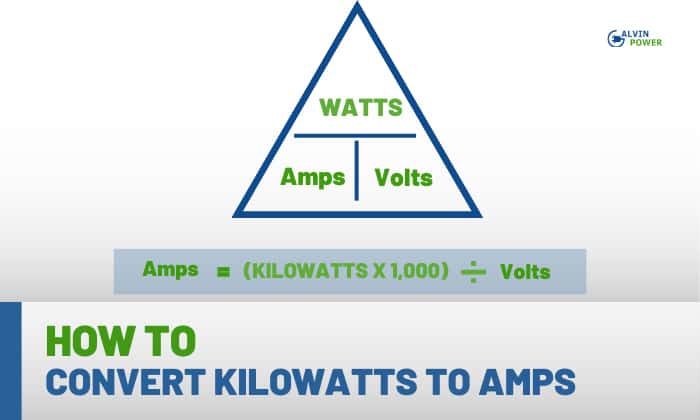
These three are in a constant, beautiful (and sometimes fiery) relationship, governed by a simple formula: P = I × V.
Or, in plain English: Power (Watts) = Current (Amps) × Voltage (Volts).
See? Not so bad! It's like a tiny electrical love triangle, where if you know two parts, you can always find the third. And today, we're finding the Amps!
The Big Reveal: Kw to Amps (with a Dash of Conversion!)
Since we want Amps (I), and we know Power (P) and Voltage (V), we just need to rearrange our love triangle formula a little:
I = P / V
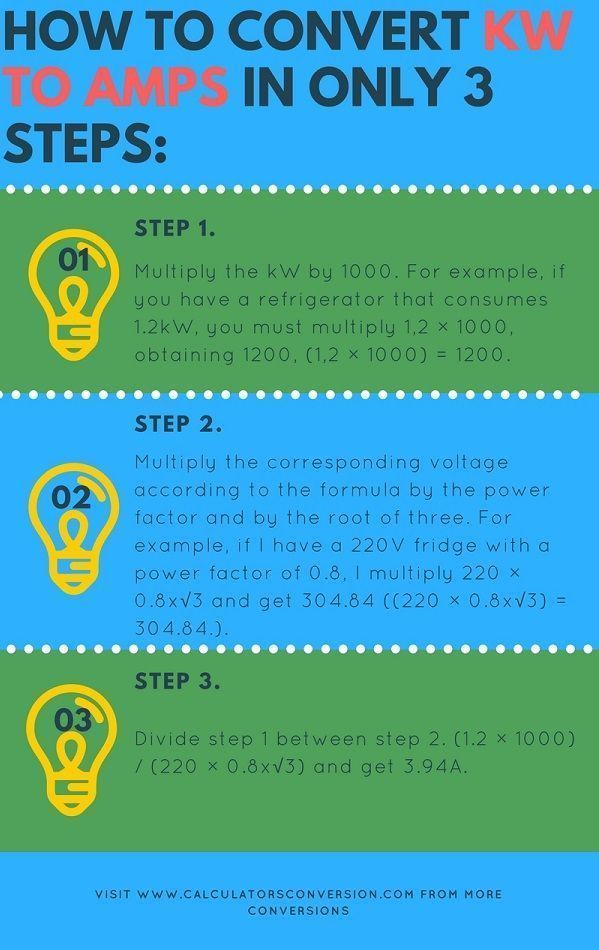
But wait! Your appliance is probably listed in Kw, and our formula wants Watts. No problem, we're electrical superheroes now! Just multiply your Kw value by 1000.
So, Watts = Kw × 1000.
Therefore, the glorious, much-anticipated formula for Amps is:
Amps = (Kilowatts × 1000) / Volts
Let's take an example: You have a monstrous 2.4 Kw electric kettle (because who has time to wait for tea?!), and your house runs on 120V. How many amps is that?
Amps = (2.4 Kw × 1000) / 120V
Amps = 2400 Watts / 120V
Amps = 20 Amps
So, your kettle is drawing 20 Amps. If your kitchen circuit is only rated for 15 Amps (a common rating), guess what? You're going to be resetting that breaker faster than you can say "cuppa." This is precisely why knowing this stuff is so handy!
Hold Up, There's a Plot Twist: Power Factor! (Single Phase vs. Three Phase)
Okay, I gave you the simple, beautiful version. But electricity, like life, isn't always that straightforward. For single-phase AC circuits (which is what 99% of home appliances use), there's a little something called the Power Factor (PF).
Think of Power Factor as the efficiency rating of your appliance. Not all the power flowing is actually doing "useful" work. Some of it just sloshes around like a mischievous ghost in the wires. A perfectly efficient appliance would have a PF of 1.0. Most appliances are around 0.8 to 0.95. For our purposes, a common, safe assumption for a home appliance is 0.8 or 0.85 if you don't know it. The lower the PF, the more current an appliance needs to do the same amount of actual work, because some of that current is just messing about.
So, for a more accurate single-phase calculation:
Amps = (Kilowatts × 1000) / (Volts × Power Factor)
Let's re-do our 2.4 Kw kettle, assuming a Power Factor of 0.8 (because kettles are mostly resistive, so their PF is often closer to 1, but let's play safe and show the formula):
Amps = (2.4 Kw × 1000) / (120V × 0.8)
Amps = 2400 Watts / 96
Amps = 25 Amps
See how the Amps went up? That's the Power Factor reminding us that not all power is created equal. Your kettle is still 2.4 Kw, but it demands a bit more current because of that inefficiency. And 25 Amps? Definitely going to trip a 15 Amp circuit. Probably even a 20 Amp one!
What about Three-Phase?
If you're dealing with three-phase power, congratulations, you're probably either running a small factory, a very enthusiastic workshop, or you're just showing off. Three-phase power is more efficient for transmitting large amounts of energy. The formula gets a tiny bit beefier, involving the square root of 3 (approximately 1.732).
Amps = (Kilowatts × 1000) / (Volts × Power Factor × √3)
But honestly, if you're working with three-phase, you're probably already best friends with an electrical engineer, or you've got a manual that spells this out. For typical household needs, stick to the single-phase formulas!
Final Thoughts and a Friendly Warning
Converting Kw to Amps isn't about being an electrical wizard; it's about being informed and safe. Knowing this conversion helps you avoid tripped breakers, overheated wires, and the dreaded "magic smoke" that escapes from electronics when they decide to give up the ghost.
Remember:
- Know your voltage! It's crucial.
- Assume a Power Factor of 0.8 or 0.85 if you don't know the exact figure for single-phase, to err on the side of caution.
- Never, ever mess with your home's wiring unless you are absolutely qualified and know what you are doing. This article is for understanding, not for becoming an overnight DIY electrician. When in doubt, call a licensed professional. They have insurance for a reason!
So there you have it! From confusing Kw to confident Amps. Go forth and confidently calculate, my friend. Just try not to over-amp your tea party.