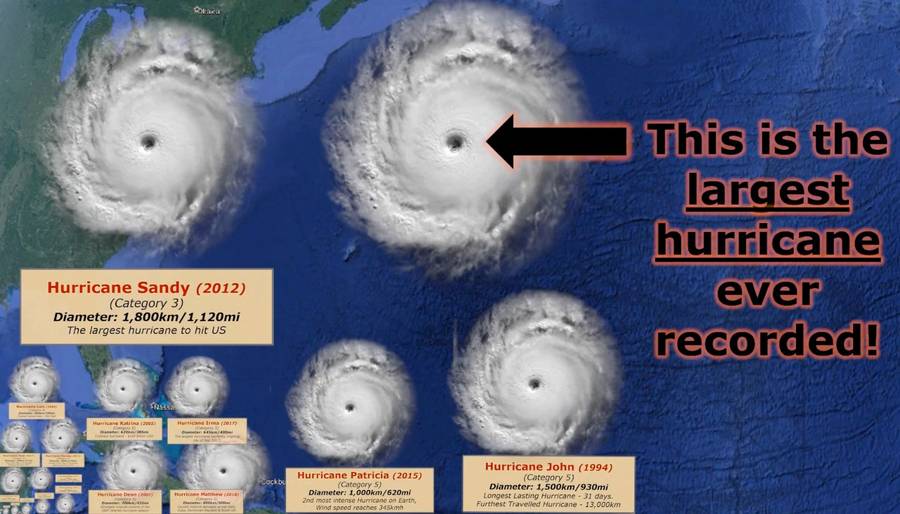
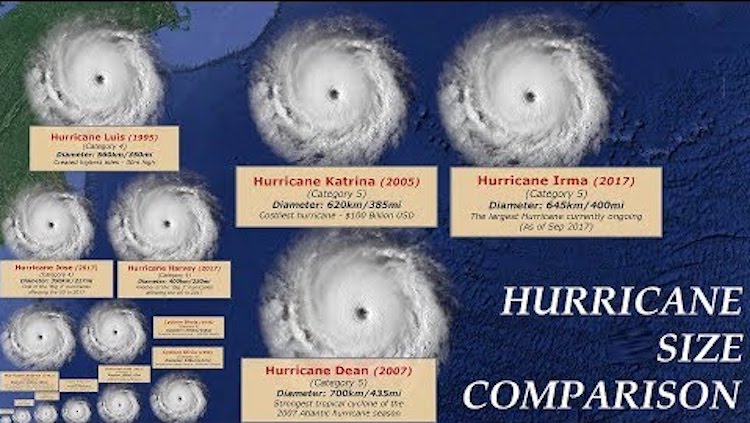
Ever stared at a weather map, saw a swirling mass of clouds, and thought, "Whoa, just how big is that thing?" Hurricanes, those magnificent and sometimes terrifying weather systems, command our attention like few other natural phenomena. We often hear about their strength, their wind speeds, or their potential for havoc, but let's chat about something equally awe-inspiring: their sheer, mind-boggling size.
Imagine a giant, cosmic frisbee spinning across the ocean. That's kinda what we're talking about when we discuss hurricane size. It's not just about the tiny, calm "eye" at the center, but the overall diameter of the storm's cloud shield and powerful winds. This colossal footprint can vary wildly, from a compact, intense punch to an sprawling, ocean-devouring behemoth.
The Average Joe vs. The Gentle Giant
On average, a typical hurricane spans about 200 to 400 miles (320 to 640 kilometers) across. To put that in perspective, that's roughly the distance from New York City to Boston, or the entire length of Florida! So, when you see a hurricane approaching, it’s not just a localized storm; it's a weather system that can envelop entire states, bringing heavy rain, high winds, and storm surge to a vast area.
But like humans, hurricanes come in all shapes and sizes. Some are relatively small, yet incredibly powerful. Think of Hurricane Andrew in 1992 – a Category 5 monster that was only about 60 miles wide, but its concentrated fury devastated South Florida. It’s a stark reminder that size isn't the only metric for danger.
Meet the Big Boss: Typhoon Tip
When it comes to the absolute giants, one name stands out: Typhoon Tip. This absolute beast, which formed in the western Pacific in 1979, holds the record for the largest tropical cyclone ever recorded. At its peak, Tip's circulation stretched an unbelievable 1,380 miles (2,220 kilometers) in diameter! That's wider than the contiguous United States from north to south, and roughly half the width of Australia. Imagine the entire state of Texas being just a small part of this storm's outer bands. Truly mind-bending stuff.
What Makes Them So Big?
So, what fuels these monstrous weather events? It's a combo of factors:
- Warm Ocean Waters: This is the hurricane's fuel. The warmer the water, the more energy it can pull to grow.
- Low Wind Shear: When there are minimal changes in wind speed and direction with height, it allows the storm to maintain its structure and grow vertically and horizontally.
- Atmospheric Pressure: Extremely low pressure in the storm's center acts like a vacuum, drawing in more air and moisture.
- Coriolis Effect: This earth's rotation force helps the storm spin and organize.
Fun fact: Hurricanes, typhoons, and cyclones are all the same thing – just different names depending on where they form! "Hurricane" is for the Atlantic and Northeast Pacific, "Typhoon" for the Northwest Pacific, and "Cyclone" for the South Pacific and Indian Ocean.
Navigating the "Cone of Uncertainty"
Understanding hurricane size isn't just about trivia; it's about preparedness. When you see that famous "cone of uncertainty" on a forecast map, remember that it represents the probable track of the *center* of the storm. The storm itself, with its sprawling winds and rain, will extend far beyond that cone. Always factor in the storm's broader reach when making your own plans, even if you're not directly in the bullseye.
Practical tip: Even a Category 1 hurricane can have wind impacts hundreds of miles from its eye, and its rain bands can stretch even further. Think of hurricane preparation like packing for a road trip; you need to consider the whole journey, not just the destination.
A Bigger Picture
Whether it’s a compact force like Andrew or a sprawling giant like Tip, hurricanes remind us of nature's raw power and immense scale. They make us feel tiny, yet also capable of incredible resilience and community spirit when facing down these forces. Just like we navigate the "cones of uncertainty" in life, understanding the broader impact and preparing for what's ahead can make all the difference.
So, next time you see that swirl on the map, take a moment to appreciate its incredible scale. It's not just a point on a radar; it's a dynamic, powerful entity that can dwarf entire countries – a beautiful, terrifying testament to the living planet we call home.