
Alright, pull up a chair, grab a coffee (or, if you're me on a particularly hot day, an iced anything), because we need to talk about something truly heroic:
resurrecting your car's AC.
You know the feeling, right? It's the height of summer, the sun is blazing like an angry god, and you step into your car. Instantly, you're a human science experiment, witnessing the fascinating phenomenon of sweat production at maximum velocity. You crank the AC knob with the desperate hope of a lottery winner, but all you get is... well, an unenthusiastic sigh of slightly-less-hot air. It’s like your car is mocking you, saying, "Oh, you wanted *cold*? That's cute."
This, my friends, is where the mysterious world of AC refrigerant and its trusty sidekicks, the gauges, come into play. Now, I know what you’re thinking: "Gauges? That sounds like something only a certified wizard or someone with a degree in 'Automotive Alchemist' would understand!" And for a long time, I was right there with you, picturing arcane symbols and complex incantations.
The Quest for Cold: Embracing the Gauges
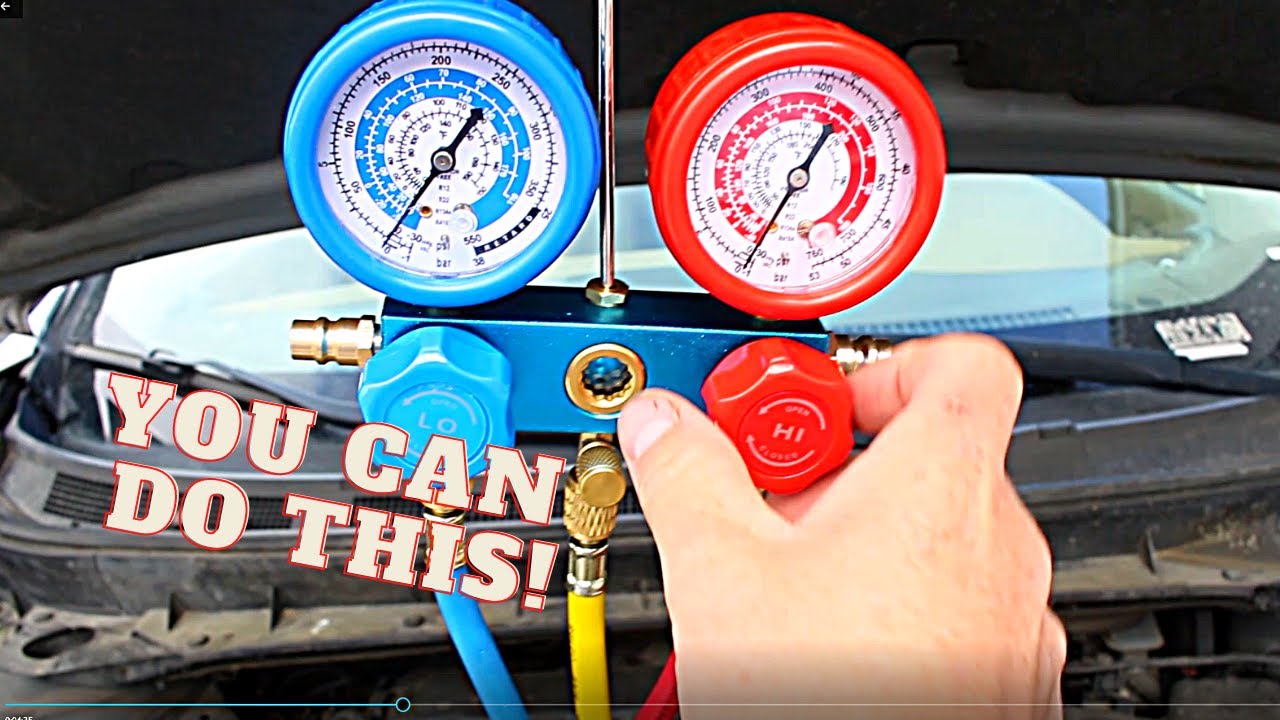
But then, curiosity (and the sheer agony of another sweltering commute) got the better of me. I decided to face the beast. The beast, in this case, being a set of AC manifold gauges. These aren't just any gauges; they’re like the stethoscope of your car's AC system. They tell you if your system is merely thirsty, or if it's got a more serious case of "leaky-sneezy."
Think of it this way: Your car’s AC works by circulating a special refrigerant that absorbs heat from the cabin and then releases it outside. It's not *making* cold; it's *moving* heat. Pretty mind-blowing, right? When the refrigerant level gets low, it just can't do its heat-transferring job effectively. And that's where our heroes, the gauges, come in. They measure the pressure of this magical refrigerant on both the high-pressure and low-pressure sides of the system.
Connecting them is the first step, and it feels a bit like performing surgery on a robot. You’ve got a blue hose for the low side, a red hose for the high side, and a yellow one that’s your gateway to adding the refrigerant. Don’t mix them up, folks, unless you want to turn your car into a bizarre science fair project!
Decoding the Mystery: Highs, Lows, and What They Mean
Once connected, with the car running and the AC blasting on full, you look at the dials. One gauge (the blue one) typically reads the low-side pressure, and the other (the red one) reads the high-side. Now, here's the kicker: You're not aiming for arbitrary numbers. Each car, depending on the ambient temperature, has a specific range where those pressures should ideally be. It's like checking your blood pressure, but for your car. Too high, too low – both can be bad news.
If your low-side pressure is significantly... well, low, and your AC is blowing lukewarm, bingo! You've likely found your culprit. It’s a bit like your car saying, "Hey, I'm just a little parched over here!"
Now, for the thrilling part: adding the refrigerant. You connect your can of R-134a (the modern magic juice) to the yellow hose, open a valve, and *voila*! You hear a satisfying hiss, and the low-side gauge needle starts to climb. It’s a delicate dance, a slow waltz, adding a little, checking the gauges, feeling the air coming out of the vents. You’re looking for that sweet spot where the low side is within its specified range, and the high side isn't going through the roof. Patience, young grasshopper.
The Perils of Over-Enthusiasm (and Other Warnings)
But here's a crucial, humorous, yet serious warning: Do NOT overcharge your system! This isn't a "more is better" situation, like adding extra sprinkles to your ice cream. Too much refrigerant and you risk damaging your compressor, which is the expensive heart of your AC system. We're talking several hundreds, maybe even a thousand dollars, to fix. Suddenly, that initial sweat-fest doesn't sound so bad, does it?
Another thing: if your system is completely empty, as in, the low-side gauge barely registers, you probably have a leak. And adding more refrigerant without addressing the leak is like trying to fill a bathtub with the drain plug out. It's futile, wasteful, and frankly, a bit silly. This is where a professional might be needed to find and seal the leak before recharging.
And for goodness sake, wear eye protection and gloves! Refrigerant is extremely cold, and a direct spray to the skin or eyes is a fast-track to a frostbite-induced headache. You don't want to explain to your doctor how you tried to give your car AC a spa treatment and ended up with a frozen eyeball.
The Sweet Taste of Victory
Finally, the moment of truth. You've added just enough, the gauges are reading correctly, and you step back into your car. You turn the AC on. And there it is: that glorious, crisp, nose-tinglingly cold air! It's a feeling of pure triumph, a silent "HA!" to the summer sun and the mechanics who might have charged you an arm and a leg for a simple top-off.
Using AC gauges isn't about being an automotive expert; it's about being informed, a little daring, and not afraid to learn. It’s about taking control of your comfort, saving a few bucks, and earning serious bragging rights. So next time your car's AC starts whispering sweet nothings of warm air, remember the gauges. They might just be your ticket to a blissfully cool ride.


