
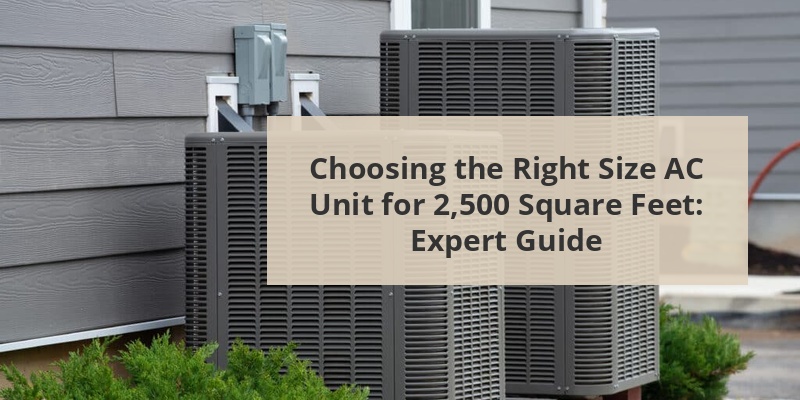
Alright, pull up a chair, grab your imaginary iced latte, because we need to talk about something serious. Something that separates the blissful, frosty havens from the sweat-soaked, cranky infernos: your AC unit. Specifically, for a big ole 2500 square foot home. That’s not a studio apartment, folks; that’s a whole lotta real estate that needs to stay chill.
Imagine this: It’s the dog days of summer. The sun is trying to melt your driveway, and inside, your thermostat is stuck at “surface of the sun.” You’re sweating through your socks, questioning all your life choices, and wondering why your fridge isn’t big enough to live in. Sound familiar? We’ve all been there. And usually, the culprit isn't just the weather; it's an AC unit that’s either having an existential crisis or is simply too small for the job.
The Big Question: How Big (Literally)?
When we talk about AC size, we're not talking about how much space it takes up in your yard (though that’s a consideration for your HOA, I guess). We’re talking about its cooling power, measured in something called BTUs. That stands for British Thermal Units, which sounds terribly formal for something so crucial to our comfort. Think of a BTU as the amount of energy needed to raise one pound of water by one degree Fahrenheit. For AC, it's how much heat it can remove.
Now, for a 2500 sq ft home, there’s a general rule of thumb. It’s like a dating app for your AC: rough guidelines to get you started. Most experts suggest you need about 20 BTUs per square foot. So, let’s do some quick, café-napkin math: 2500 sq ft * 20 BTUs/sq ft = 50,000 BTUs.
But wait, there's more! AC units are often sold in “tons.” No, not like a ton of bricks you drop on your neighbor's lawn (please don't). One ton of cooling power equals 12,000 BTUs. So, for your 50,000 BTU monster, you'd need something around 4 to 5 tons. That’s a serious piece of equipment, ready to battle the heat like a superhero with a frost ray.
Why "Just Right" is Like Goldilocks' Dream
This isn't a "bigger is always better" situation, folks. Oh no, that’s where things get interesting, and potentially, expensive. Getting the size just right is paramount. Think of it like this:
Too Small: If you try to cool your 2500 sq ft palace with an AC meant for a studio, you're asking for trouble. It’ll run constantly, struggle endlessly, never quite reach comfort, and send your energy bills through the roof. It’s like asking a chihuahua to pull a freight train: adorable, but utterly ineffective.
Too Big: This might sound counter-intuitive. "More power, Captain!" you cry. But a unit that's too powerful for your space will "short cycle." It’ll turn on, blast a wave of cold air, reach the thermostat setting super fast, and then shut off. The problem? It doesn't run long enough to effectively remove humidity. You’ll end up with a house that’s cool, yes, but also feels muggy and clammy – like a walk-in refrigerator after a sauna. Plus, frequent start-ups are less efficient and put more wear and tear on your system. It's like using a fire hose to water a houseplant – overkill.
Beyond the Square Footage: The Secret Ingredients
While 20 BTUs per square foot is a fantastic starting point, it's just that – a starting point. There are so many other factors that can turn that number up or down like a DJ’s mixing board:
1. Your Climate Zone: Living in blistering Arizona heat? You’ll need more power than someone in, say, rainy Seattle (sorry, Seattle, you have other weather issues). Humid climates, especially, require more oomph to dehumidify.
2. Your Home’s Insulation: Is your house sealed up like a submarine, or does it have more drafts than a medieval castle? Good insulation (walls, attic, windows) means less heat seeping in, and less work for your AC. Bad insulation means your AC fights an uphill battle.
3. Windows, Windows, Windows: How many do you have? Are they old, single-pane relics or modern, energy-efficient wonders? Do you have giant, south-facing windows soaking up sun all day? All this impacts the heat load.
4. Ceiling Height: A 2500 sq ft home with 8-foot ceilings has less air volume than one with soaring 12-foot vaulted ceilings. More air to cool = more BTUs needed.
5. Occupancy and Appliances: Are you a solo hermit or do you host weekly family reunions with 20 people and a full kitchen baking marathon? More bodies and heat-generating appliances (ovens, computers, that super-hot vintage stereo) add to the load.
6. Ductwork: Leaky, poorly designed, or uninsulated ductwork is like trying to deliver cold air through a colander. Significant cool air can be lost before it even reaches your living spaces.
Why You Need a Pro (No DIY Heroics Here)
Listen, I love a good DIY project as much as the next person. Changing a lightbulb? Go for it! Painting a wall? Knock yourself out! But sizing and installing an AC unit for a 2500 sq ft home? That’s not a YouTube tutorial kind of job. This is where you call in the big guns – the HVAC professionals.
They’ll perform a detailed "load calculation" (sometimes called a Manual J calculation). This isn't just guessing; it's a precise assessment of *all* those factors – insulation, windows, climate, ceiling height, even the direction your house faces. They'll ensure you get a system perfectly tailored, not just to your square footage, but to your home’s unique personality.
A Quick Word on Efficiency (SEER and SEER2)
Once you know the right size, you'll also want to think about efficiency. This is usually measured by a rating called SEER (Seasonal Energy Efficiency Ratio) or the newer SEER2. Higher numbers mean more efficient operation, which translates to lower energy bills and a happier planet. It might cost a bit more upfront for a higher SEER2 unit, but it's an investment that pays dividends in comfort and savings over the years. Plus, who doesn't love saving a few bucks on the electric bill?
The Takeaway: Stay Cool, My Friends
So, there you have it. Choosing an AC unit for your 2500 sq ft home isn't just about picking something that looks good in the brochure. It's about a delicate dance of BTUs, climate, insulation, and professional know-how. Get it right, and you’ll enjoy years of perfectly chilled bliss, a sanctuary from the summer swelter. Get it wrong, and well… let’s just say you might still be thinking about moving into your fridge. Stay cool!


