Alright, settle in, grab a virtual cuppa, because I've got a little mathematical brain-teaser for you that sounds deceptively simple. We're going to talk about a number that looks like it could fit on a postage stamp: 2 to the power of 30. Sounds innocuous, right? Like something a very chill robot might whisper in its sleep. But oh, my friends, this number is a total party animal, a numerical behemoth hiding behind a very innocent-looking façade.
The Big Reveal: It's Over a Billion!
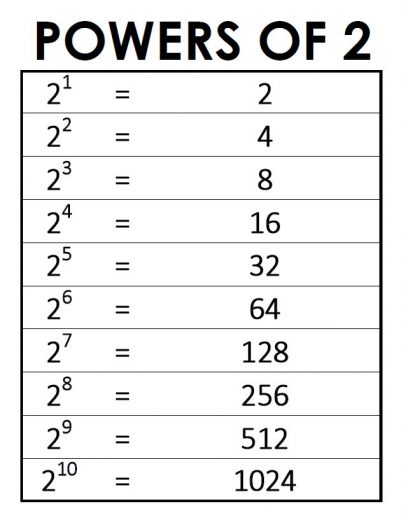
So, what exactly is 2 to the power of 30? In plain English, it means you take the number 2 and multiply it by itself, not once, not twice, but thirty whole times. Two times two, times two, times two... you get the picture. If you actually tried to do this manually, your fingers would probably fall off, and your calculator would likely stage a dramatic protest, possibly involving smoke and a tiny, indignant sigh.
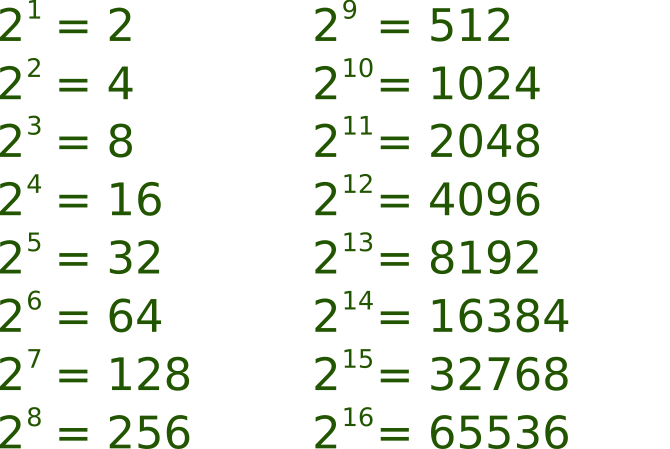
The actual number, when the dust settles and all the twos have had their multiplying fun, is a staggering 1,073,741,824. Yes, you read that right. That's one billion, seventy-three million, seven hundred forty-one thousand, eight hundred twenty-four. See? I told you it was a party animal!
Your Computer's Secret Language
Now, why is this specific number so important, besides making mathematicians do a happy little jig? Because it's the rockstar of the digital world! If you've ever heard the term "gigabyte" (and if you own a phone, computer, or even a fancy toaster, you probably have), then you've implicitly dealt with this number.
Computers, bless their silicon hearts, don't understand our human-centric base-10 counting system. They speak in binary: 0s and 1s. Everything they do, from streaming your favorite cat videos to calculating rocket trajectories, boils down to these two humble digits. And because of this binary nature, computer memory and storage sizes are almost always powers of two.
A kilobyte isn't exactly 1,000 bytes; it's 2 to the power of 10 (1,024 bytes). A megabyte is 2 to the power of 20 (1,048,576 bytes). And a gigabyte? Drumroll please... it's 2 to the power of 30 bytes! So, every time your phone proudly declares it has 64GB of storage, it's actually boasting about 64 multiplied by that beautiful, billion-plus number we just discovered.
What Would a Billion of Anything Look Like?
Let's put this into some hilariously impractical, everyday terms. Imagine you had 1,073,741,824 of something. What could it be?
Money, Honey: If you had 2^30 dollars, you wouldn't just be rich; you'd be in a whole new tax bracket that probably only includes cartoon villains and countries. You could buy entire small nations, colonize the moon with your own private yacht club, or finally afford avocado toast in Manhattan without a second thought. You'd be swimming in cash like Scrooge McDuck, but with a much, much bigger vault.
The Counting Conundrum: How long would it take you to count to this number? If you could count one number per second, non-stop, without breaks for eating, sleeping, or questioning your life choices, it would take you roughly 34 years. By the time you finished, the phone you started counting with would be a museum piece, and you’d have a serious case of numerical fatigue.
Grains of Sand: Ever tried to count grains of sand? Me neither, because it's a fool's errand. But if you had 2^30 grains of sand, you'd have more than a decent-sized beach. You could probably build your own personal desert island, complete with a tiny palm tree made of exactly one palm leaf, just to be ironic.
Human Hair Strands: The average human head has about 100,000 to 150,000 hairs. To get to 2^30 hairs, you’d need the entire population of a good chunk of Europe to donate their hair. That's a lot of bad hair days, collectively.
The Invisible Hand of Powers of Two
This number, 2 to the power of 30, is working tirelessly behind the scenes in countless aspects of modern life. It's in the resolution of your high-definition TV, the speed of your internet connection, and the capacity of the solid-state drive in your laptop. It's a silent, numerical hero, allowing for the vast quantities of data we create and consume every single day.
So, the next time you hear someone casually mention "a gigabyte," take a moment to appreciate the sheer enormity of the number hiding behind that seemingly simple term. It's not just a thousand million; it's a very specific, very important, and slightly sassy billion. It’s a testament to the fact that sometimes, the simplest mathematical expressions can lead to the most mind-bogglingly large and impactful results. And that, my friends, is something worth raising a virtual cuppa to!