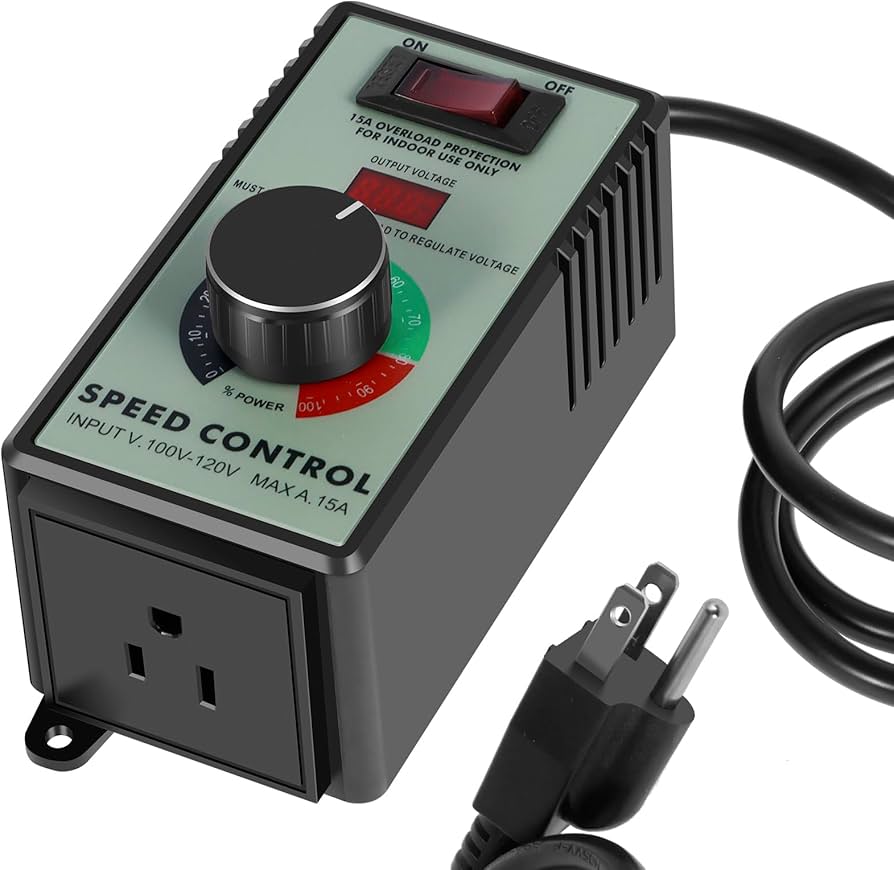
Ever noticed how your kitchen blender can go from a gentle, sleepy churn to a full-on, smoothie-pulverizing tornado with just a flick of a switch or a twist of a dial? Or how your handy power drill lets you start a screw with exquisite slowness before zipping it home at top speed? That, my friends, isn't just magic. It’s the incredibly clever world of 110V AC Motor Speed Control making your life a whole lot easier, smoother, and frankly, more fun.
Now, before your eyes glaze over thinking this is some super-techy, boring topic, let's make it clear: we're talking about the everyday motors in your home. The ones that hum along in your washing machine, whir in your stand mixer, or bring a cool breeze via your trusty fan. These are the workhorses of modern living, and knowing a little bit about how they get told to slow down or speed up is like peeking behind the curtain of daily convenience.
Why Does My Blender Have "Stir," "Chop," and "Liquefy"?
Imagine for a second if every motorized appliance in your house only had an "on" and "off" button. Sounds like a nightmare, right? Your blender would either be completely idle or going at 100% full-throttle, all the time.
Picture trying to make a delicate hollandaise sauce. One speed? You'd either have lumps of butter or a curdled mess, no in-between! Or trying to drill a tiny pilot hole for a delicate picture frame – at full speed, you’d probably strip the screw head, splinter the wood, or send your drill bit flying across the room.
That’s where motor speed control steps in like a superhero in a utility belt. It’s the ability to tell an electric motor, "Hey, go slow and gentle," or "Okay, now unleash the beast!" It gives us precision, flexibility, and a whole lot of less frustration.
It’s Like a Dimmer Switch, But for Power!
Think about a light dimmer switch. You're not turning the light bulb on and off super fast; you're actually changing how much electricity flows to it, making it brighter or dimmer. Motor speed control works on a similar principle, but instead of brightness, it's about power and rotation.
For our everyday 110V AC motors (AC stands for Alternating Current, which is what comes out of your wall sockets), one common way to control their speed is by carefully managing the power they receive. It’s a bit like giving a motor a series of tiny, super-fast "on" and "off" signals, but the trick is in how long those "on" periods last.
The longer the "on" time in each tiny burst, the more power the motor gets, and the faster it spins! Short "on" times mean less power, slower speeds. It's incredibly clever and happens so fast you don't even notice the flickers – just the smooth change in speed.
Little Stories from the World of Variable Speed
-
The Fan That Knows Best: It's a sweltering summer day. Do you need a gentle rustle of air to cool down, or a full-on gale to mimic a tropical storm? Your ceiling fan's speed settings aren't just for show. They allow you to dial in the perfect breeze, saving energy (and your hair) when only a whisper is needed. Without speed control, it would be either "stuffy" or "hurricane indoors."
-
The Baker's Secret Weapon: Anyone who bakes knows the magic of a stand mixer. You start slow to gently combine flour and butter, preventing a flour cloud explosion, then gradually ramp up to whip egg whites into stiff peaks. This delicate dance of speeds ensures your soufflé rises and your cookies are perfectly mixed, all thanks to that unassuming speed dial. Imagine trying to cream butter and sugar at warp speed! Messy, right?
-
The Handy DIYer's Best Friend: Your cordless drill is practically a member of the family if you're into home improvement. That trigger isn't just an on/off switch; it’s a sophisticated speed controller. Squeeze it gently for slow, precise starts when driving a screw, then press harder to power through. This prevents stripping screws, splitting wood, or worse, snapping a drill bit. It’s about being the master of your task, not just a passenger.
Why Should *You* Care? Beyond the Gadgets!
Okay, so besides making your daily life smoother and preventing culinary disasters, why should this seemingly techy tidbit matter to you?
First, it’s about understanding the little bits of engineering brilliance that make our modern world hum. Appreciating that thoughtful design goes into even the simplest of appliances helps us be smarter consumers. When you see "variable speed," you now know it’s a feature designed for your convenience and better results.
Second, it’s about empowerment. Knowing a little bit about how things work means you're less likely to be baffled by technology and more likely to appreciate its subtle genius. It’s no longer "magic," but clever engineering.
And finally, it's about efficiency and longevity. Letting motors run only as fast as needed often means they use less electricity and experience less wear and tear. Your appliances last longer, your energy bills are happier, and your pocketbook smiles.
So, the next time you effortlessly switch your blender from "chop" to "puree," or feel the precise control of your drill, give a little nod to the unsung hero working behind the scenes: 110V AC Motor Speed Control. It's a small detail that makes a big, big difference in the rhythm of our everyday lives!