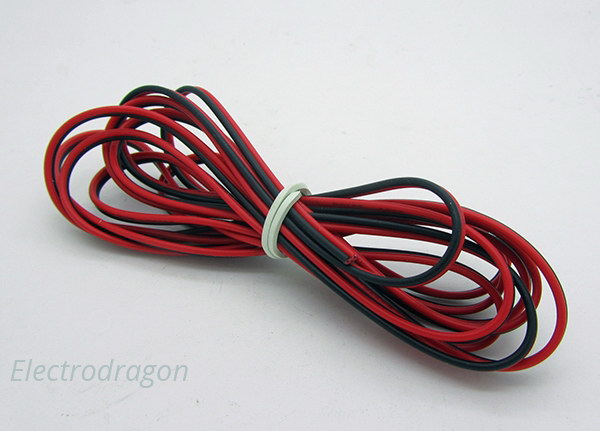
Black And Red Electrical Wires

Have you ever paused to really look at the tangle of wires behind your TV, or the humble connections inside a battery-powered toy? It might seem like a chaotic mess, but often, there's a simple, elegant system at play, especially when you spot the familiar duo of black and red electrical wires. These colors tell a story, acting as a universal language for electricity. Learning a little about them isn't just for aspiring electricians; it's a fun way to peek behind the curtain of our electrified world and understand the silent choreography that powers so much of our daily lives, making the seemingly complex a little more approachable and even a bit magical.
At its heart, the purpose of black and red wires, particularly in DC (Direct Current) circuits like those found in batteries, is all about clarity and safety. Red almost universally signifies the positive terminal, the "hot" side where current is considered to flow from. Black, on the other hand, is usually the negative terminal, the path where current returns, often referred to as the "ground" or "common" side. This simple color-coding system is incredibly beneficial because it prevents confusion and potential mishaps. Imagine trying to connect a battery without knowing which terminal was which! You could short-circuit devices, damage components, or even create a fire hazard. The red-and-black convention makes assembly and troubleshooting easier and safer, offering an immediate visual cue about the direction and polarity of electrical flow.
You'll encounter these colorful conductors everywhere, both in formal learning environments and in the casual hum of everyday life. In a science classroom, simple circuit experiments often use red and black wires to connect batteries to light bulbs or buzzers, helping students visualize the flow from positive to negative. Robotics kits frequently employ them to link motors and sensors to power sources. In your home, while not always visible, they're the silent heroes inside remote controls, powering up your TV or fan. Crack open a child's toy car or a flashlight, and you'll likely find red and black wires diligently connecting the battery pack to the motor or LED. Even the robust cables connecting your car battery are usually color-coded: red for positive, black for negative, a critical detail for safe jump-starting.
Must Read
Curious to explore this further? You don't need to be an expert! One simple and safe way to observe this in action is to get a low-voltage DC power source, like a 9-volt battery, and a small LED light. Connect a red wire to the battery's positive terminal and a black wire to its negative terminal. Then, carefully touch the other ends of the wires to the correct terminals of the LED – usually, the longer leg is positive. Watch as the LED illuminates, demonstrating the clear path of electricity thanks to our colored guides. You can also peek into the battery compartments of household items like toys or radios; often, you'll see small red and black wires leading from the battery contacts. Remember, when dealing with electricity, even low voltage, safety is paramount. Stick to battery-powered devices and never experiment with household mains electricity. By paying a little more attention, you can uncover the fascinating, color-coded secrets that power our modern world.