
Amp Rating For 1 0 Copper Wire

Hey there, future electrical guru! Ever found yourself staring at a really thick piece of copper wire, wondering, "How much juice can this bad boy handle?" Well, you've come to the right place! Today, we're diving into the wonderful world of 1/0 copper wire amp ratings, and we're going to make it as fun and breezy as a summer afternoon stroll. No scary textbooks, I promise!
Meet the Beast: What's 1/0 Copper Wire Anyway?
First off, let's talk about our star player: 1/0 copper wire. You might hear it pronounced "one aught" – like "naught" but with a "one" in front. This isn't your grandma's lamp cord, folks. This is a seriously thick wire, a real heavyweight champ in the electrical world. Think of it as the sumo wrestler of wires!
Why copper? Because copper is like the Usain Bolt of electrical conductors – super efficient at letting electrons zoom through. And 1/0? That number tells you it's beefy. The lower the AWG (American Wire Gauge) number, the thicker the wire, and once you hit 1 AWG, the next sizes go to 1/0, 2/0, 3/0, and 4/0. So, 1/0 is your first step into the "super-sized" wire category.
Must Read
Why Do Amp Ratings Even Matter? (Spoiler: Safety First!)
Okay, so we have a thick wire. But why do we care how many "amps" it can handle? Imagine trying to squeeze a whole Thanksgiving dinner into a tiny sandwich bag. What happens? Splatter! Or, more likely, the bag rips. The same principle applies to wires and electricity.
Amps (short for amperes) are basically the measure of electrical current flow. If you try to push too many amps through a wire that's not rated for it, it gets hot. Like, really hot. And when wires get too hot, bad things happen: insulation melts, fires start, and nobody wants that kind of drama in their life!

So, an amp rating (or "ampacity," if you want to sound super fancy) tells you the maximum safe current a wire can continuously carry without turning into a glowing toaster element. It's all about keeping things cool, calm, and collected.
The Big Reveal: How Many Amps for 1/0 Copper?
Alright, drumroll please! So, what's the magic number for 1/0 copper wire? Well, this is where it gets a little bit like choosing ice cream flavors – there's more than one answer, depending on the "recipe" (aka insulation type and temperature rating).
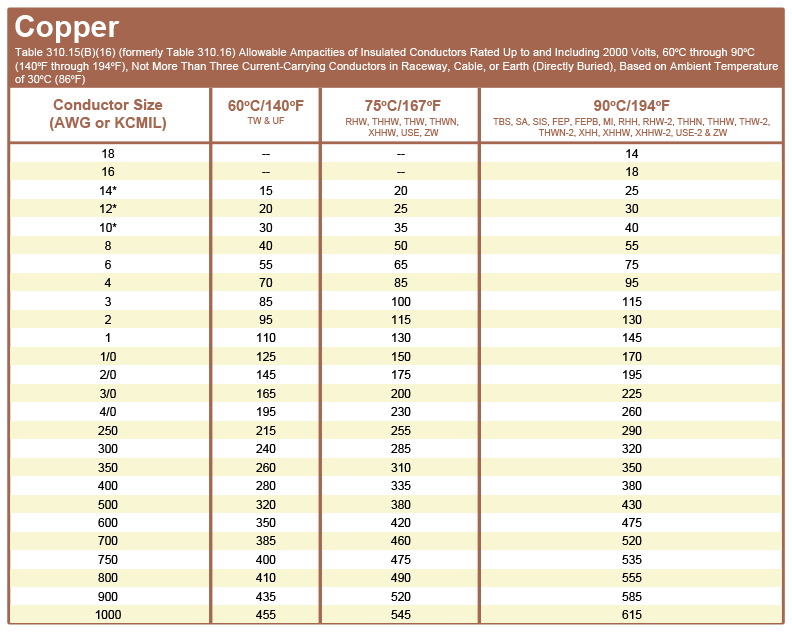
The National Electrical Code (NEC) is like the ultimate rulebook for electricians, and it has handy tables for this. Here’s the scoop for 1/0 AWG copper wire, based on common insulation temperature ratings:

- For 60°C rated insulation (e.g., TW, UF): You're looking at around 150 amps. This is your baseline, often used for older setups or specific types of connections.
- For 75°C rated insulation (e.g., THWN, RHW, XHHW-2): The ampacity bumps up to a respectable 175 amps. This is a very common rating, especially because many circuit breakers and equipment terminals are rated for 75°C.
- For 90°C rated insulation (e.g., THHN, XHHW-2): This wire can handle a whopping 225 amps! Pretty impressive, right?
Hold on a sec, though! Here's the catch (and it's an important one): Even if your 1/0 wire has super-duper 90°C insulation, you often can't actually load it up to 225 amps in real life. Why? Because the NEC says you have to consider the lowest temperature rating of the wire, the breaker, or whatever equipment it's connected to. So, if your breaker is only rated for 75°C (which many are), you're generally limited to that 175 amp sweet spot. Bummer, I know, but safety first!
So, for most residential and commercial applications, when someone asks about 1/0 copper, you're usually thinking in the realm of 150 to 175 amps, with 175 amps being a very common practical limit.
More Than Just Insulation: Other Factors to Juggle
Just when you thought you had it all figured out, life (and electricity) throws a few more curveballs! The actual usable ampacity can be affected by:
- Ambient Temperature: If your wire is running through an oven (please don't!), it can carry less current. Hot surroundings mean lower ampacity.
- Bundling: Running a whole bunch of wires together in a conduit is like a wire sauna – they all heat each other up! The NEC requires "derating" (reducing the ampacity) when you have too many wires bundled.
- Conduit Fill: Too many wires crammed into a pipe can restrict air flow and cause heat build-up.
It's a bit like baking a cake – you need the right ingredients, the right oven temperature, and enough space in the pan, or you end up with a… well, a mess! And with electricity, a mess can be dangerous.
When Do You See This Monster Wire?
So, where does 1/0 copper typically hang out? You'll often find it as:

- Main service feeders to larger homes or businesses (that's the big cable bringing power from the utility pole or meter into your main electrical panel).
- Feeders to large subpanels or disconnects.
- For powering very large, dedicated appliances or equipment, like a hefty electric car charger or certain industrial machinery.
A Friendly Nudge (Because I Care!)
Understanding wire ampacity is fantastic, but remember, electricity is not a toy. This article is just a friendly chat to enlighten you, not a DIY guide for wiring your house! Always, always, always consult a qualified, licensed electrician for any actual electrical work. They know the codes, they have the experience, and they'll keep you (and your home) safe. Think of them as the superhero guardians of sparks and wires!
Wrapping It Up With a Smile!
So there you have it! You're now officially smarter about 1/0 copper wire and its mighty ampacity. You understand that it's a thick, capable conductor, typically rated for 150 to 175 amps in practical applications, and why those numbers are so crucial for safety.
Isn't it amazing how much power and science goes into keeping our lights on, our devices charged, and our homes humming safely? Take a moment to appreciate the unsung heroes of the electrical world, like our friend, the 1/0 copper wire. You've just expanded your brain with some really useful knowledge, and that's something to smile about! Keep learning, keep exploring, and stay brilliantly curious!