
American Welding Society Electrode Classification

Alright, so you’re staring at a welding rod, right? It’s got a bunch of letters and numbers on it, looking like some secret code. Don't panic! It's not as scary as it looks. It's actually the American Welding Society (AWS) electrode classification, and it tells you everything you need to know about that little metal stick. Think of it like a decoder ring for welders, but way less flimsy.
Basically, it's the AWS’s way of saying, "Hey, this electrode is good for this kind of welding, in this position, with this kind of current." It's super useful stuff, and once you understand it, you'll be picking the right electrode for the job like a pro.
Decoding the Electrode: E-XXYY-Z
Let's break down that magical sequence: E-XXYY-Z. Each part tells you something different. Ready? Let’s dive in! (Don’t worry, there’s no math involved, unless you count counting letters and numbers… which I don’t.)
Must Read
The "E": This is the easy part! The "E" simply stands for electrode. Yep, just like that. They could have made it "Extraordinarily Important Welding Thingy," but I guess they went for simplicity.
The First Two Digits (XX): Okay, here’s where it gets a little more interesting. These two numbers tell you the tensile strength of the weld metal in thousands of pounds per square inch (ksi). So, an E6010 electrode, the "60" means the weld metal has a tensile strength of roughly 60,000 psi. This is the force needed to pull it apart! Not that you'd want to pull your welds apart, of course. Unless... you're testing them? Okay, moving on!
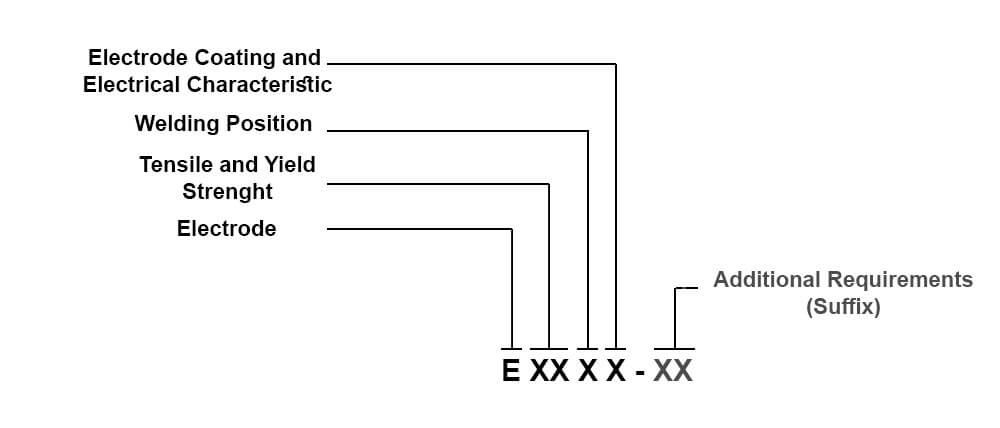
The Third Digit (Y): This digit indicates the welding positions the electrode is suitable for. Get ready for some welding yoga poses! Here’s a quick rundown:
- 1: All positions (flat, horizontal, vertical, and overhead). This is your all-around superstar.
- 2: Flat and horizontal positions only. Perfect for laying down some nice, easy beads.
- 4: Flat, horizontal, overhead, and vertical down positions. (Like a “1” but with the added caveat of vertical down technique.)
So, if you see an E7018, the "1" means you can weld in any position. Handy, right? Unless you like wrestling with gravity while welding upside down. I don't judge.

The Fourth Digit (Y): This digit tells you about the type of coating on the electrode and the welding current it requires. This is where things get a bit more specific, and it's usually best to consult a welding chart or the electrode manufacturer's information for the nitty-gritty details. Some common options include:
- 0: DC+, high penetration, fast freezing.
- 1: AC or DC+, moderate penetration.
- 4: AC or DC-, low penetration.
- 8: AC or DC+, low hydrogen, excellent weld quality. (A popular choice for a reason!)
These digits tell you about the coating on the electrode and the welding current required. These combinations define arc characteristics and penetration. So, a "10" electrode generally is DC reverse polarity and "11" is AC or DC reverse polarity.
The Suffix (Z): This is an optional digit, sometimes followed by other letters, that indicates special characteristics of the electrode, such as low hydrogen content, improved impact properties, or specific alloy additions. For example, E7018-H4R. The "H4" indicates a low hydrogen content while the "R" indicates it is moisture resistant. Think of it as the electrode's personality traits.
Putting It All Together
Let's say you have an electrode marked E7018. What does it all mean?
- E: Electrode
- 70: 70,000 psi tensile strength
- 1: All position welding
- 8: Low hydrogen coating, typically used with AC or DC+
So, an E7018 is a strong, all-position electrode with a low-hydrogen coating that produces high-quality welds. Pretty cool, huh?
Important reminder: This is a simplified explanation. Always check the manufacturer's specifications and safety data sheets for the specific electrode you are using. Your safety and the quality of your welds depend on it!
Don't Be Intimidated!
Learning the AWS electrode classification system might seem daunting at first, but with a little practice, you'll be reading those numbers like a seasoned pro. And remember, even the best welders started somewhere. Don't be afraid to experiment (safely!) and ask questions. Welding is a skill, and like any skill, it takes time and practice to master.
So go forth, fearless welder! Pick up that electrode, strike an arc, and create something amazing! You've got this! And if you mess up? Well, that’s what grinders are for. 😉