
Air Conditioning Unit Size Calculator
Okay, picture this: My friend Dave, bless his cotton socks, decided to upgrade his ancient air conditioner last summer. It was one of those sweltering weeks where the air felt like a warm, wet blanket, and you basically just existed until sundown. Dave, being the logical fellow he is, figured, "Old one was small, new one should be big!" He went for the biggest, most powerful unit the local big-box store had in stock, beaming with pride as it got installed.
Fast forward a few weeks. I visit him, expecting a arctic blast when I step inside. Instead, his living room feels… chilly, but also a bit damp? And the AC unit? It's kicking on for like, ten minutes, then shutting off for five, then on again. Constantly. His power bill was higher than a kite on a windy day, and he was still complaining about that "clammy" feeling. He genuinely thought his new, super-sized AC was just… broken. You've been there, right? Thinking you've got a problem, when really, it's just a common misunderstanding of how these things actually work.
Turns out, Dave fell victim to a surprisingly common misconception: bigger isn't always better, especially when it comes to air conditioning. And this, my friends, is where the unsung hero of home comfort steps in: the Air Conditioning Unit Size Calculator.
Must Read
Why Your AC Unit's Size is More Important Than You Think
You see, getting the right size AC isn't just about cooling your house down. It’s about efficiently cooling it down, and more importantly, dehumidifying it. That clammy feeling Dave had? That's what happens when an AC is too big. It cools the air so quickly that it doesn't run long enough to properly pull the moisture out of the air. It’s like trying to perfectly toast a marshmallow with a flamethrower – too fast, uneven, and kinda sticky.
On the flip side, an AC unit that’s too small will run constantly, struggling to reach your desired temperature, never quite getting there, and sending your energy bills through the roof. It’s a lose-lose, really. You’re hot, you’re humid, and you’re paying extra for the privilege. Ouch.
The sweet spot, the Goldilocks zone, is an AC unit that’s just right. And how do you find that magical sweet spot? You guessed it: with a calculator!
Beyond Square Footage: What Goes Into the Magic Formula?
Most people think AC sizing is just about square footage. "My house is X square feet, so I need Y BTUs!" (BTU, by the way, stands for British Thermal Unit, and it’s basically how we measure an AC’s cooling power). But oh no, dear reader, it’s so much more nuanced than that. Think of it like baking a cake; you can't just throw in flour and hope for the best.
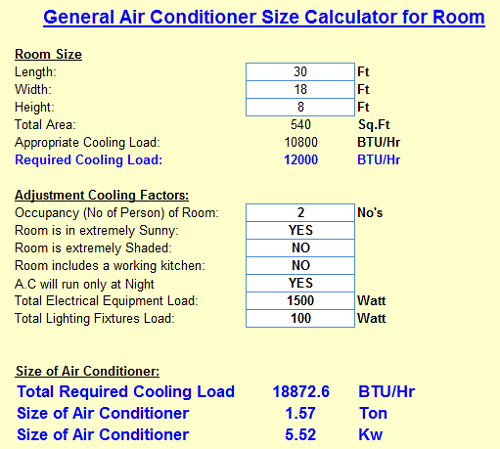
A good AC unit size calculator, whether it’s a free online tool or the sophisticated software an HVAC professional uses, considers a bunch of super important factors:

- Your Home’s Actual Size: Yes, square footage is still a player, but so is ceiling height!
- Insulation Quality: How well do your walls, attic, and windows hold in the cool air? A leaky old house needs more power than a brand-new, super-insulated one.
- Window Wisdom: How many windows do you have? Which direction do they face? South-facing windows get a lot more sun (and heat!) than north-facing ones.
- Local Climate: Are you in scorching Arizona or mild Seattle? Big difference, right?
- Occupancy Count: Believe it or not, every warm body in your home adds a little bit of heat. A family of five generates more heat than a single person.
- Heat-Generating Appliances: Your kitchen, laundry room, even your monster gaming PC – they all pump out heat.
- Ductwork Condition: Though not directly for sizing, poorly sealed ducts can cause huge energy losses, making even a perfectly sized unit struggle.
See? It's not just a simple math problem. It's a whole science experiment about your specific living space! It’s like getting a tailor-made suit for your house instead of buying off the rack.
So, How Do You Use One? And Where Do You Find It?
You can find plenty of free AC unit size calculators online. A quick Google search for "AC BTU calculator" will give you a good starting point. They'll ask you a series of questions about your home based on the factors above. Be honest and accurate with your answers to get the best estimate.

Now, here’s the important part: these online calculators are fantastic for giving you a rough idea, a ballpark figure. But for something as significant and costly as an AC unit, you really, really want to consult with a professional HVAC technician. They use even more detailed calculations, often called a "Manual J" load calculation, which is the industry standard for precision.
Think of the online calculator as your first step, your research phase. It empowers you with knowledge so you can have an intelligent conversation with a pro, rather than just nodding along to whatever they suggest. You'll understand why they recommend a certain size, and you won't fall for the "bigger is better" trap like my poor friend Dave.
Investing a little time in understanding your home’s specific needs through an AC unit size calculator can save you a ton of money, energy, and sweaty frustration in the long run. Trust me on this one. Your future self, lounging comfortably in your perfectly cooled (and dehumidified!) home, will thank you.
