
Air Conditioner 1 Pk Berapa Watt
Alright, settle in, grab your iced coffee, because we're about to demystify one of life's great modern puzzles: Air Conditioner 1 PK Berapa Watt? Or, in plain English, "How many watts does a 1 horsepower AC chew through?" It sounds like a question cooked up by a mad scientist, but trust me, your wallet (and your sanity on a scorching day) desperately wants to know the answer.
Picture this: It's the middle of summer. The sun outside is basically a giant magnifying glass focused directly on your house. Your cat is melting. You're questioning all your life choices that didn't involve moving to the Arctic. Then, a miracle! You flick on the AC, and a cool, angelic breeze washes over you. Ahh, bliss! But then, a nagging thought creeps in, like a tiny, energy-bill-sized gremlin: "How much is this magical chill costing me?"
The Curious Case of the "PK"
First, let's tackle the "PK" part. No, it's not short for "Pretty Kwik" or "Power King," though it might feel like both when that icy blast hits you. "PK" stands for Paardekracht (Dutch) or Pferdestärke (German), which both translate to… wait for it… Horsepower. Yes, the same horsepower that powers your car, or theoretically, a very enthusiastic horse. This unit, when applied to AC, traditionally refers to its cooling capacity. It's like saying, "This AC has the cooling power of one horse doing a really intense cooling trot."
Must Read
Historically, one mechanical horsepower is roughly 746 watts. But here's where it gets a bit like trying to solve a Rubik's Cube blindfolded: An AC unit's "PK" rating usually refers to its cooling output, not its direct electricity input. So, while a 1 PK AC is indeed capable of producing a certain amount of cooling power, the electricity it consumes to achieve that coolness is where the Watts come in.
Enter the Watt: Your Wallet's Arch Nemesis (or Best Friend)
Watts, my friends, are the real currency here. Watts are the measure of electrical power consumption. Think of it like this: If PK is how much work the horse can do (cooling), Watts are how much oats the horse needs to eat to do that work. The more Watts, the more oats, the bigger your electricity bill. Simple, right? (Don't worry, it gets slightly more complicated before it gets simpler again).
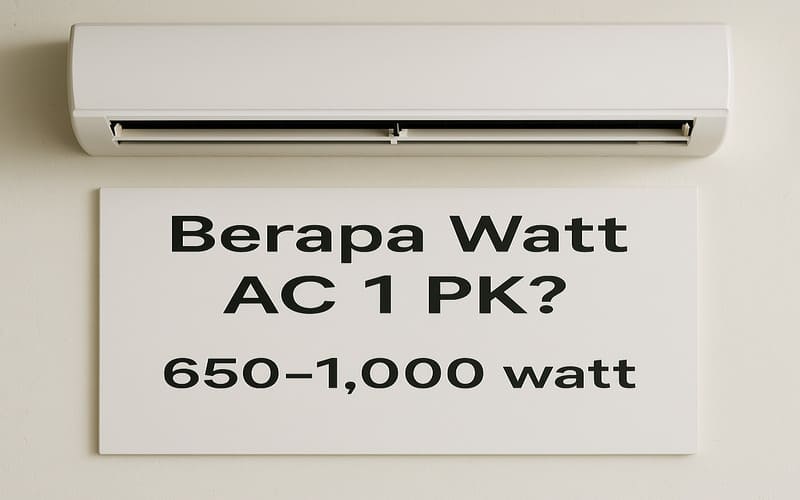
So, the million-dollar question: How many watts does a 1 PK AC actually use? Drumroll, please… Generally speaking, a 1 PK (or 1 HP) AC unit will consume anywhere from 800 to 1000 Watts of electricity per hour. Some older, less efficient models might even creep a bit higher, while newer, super-efficient inverter models might dip slightly below that. Yes, you read that right. Your 1 PK AC isn't just merrily sipping 746 watts; it's often more like a thirsty teenager with a super-sized slushie!
Why the discrepancy? Well, engineering, my dear friends! The compressor, the fan, the mysterious whirring bits and bobs inside – they all need power to operate. Plus, converting electrical energy into cooling energy isn't a 100% efficient process. There's always some energy lost as heat (ironically!), friction, and the sheer effort of making a room feel like a walk-in freezer on a summer's day.

The Plot Thickens: Factors That Make Your AC a Bigger Watt-Gobbler
Now, before you start hyperventilating about your next electricity bill, let's talk about the nuances. Because, just like how one person can eat a whole pizza while another nibbles, your AC's actual watt consumption isn't always fixed. It's a dynamic, living, breathing (and chilling) entity influenced by several factors:
1. Room Size and Insulation: Trying to cool a ballroom with a 1 PK AC is like trying to empty the ocean with a teacup. The AC will work overtime, consuming maximum watts, and still probably lose the battle. Good insulation means less energy escapes, so your AC doesn't have to work as hard.
2. Outside Temperature: The hotter it is outside, the harder your AC has to fight to maintain your desired indoor temperature. More fighting equals more watts.

3. Your Thermostat Setting: Every degree you drop your thermostat is like asking your AC to sprint harder. Setting it to a ridiculously low temperature (like "Antarctica in January" when it's "Sahara in August" outside) will make your AC run continuously, guzzling watts like there's no tomorrow.
4. AC Technology (Inverter vs. Non-Inverter): This is a big one! Inverter ACs are the smooth operators. They can vary their compressor speed to maintain temperature, rather than constantly turning on and off at full blast (which is what non-inverter models do). This flexibility means they are often significantly more energy efficient and can save you a pretty penny in the long run.

5. Maintenance: A dirty filter is like trying to breathe through a pillow. Your AC has to work harder to pull air through, leading to increased watt usage and reduced cooling efficiency. Clean those filters, folks!
So, What's the Takeaway from This Cafe Confession?
Don't let the numbers scare you away from the sweet, sweet relief of air conditioning. Understanding Air Conditioner 1 PK Berapa Watt simply empowers you to be a smarter, savvier cool-seeker. A 1 PK AC typically consumes between 800-1000 watts, but that's not a fixed number. It's a range, influenced by everything from your room's thermal integrity to the magic (or lack thereof) of inverter technology.
Next time you flip that switch, you'll know that your trusty 1 PK unit isn't just blowing cold air; it's also engaged in a delicate dance with your electricity meter. Be mindful of your settings, keep those filters clean, and perhaps, consider an inverter model when it's time for an upgrade. Your wallet (and Mother Earth) will thank you. Now, who's up for another iced coffee?