
4 Ton Ac Unit Square Footage

Ah, the eternal question! You've just dropped a significant chunk of change on a shiny new 4-ton AC unit. Now you want to know: how much space will this cool kingdom cover?
Immediately, your brain jumps to the easiest metric: square footage. It’s a nice, neat number, isn't it? We all love a simple formula.
But here's where my slightly unpopular opinion waltzes in. Relying solely on square footage for AC sizing is like trying to guess a person's favorite food just by knowing their height.
Must Read
It’s a start, sure, but it misses all the delicious, critical details. Let's playfully unravel this mystery, shall we?
The Myth of the Magic Square Footage Number
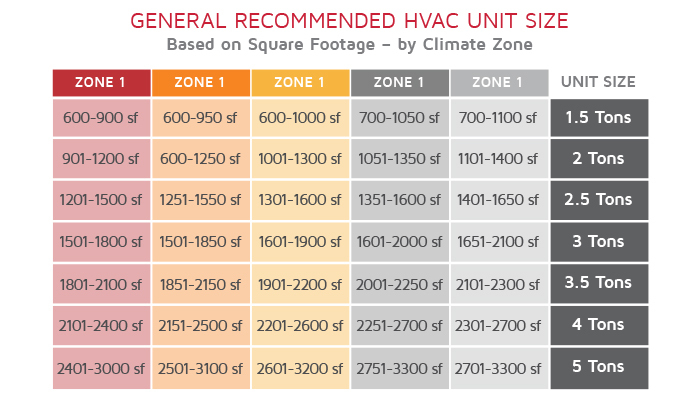
For generations, homeowners have been told, "Oh, a ton of AC cools about 400 square feet." So, by quick math, a 4-ton unit should handle a respectable 1600 square feet.
Sounds easy, right? Too easy, perhaps. This is the kind of advice you hear at barbecues, often delivered by someone who once changed a lightbulb and now feels like an electrician.
It's like saying a car can drive "X" miles per hour just because it has an engine. Well, sure, but what about traffic? Or hills? Or a flat tire?
The square footage rule is a ghost of a guideline, a whisper from a bygone era. It doesn't account for your specific home, its quirks, or its personality.
What Even Is a "Ton" of AC, Anyway?
First, let's clear up a common misconception. A ton of AC doesn't mean your unit weighs 2,000 pounds. Imagine trying to install that behemoth on your roof!
No, a "ton" here refers to cooling capacity. It harks back to the days of ice harvesting. One ton of cooling power is equivalent to the amount of heat absorbed by one ton of ice melting over 24 hours.
Think of it as 12,000 BTUs (British Thermal Units) per hour. So, our mighty 4-ton AC unit blasts out 48,000 BTUs of cooling power. That's a lot of chill!

But how that chill spreads and fights the heat in your home is where things get interesting, and where square footage becomes a mere footnote.
Beyond the Footprint: What Really Matters for Your 4-Ton AC
Let's dive into the messy, delightful truth. Your home is a unique snowflake, not a bland box on a blueprint. And your AC unit needs to understand its soul.
Windows: The Heat Magnets
Ah, windows! They bring in lovely natural light. They also bring in glorious, uncompromising heat. Especially if they face the afternoon sun.
Big, beautiful, south-facing windows are like giant invitations for the sun to come in and make itself cozy. Your 4-ton AC unit will then have to politely ask the sun to leave.
Even double-pane, low-E windows have their limits. A house with lots of glass will need more cooling power than one with tiny peek-a-boo windows, even if the square footage is identical.
Insulation: Your Home's Winter Coat (or Lack Thereof)
Is your attic stuffed with fluffy, glorious insulation? Or does it look like a sad, forgotten space with more gaps than a politician's promise?
Good insulation keeps the heat out in summer and in during winter. Poor insulation means your AC unit is constantly battling heat sneaking in through walls, ceilings, and floors.
It's like trying to cool a sieve. You can pour all the cold water you want, but it just keeps leaking out.

Ceiling Height: More Air to Chill
Those vaulted ceilings are stunning, aren't they? They add drama and openness to a room. They also add a lot more air that your 4-ton AC unit needs to cool.
A 10-foot ceiling has 25% more volume than an 8-foot ceiling for the same square footage. More volume means more energy to cool it down.
So, a grand foyer might look magnificent, but it's a mighty challenge for your AC to maintain a comfortable temperature.
Your Roof: A Sun Trap or a Cool Cap?
What color is your roof? A dark-colored roof absorbs a tremendous amount of solar radiation. It essentially turns your attic into a giant oven.
That heat then radiates down into your living space. A lighter-colored roof, or one with good ventilation, reflects more heat, giving your AC unit a much-needed break.
It's a silent battle happening right above your head!
Appliances and People: Your Internal Heat Generators
Think about your kitchen. When the oven is roaring for Sunday dinner, or you're running the dishwasher, those appliances generate heat.
And what about people? We're all little heat machines, emitting warmth into the air. A house frequently filled with boisterous guests will need more cooling than a quiet hermitage.
A bustling home office with multiple computers and monitors? Each one adds to the heat load. Your 4-ton AC unit has to account for all these tiny furnaces.
Climate: Not All Summers Are Created Equal
Are you in sizzling Phoenix, Arizona, where the sun bakes everything into submission? Or are you in a milder climate with cooler summers and lower humidity?
The outdoor temperature and humidity levels play a massive role. An AC unit in a dry, 100-degree environment works differently than one in a humid, 85-degree environment.
The 4-ton AC unit's job gets tougher the hotter and muggier it gets outside. It's fighting a stronger opponent.
Ductwork: The Hidden Pathways of Cold Air
Imagine your ductwork as the highways for your cool air. If these highways have leaks, cracks, or are poorly insulated, a lot of that precious cold air escapes before it even reaches your rooms.
This means your AC unit has to work harder and longer to compensate for the lost air. It's like trying to fill a bucket with holes.
Often, leaky ducts are the silent saboteurs of an otherwise perfectly sized AC system.
The True "Unpopular Opinion" on 4-Ton AC Square Footage
So, what's the big takeaway from all this playful exploration? It's that the question of "4-ton AC unit square footage" is incomplete. It's like asking "How long is a piece of string?"
"Anyone who gives you a single, precise square footage number for a 4-ton AC unit without asking any other questions is probably oversimplifying things, guessing, or hasn't had their coffee yet."
There's no magic number where a 4-ton unit perfectly fits. It could comfortably cool 1500 square feet in one home, struggle with 1200 square feet in another, and be overkill for 1800 square feet in a third.
It depends entirely on the unique characteristics of your home, your lifestyle, and your local climate.
So, What's a Homeowner to Do?
Don't despair! This isn't meant to make your head spin. It's simply an invitation to look beyond the simple numbers and understand the complexity.
When you're looking to size an AC unit, especially a powerful 4-ton AC unit, you need an expert. Someone who does more than just glance at your home's footprint.
A good HVAC technician will perform a Manual J calculation. No, it's not a secret handshake! It's an industry standard method that considers all the factors we've discussed.
They'll look at your windows, your insulation, your ceiling height, your local climate, and even how many people usually live in your home. They'll measure, calculate, and then recommend the perfect fit.
Getting the right size is crucial. An undersized unit will run constantly and never quite cool your home. An oversized unit will cycle on and off too frequently, leading to humidity problems and wasted energy.
So, next time someone throws out a quick square footage number for your 4-ton AC unit, just smile. You now know the real story. And it's far more interesting than a single number!